
Igrutinovic: EU enlargement and internal reforms are interconnected processes; Kos will manage expectations on the ground

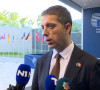
Milan Igrutinovic, a research fellow at the Institute for European Studies, assesses that the enlargement of the EU to include new members, including the Western Balkans, will be closely interconnected with the process of internal reforms within the Union. He emphasizes that, for this reason, the future EU Commissioner for Enlargement, Marta Kos, will implement what has been agreed in Brussels and will be constrained by "managing expectations on the ground."
"I expect her to implement the agreements reached in Brussels. The topic of enlargement is currently and formally closely tied to the issue of internal reforms in the EU. When talking about potential EU enlargement, the entire mainstream of political parties that make up the College of Commissioners speaks in the context of the EU's need to reform itself internally on matters like decision-making and budgetary changes after 2027. These are two parallel processes. One will not proceed without the other, and it is simply expected that the Commissioner for Enlargement will manage expectations on the ground and align the timeline of this process with what is expected to happen within the EU regarding these changes," Igrutinovic told Kosovo Online.
He adds that the choice of the new Commissioner for Enlargement is the result of the conflict between Viktor Orban’s government and Brussels, as well as the fact that Slovenia is interested in EU enlargement.
"There has been a slight shift in power. It seems that the majority is more satisfied that someone from Hungary was not selected due to the long-standing conflict between Orban’s government and Brussels. It is considered that the Slovenian candidate is somehow in a better position to harmonize and convey agreed positions from Brussels on the ground. She comes from a country and political culture that is very interested in enlargement. So, in that sense, the candidate is not particularly controversial," Igrutinovic said.
When asked how much this will help candidates from the region, Igrutinovic believes that this help will primarily be at a "tactical level," but that key decisions will be made in the leading EU member states.
"Probably at some tactical level, she might speed up some projects and present them better to the Commission, maybe she has a better feel for the culture of this region, and she can present the process better in Brussels. But I think it is primarily structured by the internal policies of the EU, and without serious approval from Brussels, Berlin, Paris, and the Eastern European countries that now have influence due to Ukraine," Igrutinovic noted.
He reminds that Ukraine and Moldova will also be within the scope of the new Commissioner for Enlargement, and there is no doubt that they will attract the most attention, leading to less focus on the Western Balkans than before.
"We expect that attention on the Balkans will perhaps be less than it has been so far, but it will fundamentally depend on internal political relations in the EU and the potential reforms that are yet to be written and operationalized in the coming years. So, I do not expect substantial changes in how this process is conducted on the ground," Igrutinovic concluded.


0 comments