
Djuric: Nothing exposes the current administration in Pristina more than its brazen attack on the UN
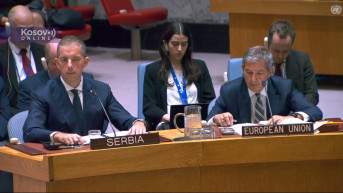
Serbian Foreign Minister Marko Djuric said last evening that nothing exposes the current administration in Pristina more than its brazen attack on the UN, accusing it of dismissing as “micro-incidents” ethnically motivated incidents, arbitrary arrests and attacks on the Serbian Church documented by UN observers, thereby belittling the victims.
At the end of the UN Security Council session, Djuric responded to Kosovo's minister Glauk Konjufca, saying it was not true that he had failed to mention Albanian victims in his address. On the contrary, he said he had stressed that justice must be the same for everyone and that there should be neither Serbian nor Albanian justice.
“Albin Kurti's government representative accused us of a number of things, and I do not want to leave them unanswered. First, he accused us of a lack of objectivity. The representative of Pristina said that I had not mentioned Albanian victims. That is not true. I mentioned both Serbian and Albanian victims several times, clearly stating that we are not seeking Serbian or Albanian justice, but objective justice,” Djuric pointed out.
He also said that the representative of Pristina had accused Serbia of fabricating war crimes against Serbs, noting that this was nothing less than an insult to both Serbian and Albanian victims and an undermining of international justice in the very chamber of the UN Security Council.
“We also heard something that can only be described as the Kurti regime's political obsession with Aleksandar Vucic, and even with members of his family. This amounts to nothing less than clear support for one side in the upcoming parliamentary elections in Serbia. It also very clearly explains why Serbs in Kosovo are being denied the right to vote in the upcoming elections. Kurti knows that the vast majority of them support Vucic. That is the real reason he does not want them to vote,” Djuric said.
Regarding the reference to Serbian Deputy Prime Minister Ivica Dacic's statement about Prizren, Djuric said that Dacic, as someone born in Prizren, had every right to speak about flying his national flag in the city where he was born. He added that what was far more concerning was that, more than a quarter of a century later, none of the more than 20,000 Serbs had returned.
“And we all remember that in 2004, the UNESCO World Heritage Site, the Serbian Church of the Virgin of Ljevis, was burned to the ground,” Djuric said.
He also recalled that three Serbs lost their lives in the incident in Banjska in circumstances that have not been properly investigated, as did a Kosovo police officer, which was deeply regrettable.
“In this case, however, blame was assigned to the Serbian side in advance, without any real opportunity for due process,” Djuric stressed.
On the other hand, he noted that no one had demanded accountability from the person who shot Stefan Stojanovic in 2023, a Serbian child who was shot on Orthodox Christmas Eve that year by an active member of the Kosovo Security Force, who has yet to be held accountable.
“Finally, nothing exposes the current administration in Pristina more than its brazen attack on the UN itself. Pristina accused the UN of failing to exercise due diligence after independent UN observers documented 192 ethnically motivated incidents, arbitrary arrests and attacks on the Serbian Church. Pristina's response is to condemn and belittle the victims, calling these abuses micro-incidents, and to shoot the UN messenger,” Djuric noted.
He also observed that Pristina now openly acknowledges that Serbs were forcibly removed by police during religious and historical commemorations, treating peaceful worshippers and mourners as criminals.
“Treating peaceful worshippers and mourners as criminals is precisely why UNMIK's mandate, established by United Nations Security Council Resolution 1244, as well as the international security and political presence in Kosovo and Metohija, remain essential,” Djuric stressed.
Konjufca: Believe me, it is pure propaganda
Responding to Djuric's remarks, Konjufca claimed that Serbia had repeatedly tried to portray law enforcement activities as intimidation intended to drive Serbs out of Kosovo.
“Believe me, this is not true. It is pure propaganda. Of all the cases reported and exploited for media and diplomatic propaganda by Serbia's Office for Kosovo and Metohija, none has been found to have a clear or factually substantiated link to ethnic motivation,” Konjufca said.
Regarding Serbian judges and prosecutors, he said their institutional record should be assessed in relation to the applicable legal framework, the institutional rationale and implementation.
“These judges and prosecutors left Kosovo's legal system and joined illegal structures run by Serbs, thereby breaching their allegiance to the Kosovo Constitution and choosing to serve another country. Although the finalisation of their resignations raised concerns about their potential impact on the multiethnic composition of judicial institutions, these concerns should be considered alongside the subsequent recruitment processes conducted in 2022, 2024 and 2025, including positions or reserved places for members of the Serb community,” Konjufca said.
He added that it was “regrettable that Serbia repeatedly abuses even this platform to campaign for domestic political purposes”.
“Kosovo is a secular, multiethnic and multireligious state. Religious harmony has long been one of the most significant characteristics of my people. Our founders came from different religious communities, including Muslim, Catholic and Orthodox communities. And how can a country, for example, be classified as religiously extremist? We recently elected a new president who is Roman Catholic. Serbia is known for abusing its Church to promote ethnic divisions and nationalist aspirations,” Konjufca claimed.
He also said that “unlike Serbia, which has a long-standing tradition of ethnic discrimination, the Kosovo government operates on the basis of the rule of law, clear procedures and human rights principles, regardless of ethnicity”.
Konjufca also said that people in Kosovo were not arrested or prosecuted “without strong evidence”.
“Kosovo is a democratic state and protects all these areas against illegal construction and structures. No other country in Europe, and perhaps in the world, is monitored as closely as Kosovo by diplomatic and international missions. EULEX and the OSCE, as well as diplomatic representatives of the EU and the UN, have full access to these investigations and the legal actions taken by our authorities,” Konjufca added.
0 comments