
Kurti: We expect a positive change in Belgrade’s approach toward the Republic of Kosovo
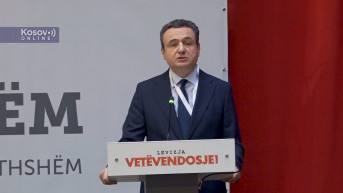
Kosovo Prime Minister Albin Kurti said he expected political changes in Serbia to bring about a “positive change” in Belgrade’s approach toward Pristina. Addressing party colleagues at a meeting of the General Council, he also spoke about the killing of Arlinda Zekaj, stressing that he would push for every official who had failed to perform their duty in her case to be held accountable. He also commented on the protests in Albania, saying he was following developments there with concern.
Kurti reiterated that the Albanian Coalition had secured two seats in the Serbian National Assembly elections last week, achieving the best result for Albanians in Serbia since 2000.
Such a result, he added, was proof that the common interest had been placed above party interests.
Commenting on the overall election results, he said they had led to a reconfiguration of the political landscape, with the Student List finishing first, Aleksandar Vucic’s coalition losing its parliamentary majority and Ivica Dacic’s list failing to enter parliament.
“A quarter of a century after Milosevic and Seselj were defeated, their political successors, Vucic and Dacic, have now also lost. At present, we know who lost power in Serbia, but we still do not know who has won it. We hope that this political change will be accompanied by a positive change in official Belgrade’s approach toward the Republic of Kosovo and toward Albanians in Presevo, Bujanovac and Medvedja,” Kurti said, according to Ekonomia Online.
He also said that “confronting the past, the denazification of political discourse, the institutional decriminalization and internal democratization should create the conditions for the normalization of relations with neighboring countries.”
He added that shedding light on crimes committed against Albanian civilians, identifying the locations of mass graves and determining the fate of missing persons remained obligations toward the victims and their families.
“Without the truth about the past, trust for the future cannot be built. We want good-neighborly relations, peace and cooperation based on equality and mutual respect. That is why we hope that the new developments will pave the way for the full normalization of relations between Kosovo and Serbia, with mutual recognition,” Kurti said.
On the Arlinda Zekaj case: Anyone who failed to perform their duty must be held accountable
Speaking about the killing of Arlinda Zekaj, Kurti said the case had once again exposed a serious problem in the system for protecting women, even when they report violence and seek help from the authorities.
“It has once again confronted us with the grave reality that a woman can make use of every option provided by law, report violence, seek protection and even warn in writing that her life is in danger, and yet still end up being killed,” Kurti said, according to Klan Kosova.
He stressed that Arlinda Zekaj had done precisely what institutions ask women to do when they face violence.
“I reiterate that we will pursue this to the end so that every official who failed to perform their duty is held accountable, not only through disciplinary proceedings but also criminally. Every person responsible at every link in the chain must be investigated,” Kurti said.
On the protests in Albania
Kurti also commented on the protests in Albania, saying he was following developments there with concern, according to Ekonomia Online.
“We always love Albania, regardless of the circumstances. It is an inseparable part of our national identity. That is why we follow developments there with concern, attention, responsibility and affection. Albania’s democratic progress also represents a historic national responsibility. It is vital for us, as Albanians, to prove to ourselves that we know how to build a democracy capable of withstanding the pressures of capitalism and a government that does not succumb to oligarchy,” Kurti said.
He rejected claims that the Self-Determination Movement was involved in the protests, saying that the party he leads was currently a governing force, not a protest movement.
He stressed that Kosovo was not and would never be Albania’s rival, adding that he wanted cooperation between the two to deepen in a range of areas.
“We lead the Government of the Republic of Kosovo, and Kosovo is not and will never be a rival to its sister. We welcome Albania’s progress on its path toward the European Union, as well as its economic and tourism achievements. We sincerely want these successes of the Albanian Government and the Albanian people to be consolidated and expanded through joint Kosovo-Albania projects—in infrastructure, the economy, education, defense and other areas,” the Prime Minister said.
Speaking about clashes during the protests, Kurti said that violence and injuries to citizens were a shared concern, but that beyond establishing criminal responsibility, it was also necessary to examine the causes that led to the escalation of conflict.
“On the other hand, violence and injuries to people, direct clashes in the streets, are a concern for all of us. However, it is not enough merely to establish criminal responsibility for violence. We must also understand its roots, the conditions that fuel it and the reasons why disagreements turn into clashes. Public order and the freedom to protest must be protected at the same time,” Kurti said.
Judgment against four former KLA leaders should be overturned
At the meeting of the General Council of the Self-Determination Movement, Albin Kurti said that going to elections had proved pointless, but that, in his view, given the circumstances following the judgment against Hashim Thaci, Jakup Krasniqi, Kadri Veseli and Rexhep Selimi, it had been even more important not to go to elections.
He described the judgment as unjust in legal and moral terms, as well as historically and factually inaccurate.
“Going to elections proved pointless, but this time it was even more important not to participate in them, given the circumstances created following the judgment against the four former KLA leaders—Hashim Thaci, Jakup Krasniqi, Kadri Veseli and Rexhep Selimi—a judgment that is legally and morally unjust, and historically and factually inaccurate. In circumstances of injustice that caused great anger and dissatisfaction in our country, we had a responsibility to confront and respond to this decision, but also to manage public discontent,” Kurti said.
Kurti added that the judgment should be overturned and corrected on appeal.
“This judgment must certainly be overturned and corrected in the second-instance proceedings as soon as possible. In the meantime, the Government has approved the establishment of a working group to draft and coordinate a State Strategy concerning the appeals proceedings before the Specialist Chambers in The Hague. The group includes representatives of the country’s institutions and parliamentary political parties and will work under the leadership of Deputy Prime Minister and Minister of Foreign Affairs and Diaspora Glauk Konjufca,” Kurti said.

0 comments