
Who is Who – Andras Klein: Hungary's new envoy for the Western Balkans is well-versed in Belgrade-Pristina relations
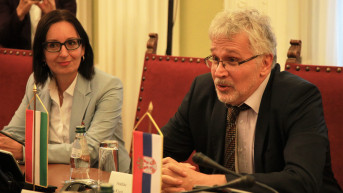
Hungarian diplomat Andras Klein was appointed Hungary's Special Envoy for the Western Balkans on September 1 this year. Before his appointment, he served as ambassador to North Macedonia, and previously headed the Western Balkans Department at the Ministry of Foreign Affairs. Relations between Belgrade and Pristina feature prominently in his diplomatic statements and published work, while he sees the European perspective as an important instrument for stabilizing the region.
Klein was born in Paris in 1969. He graduated in French and Spanish from the Faculty of Humanities in Budapest, and after completing his studies, worked as a teacher at a bilingual Spanish-Hungarian secondary school in Budapest.
He joined the Hungarian Ministry of Foreign Affairs in 2000 at the invitation of then Deputy State Secretary Csaba Lorinc, who served as his professional mentor. He initially worked as head of Lorinc's office, then served as secretary of the Hungarian Parliament's Foreign Affairs Committee from 2002 to 2010, and as deputy chief of staff at the Ministry of Foreign Affairs from 2010 to 2012.
He was appointed Hungary's ambassador to Bulgaria in 2012, a position he held until 2016. He then took over as head of the Western Balkans Department at the Hungarian Ministry of Foreign Affairs, where he served until 2022. That same year, he was appointed Hungary's ambassador to North Macedonia.
Views on Serbia and Kosovo
Klein has frequently addressed issues concerning Serbia, Kosovo and Serb-Albanian relations in his professional and publicist work.
In his 2020 article, “The necessity of Western Balkans integration”, published while he was head of the Western Balkans Department at the Hungarian Ministry of Foreign Affairs, he highlighted the importance of European integration for regional stability and warned that slowing the integration process negatively affected Belgrade and Pristina's willingness to make progress in the dialogue.
He placed particular emphasis on the position of the Serb community in Kosovo, stating that “the continued existence of Kosovo within its current borders is not possible without ensuring the rights of the local Serbian minority.”
In the same paper, he also addressed the position of national minorities in Serbia. He noted that Serbia, partly thanks to Hungarian support for European integration, had developed a system of cultural autonomy for the Hungarian minority, as well as for other national communities, including Albanians in Bujanovac, Medvedja and Presevo.
Serb-Albanian relations and the influence of major powers
In 2022, Klein published a review of historian Laslo Markus's book The History of Kosovo: From Dardania to the Brussels Dialogue in the Hungarian journal Pro Minoritate, under the title “The entire history of Kosovo from the perspective of an active diplomat”.
In the article, he examined the historical roots of the Serb-Albanian conflict, the development of the Albanian national movement and the influence of major powers on Kosovo's political circumstances. He argued that political consolidation between Kosovo Albanians and Serbs would be difficult to achieve without strong international engagement.
He also stressed that the interests of major powers had often played a decisive role in Kosovo and throughout the Balkans over the course of history, frequently overshadowing the interests of local populations.
He further noted that, despite declaring independence in 2008, “Kosovo has not yet completed the process of building a functioning state.”
The dangers of changing borders
Klein also discussed Serb-Albanian relations in an interview with the Hungarian Institute of History, published in January this year, in which he stressed that the conflict could not be understood without knowledge of its history. He also warned that any potential change to borders in the Balkans could open up a series of new territorial questions, including the possibility of Kosovo and Albania uniting and the northwestern part of North Macedonia, where Albanians make up the majority, seceding.
“If, for example, Bosnia and Herzegovina were to break up and new borders were established, the next question would immediately arise: why should Kosovo not be allowed to unite with Albania, and why should the northwestern part of North Macedonia, where Albanians make up the majority, not be allowed to secede? That is why drawing new borders is dangerous. We have seen, in the case of the breakup of Yugoslavia, the suffering and bloody events that they can bring in certain circumstances,” Klein said.
Support for Serbia's European integration
Following his appointment as special envoy, Klein met on September 9 with Elvira Kovac, Deputy Speaker of the Serbian Parliament and Chair of its European Integration Committee.
On that occasion, he said that Hungary strongly supported Serbia's European integration and wanted to make it clear, following the change of government in Hungary, that this position would not change. At the same time, he pointed to the need for an open discussion about why Serbia's European integration was not progressing at the expected pace.
He visited Kosovo on October 29, when he was received by Kreshnik Ahmeti, Deputy Minister of Foreign Affairs and Diaspora. An important part of their talks focused on current developments in the Western Balkans, the security situation and challenges affecting regional stability.
Today, he also met with North Macedonia's Foreign Minister Timco Mucunski, who announced that the meeting had reaffirmed the excellent bilateral relations and strategic cooperation between the two governments.
Interest in the Balkans
Klein's father was also a diplomat. He served three postings in France and ended his career in Argentina. His mother is Bulgarian, and he speaks Bulgarian at a native level. Klein has said that he spent much of his childhood visiting relatives in Bulgaria and identified his family and cultural ties to the region as one of the reasons for his longstanding interest in the Balkans.
Speaking about his writing, Klein said that his publications were mainly devoted to foreign policy issues. He also highlighted his work on the editorial board of the journal Pro Minoritate, where he strives to prepare an issue dedicated to the Balkans every year.
“I try to buy and read every paper on Balkan politics published in Hungary. Unfortunately, despite the fact that the Balkans is generally important to our country, very few such papers are published,” Klein said.



0 comments