
Lunic: Expansion of the military alliance between Albania, Croatia, and Kosovo a real threat to Serbia

Geopolitics and security consultant Nikola Lunic stated that although the declaration on military cooperation between Albania, Croatia, and Kosovo essentially represents a “meaningless piece of paper,” a possible expansion to include North Macedonia and Turkey would pose a real danger to Serbia.
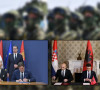
Kosovo, Albania, and Croatia plan to make the purchase of defense capacities from the US the first concrete obligation under the declaration signed on March 18 in Tirana.
Lunic said that although the agreement is a “meaningless piece of paper,” its aim is an attempt at joint lobbying in Washington.
“The declaration is a meaningless piece of paper that explicitly states that the signatory countries have absolutely no obligations toward one another, and the declaration itself cannot affect international commitments concerning those countries. Therefore, this initiative is also meaningless,” Lunic said.
Commenting on the intention of jointly purchasing weapons from the US, the expert noted that Croatia already does this through acquisitions of Bradleys, HIMARS, and Black Hawk helicopters, while Kosovo similarly has ordered Javelin missiles and Black Hawk helicopters.
However, he stressed that the essence of this intention lies in the attempt at joint lobbying in Washington.
“Will they succeed in pooling these acquisitions to get a better price? Not very likely. The question is also how successful that will be. But what is very important is that, for now, it serves them as lobbying in the US,” Lunic is convinced.
He specified that such weapons acquisitions cannot “easily change the balance of military power” in the region, but that what matters much more for Serbia is the future perception of the US toward the Western Balkans.
“The US perceives the Western Balkans as a region where effective governance and integration into transatlantic institutions are being obstructed. It is directly stated that this poses a threat to US national security and foreign policy,” Lunic emphasized.
He warned that a real danger to Serbia would emerge if this military alliance expanded to include North Macedonia and Turkey.
Such a scenario, he said, would not be surprising.
“It should come as no surprise if North Macedonia and Turkey were to join this initiative. In that context, if the initiative continues to expand, it could represent a real threat to Serbia. At this moment, it does not,” Lunic stressed.
Asked how to view the role of Kosovo, which is neither in NATO nor in the Partnership for Peace, Lunic said that a “major precedent” would occur if things were to change and Pristina became a NATO partner or allied country.
“A truly major precedent would be created if Kosovo were admitted to NATO or any other security structure at this time. However, one should not overlook the perception of future geopolitical developments. If Serbia remains trapped in the imposed, dictated military neutrality, then we can expect a threat to national security. In the end, it is not difficult to lobby in the US if security policy boils down to a national security strategy,” Lunic concluded.


0 comments