
Military alliances in the region: Fragmentation or “balancing” the Western Balkans?
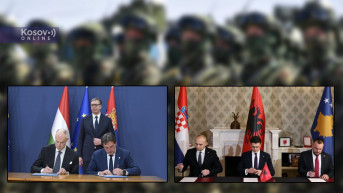
Within just ten days, two military alliances were formed in the Western Balkans. The first, in the form of a declaration, was signed by Albania, Croatia, and Kosovo; the second, through a military cooperation agreement, by Serbia and Hungary. Analysts interviewed by Kosovo Online interpret their significance differently. Some see them as a new fragmentation of this part of Europe that could lead to renewed confrontations, while others view them as a “balancing of power” in the region to prevent future conflicts.
Written by: Djordje Barovic
A trilateral memorandum in the field of defense was signed between the defense ministries of Albania, Kosovo, and Croatia in Tirana on March 18. Then, on April 1 in Belgrade, in the presence of Serbian President Aleksandar Vucic, a defense cooperation agreement was signed between Serbia and Hungary.
Retired Albanian General Esad Çolaku stated that the tripartite agreement from Tirana is “a clear signal to Serbia and other countries that might have territorial ambitions in the Balkans.”
At the same time, Albanian Defense Minister Niko Peleshi explained that the agreement with Croatia and Kosovo is “a completely natural tripartite alliance.”
Due to the signing of the military agreement in Tirana, Serbia’s Ministry of Foreign Affairs sent an urgent request to its counterparts in Croatia and Albania, stating that steps had been taken “which undermine regional stability.”
“Serbia, as a state committed to peace and military neutrality in the Balkans, rightfully demands answers regarding the nature and objectives of this security cooperation. It is particularly concerning that this military alliance is being formed without consultations with Belgrade and with the direct involvement of a structure that lacks international legitimacy and poses a security threat to the Serbian people and the entire region,” the Serbian MFA stated.
Commentary and Reactions
Commenting on the developments in the Western Balkans, former U.S. National Security Advisor John Bolton stated that he does not believe there should be any room for military alliances in Europe other than NATO, adding that an alternative military alliance, for any reason and especially one directed against Serbia or anyone else, would be “a real step backward.”
On the other hand, NATO Secretary General Mark Rutte said that the Alliance has nothing to do with it.
“NATO is not a part of that. We have seen quite a few such agreements recently, including the one in Tirana between Albania, Croatia, and Kosovo. NATO is not part of that,” Rutte briefly stated.
Balancing
For political analyst Ben Andoni from Tirana, the alliance between Albania, Croatia, and Kosovo represents “an attempt to balance power” in the Western Balkans.
“This looks like a concrete attempt to balance power in the Balkans. It's true that this kind of initiative somewhat goes against what NATO represents de jure, but small alliances between our countries go beyond a simple military agreement. Our countries are seeking to survive in a time when the global order is facing many challenges,” Andoni told Kosovo Online.
He explained that although this tripartite military alliance is not formally one yet, it still sends a clear message, primarily to Serbia.
Andoni expects other Balkan countries to join it soon.
“They are facing Serbia, which since 2023 has had an agreement with Hungary, a powerful country in both NATO and the European Union. Recently, these two countries have increasingly materialized that agreement. Meanwhile, Bulgaria is expected to join the Albanian initiative soon, and in the future possibly North Macedonia and Montenegro. This shows that countries in the Balkans are making moves that currently cannot be fully explained,” Andoni observed.
He views the cooperation between Albania and Croatia from multiple angles.
Firstly, he emphasizes, they share the same attitude toward Serbia.
“Despite initiatives like Open Balkan or the Berlin Process, they see Serbia as problematic,” Andoni clarified.
Another key “link” in Albania-Croatia cooperation is the development of military industry.
“There’s consideration of enhancing our military infrastructure, which is currently ‘dormant’. In cooperation with Croatia, the military industry could also provide economic benefits to Albania, to Croatia, and to Kosovo, which faces greater challenges with Serbia. We are seeing that the military business is gaining importance in our region. The truth is that Serbia has already outpaced us in interest in this industry, in strength, and especially in the agreements it has made in this field,” Andoni concluded.
He is convinced that the tripartite military agreement is of vital importance for Albania, but even more so for Kosovo.
"I have not seen a more significant step by Albania regarding Kosovo than this military initiative, especially at a time when there is increasing talk about the reduction of American forces. This is partly due to the U.S. position and its increasingly close relations with Serbia. That makes Kosovo more vulnerable to potential future developments. But the same applies to Albania’s future. In this way, the greatest form of assistance can be provided regardless of NATO’s Article 5, which refers to collective defense in the event of an attack on any member of the Alliance. However, this article has become almost forgotten and remains in force only formally," Andoni explained.
(Im)balance
A similar view is held by security expert from Pristina, Nuredin Ibishi.
In an interview with Kosovo Online, he said that the tripartite alliance from Tirana is the result of a disrupted balance of power in the region.
"The balance of power in the region has been disturbed. There has been a shift toward imbalance, making these alliances more defensive in nature. An agreement was reached on joint defense and further investments in the weapons and ammunition manufacturing industry," said Ibishi.
He clarified that there is "nothing wrong" with the Kosovo-Croatia-Albania alliance, considering that its backbone consists of NATO members.
"NATO is already present here, and two of the three countries are NATO members. Kosovo is not yet, as its armed forces are still in transition and are expected to enter the pre-accession phase soon — the Partnership for Peace program," he explained.
Ibishi believes the Serbia-Hungary military alliance is a "response" to the tripartite declaration, but also warns that it poses a greater threat due to "Serbia’s territorial aspirations toward Kosovo and Bosnia and Herzegovina."
"This first alliance between Albania, Croatia, and Kosovo is more about defense since it holds no territorial claims against any country. But the second alliance could be somewhat different because Serbia has claims toward Kosovo and other countries, especially Bosnia and Herzegovina — more specifically, Republic of Srpska. In that sense, this is a kind of balance — for now," Ibishi said.
He also points out that Croatia was long seen as the military leader in the region, but that Serbia has since surpassed it, as evidenced by data from the Global Firepower military ranking.
"However, I don't see any real risk from these alliances, because NATO remains the strongest alliance, and within it, Article 5 ensures collective defense," the security expert clarified.
Asked whether this signals a military division of the Western Balkans, Ibishi replied that Hungary has no strategic interests in the region.
"Serbia has friendly relations with Hungary, and that’s also due to their stance on Russia, as both countries maintain a form of partnership and have not declared or adopted sanctions against Russia. In that respect, their positions are aligned. This is an alliance formed between two authorities — Vučic and Orbán," Ibishi said.
Grouping
Nevertheless, ISAC Fund senior advisor Marko Savkovic warns that even if the signed agreements are not formal military alliances, such grouping of Western Balkan countries is problematic and may lead to future confrontations.
"These are not real military alliances. One is a declaration, and the other is a formal agreement that builds on already existing and well-developed bilateral military cooperation. If we were to look at the broader context, I’d say this is about bringing together actors who think alike and have similar views on the region in which we live — politically and even ideologically, in the case of Serbia and Hungary, they are very close," Savkovic told Kosovo Online.
He is convinced that the military agreement between Albania, Croatia, and Kosovo forced Belgrade and Budapest to respond in kind.
“It is clearly serious enough that it compelled Belgrade and Budapest to come closer. So, they made public a military agreement that may not have originally been intended for such a public signing, thus sending a message to the other side,” said Savkovic.
He does not see such military groupings as good for the region.
“This is certainly not good for the region, because it creates the impression of groupings that could lead to confrontation in the future. And statements claiming these agreements are not directed against anyone unfortunately no longer seem convincing to either side,” Savkovic emphasized.
Commenting on NATO Secretary General Mark Rutte’s claim that the Alliance has nothing to do with these agreements, Savkovic agreed, noting that even though most of the signatory countries are NATO members, NATO remains uninvolved.
“NATO truly has nothing to do with this. If we’re talking about the declaration of the three parties — well, there’s Priština, or Kosovo, which several NATO members do not recognize. Also, NATO does not interfere — these are internal matters for its members, specifically Croatia and Albania, which decide how to conduct their defense policy to some extent independently of NATO. And that especially applies to Serbia, which continuously proclaims its military neutrality,” the analyst explained.
On the other hand, despite being a NATO member, Hungary is considered an outlier.
“It is a country that conducts a foreign policy quite different from the mainstream approach in Western politics today,” Savkovic concluded.
Defragmentation
Former Macedonian ambassador and analyst Risto Nikovski is convinced that the recently signed military agreements represent further fragmentation of the region and lead to new confrontations.
“Absolutely — this is a new division and new confrontations. In my strong opinion, it is completely unnecessary. It had been encouraging to see that almost all countries from the Balkans — those that are already in the EU and the six candidates — were all aligned along a Euro-Atlantic orientation. It was the first time in history they were all on the same path. However, the wrong policies pursued by Brussels, which left those six candidate countries waiting indefinitely, are essentially the key reason behind these new divisions and confrontations. And ultimately, Brussels will again pay the price,” Nikovski told Kosovo Online.
He believes these agreements are “absolutely not accidental” and that there is a “background” not yet fully revealed.
He sees a clear sign of an ongoing “militarization process,” not only in the U.S. decision to require NATO members to allocate 5% of GDP to defense but also in the EU’s intent to invest hundreds of millions of euros into the military industry.
He is especially concerned about the military agreement between Albania, Croatia, and Kosovo.
“This should worry us all in the region. You see, when two countries sign a defense cooperation agreement, that’s normal. But when three countries sit at the table, it becomes a pact. That signals a kind of regrouping that is clearly not coincidental and undoubtedly has specific goals and intentions,” Nikovski emphasized.
He is convinced that this is a new fragmentation of the region, regardless of whether the Serbia-Hungary military cooperation agreement was a response to the trilateral agreement between Albania, Croatia, and Kosovo.
“In any case, it is new fragmentation. Given that North Macedonia and Montenegro are already NATO members and thus covered from that perspective, only Bosnia and Herzegovina remains exposed. All these latest moves should be called defensive — but we know that defense often includes aggression and attack. These agreements are troubling and lead to further divisions in the region,” the former Macedonian ambassador said.
He warns that the tripartite pact from Tirana could be exclusively directed against Serbia and expresses concern over Kosovo’s “tactics.”
“The conflict will primarily be between Croatia and Serbia because there is a deep-rooted animosity. Generally, this trilateral or de facto pact can only be aimed against Serbia. You know, the issue of Kosovo remains unresolved — we see complete stagnation, no progress. The core problem is Kosovo’s unwillingness to fulfill its obligations or seek a compromise with Serbia. Kurti follows his own political course, often opposing or clashing with the United States — their own mentor. Whether that’s tactical or a matter of principle, you can never be sure. In any case, these developments are worrying — new divisions in the region that will surely bring us no good,” Nikovski stated.
He views the Tirana military agreement as part of a strategy rooted in Croatia.
“In this case, the foundation is clearly both local and regional. I believe the main source of this initiative is Croatia’s deepening confrontation with Serbia. We all saw it during the recent elections in Croatia — Serbia was portrayed as the 'main villain.' This is just another alliance or pact meant to challenge Serbia, to constrain it, to put it in some form of containment,” Nikovski believes.
He reminds that there is a notable arms race in the Western Balkans, led by Croatia and Serbia acquiring new military aircraft, and warns that this trend will affect countries like North Macedonia that hadn’t planned to rearm.
“This will push all of us — one way or another — especially if NATO insists on allocating 5% of GDP to defense spending. That would be devastating for North Macedonia. And not just for North Macedonia, but for many EU member states as well. We are facing serious, dangerous times — we’ll see what they bring. But in any case, the trends are not positive,” Nikovski warned.



0 comments