
Milic: All Kosovo authorities have sought to “water down” the concept of the CSM
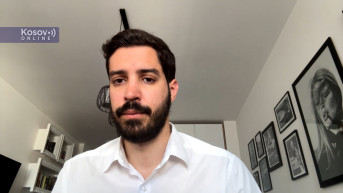
Dimitrije Milic, Program Director of the organization New Third Way, stated that without greater pressure from the United States and the European Union on the institutions in Pristina, one should not expect the formation of the Community of Serb Municipalities (CSM). He emphasized that practice has shown that all Kosovo governments to date have attempted to “water down” the concept of the CSM as much as possible.
Commenting on the tenth anniversary of the Brussels Agreement, which defined the principles of the future CSM, as well as issues related to energy, telecommunications, and the main bridge on the Ibar River, Milic underlined that a key “aggravating factor” for the lack of implementation of the agreed measures concerning the protection of the Serbian community’s rights is the fact that both the U.S. and the EU are currently preoccupied with much more pressing global issues.
“This matter has been sidelined because the current international context imposes other priorities,” Milic explained.
He added that while the Western Balkans is “strategically important” and thus significant for EU countries, at present the burning issues are the war in Ukraine and the possibility of escalation in the Gaza Strip, where a broader regional war “would have unforeseeable consequences not only for Europe but also for the global economic situation.”
“They are simply expending their limited diplomatic and political capacities on these issues. In the 1990s, despite having fewer ‘distractions’ and, relatively speaking, being much stronger than other actors on the global stage, they still did not manage to resolve the crisis in the Western Balkans quickly, which dragged on for an entire decade. Therefore, we should not expect European states to have the capacity to resolve it now, when they face even more internal and international challenges than in the 1990s. That is why it is not on the agenda,” Milic said.
He stressed that, regardless of geopolitical circumstances, “it is important to constantly return” to the issue of the formation of the CSM.
“It is always important to revisit this matter, given that various Kosovo governments have sought to dilute the concept of the CSM in order, from their perspective, to align it with the Constitution. This was a form of ‘legalistic argumentation’ for why it could not be implemented in the format discussed since 2013 and clearly defined in 2015,” Milic noted.
He is convinced that progress can only be achieved with the support of the U.S. and the EU.
“The obstacles and implementation directly depend on the degree of American and European pressure on Pristina. We have seen certain forms of pressure that negatively affect the international reputation of the Kosovo government, but this pressure still does not entail actual implementation of the CSM. There is no visible progress, particularly not at a time when global crises have escalated,” Milic stressed.
He warned that the basic concept of the CSM has been altered over the past decade “to the detriment of the Serbian community.”
“In recent years, it has mostly changed to the detriment of the Serbian community in terms of the degree of its autonomy. Through the ‘legalistic argument’ of alignment with the Kosovo Constitution, powers have in some way been reduced or, colloquially speaking, ‘watered down’ so as to be acceptable to Kosovo public opinion,” Milic said.
He pointed out that a key argument for Pristina is the concern that the CSM could become “the Republic of Srpska within the Kosovo system.”
“From the perspective of the local Albanian political elites, it has been defined as a ‘destabilizing factor within society’ or a ‘disruptive political factor’ that undermines the functionality of the government’s core institutions. That was the idea, but as long as there is no American and European pressure to implement it, it is unlikely that the Kosovo political elite will carry it out or face any consequences for failing to do so. The exception, of course, could be a particularly weak coalition government, which might be subject to greater pressure from minority communities in terms of maintaining its majority,” Milic specified.
He noted that success in the upcoming local elections in majority-Serb communities is a precondition for the issue of the CSM to be placed on the agenda of Pristina’s institutions.
“In that case, you would have local self-governments representing the local community, and then you could negotiate with greater political strength on this issue. But the question always remains as to how successfully you can impose this as a national issue, so that the Kosovo government and parliament focus on it rather than on other matters,” Milic observed.
He concluded that the outcome will ultimately depend on when, and by whom, a future functional government in Kosovo will be formed.



0 comments