
Milicevic: Government of parties currently in opposition would respect the fact that Serbs live in Kosovo
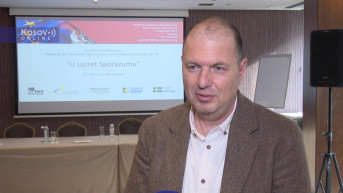
If the results of the upcoming parliamentary elections in Kosovo were such that Self-Determination cannot independently form a government, as shown by the latest opinion polls, Miodrag Milicevic, the executive director of the NGO "Aktiv," believes that a new government composed of opposition parties would be more likely than a post-election alliance between a party from the opposition and the ruling Self-Determination.
From the perspective of the interests of the Serbian community, he says that previous governments were more acceptable than the government of Albin Kurti, and he believes that if the parties that are currently in opposition were to come to power again, they would respect the fact that Serbs live in Kosovo.
"I believe they would have a policy that fosters interethnic relations to the extent that it involves acknowledging the fact that Serbs live in Kosovo and that addressing the priorities of the Serbian community is primarily tied to the government in Pristina, as well as the progress of dialogue between Belgrade and Pristina," Milicevic says.
According to a survey by the Pristina Institute for Public Opinion Research, Self-Determination currently has the support of 40.9 percent of citizens, and Milicevic says that some surveys from a few months ago showed that Albin Kurti's party was better rated, even reaching 46 percent.
"All of this is, of course, the result of the policy toward the north and in the dialogue process, namely the denial of everything agreed upon, demanding formalization with signatures, de facto and de jure recognition of Kosovo's independence by Serbia, with the aim of gradually building up the rating and potential preparation for possible elections during the summer. I say during the summer because that's when the diaspora comes, and Kurti has great support there, and it is assumed that if the elections were held during the summer, the percentage of votes would be much higher. However, according to the indicators, no one surpasses that critical 50 percent that allows someone to independently form a government," our interlocutor says.
Milicevic points out that opposition parties have been suffering various forms of pressure for a long time, especially local self-governments, which in most cases are led by opposition parties and where mayors are from the PDK, LDK, etc.
"It is unlikely that in such circumstances any of these opposition parties will form a coalition government with Self-Determination for many reasons. There are serious political disagreements, primarily related to strained relations with international partners, primarily the United States. If these percentages remain, it is more likely that we will see a coalition coming from the ranks of opposition parties rather than one that a party would make with Self-Determination. At least, that is according to these current parameters because we are not entirely sure when the elections will take place and what will precede them," Milicevic says.
When asked which post-election combination would be more suitable for the Serbian community, he says that at this moment it is clear that the ties between the Serbian community and Serbian political representatives with the current government are almost completely severed.
"That dialogue does not exist, and that is the biggest problem affecting intra-political and interethnic relations. What is currently happening is the absence of any political dialogue where it belongs, in the Kosovo Assembly. When you have such a situation, it is quite clear that all previous governments were more advanced than Self-Determination and the policy currently being presented. This kind of current policy is actually a policy of fait accompli where you have no space to react but are reactive to decisions made in Pristina. Any search for compromise becomes a mission impossible, and that is the biggest problem society faces. For the Serbian community, it would be much better if there were a constructive government in Pristina that, instead of populism, would use any communication channel, including civil society, to improve interethnic relations, establish dialogue, and, above all, understand the problems facing the Serbian community in Kosovo. At this moment, such dialogue does not exist. All other governments were far more acceptable to the Serbian community compared to the current one," Milicevic says.
As he emphasizes, the current government – Self-Determination and Albin Kurti, refuse any discussions on what has already been agreed upon in the dialogue and ratified in parliament, and he also recalls the decision of the Constitutional Court of Kosovo regarding the return of land to the Visoki Decani Monastery, which has still not been implemented.
"It is constantly emphasized that it is a political decision despite being a decision of the Constitutional Court. These are things that serve for intra-populist politics and raising ratings among their own voters and those who may have sympathies toward the current government," Milicevic says.


0 comments