
Mojsilovic: Concerning potential for the so-called KSF to be used against Serbs in Kosovo
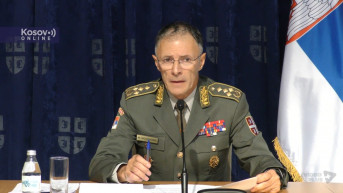
The Chief of the General Staff of the Serbian Armed Forces, Milan Mojsilovic, stated that the arming of Pristina does not contribute to peace and stability in the region, emphasizing that the “so-called Kosovo Security Force” (KSF) cannot in any way match the Serbian Armed Forces militarily, but that there is concern over the potential for it to be used against the Serbian population in Kosovo and Metohija.
“The arming of the so-called Kosovo Security Force, efforts to transform it into an army and to integrate it into military alliances are contrary to UN Security Council Resolution 1244, the Military-Technical Agreement and other signed agreements, and they do not contribute to peace and stability in the region. From a military standpoint, this formation cannot in any way match the Serbian Armed Forces, but the potential for its use against the Serbian population in Kosovo and Metohija is a cause for concern,” Mojsilovic said in an interview for Politika.
He added that the use of unmanned aerial vehicles for reconnaissance of Serbian Armed Forces bases has been registered, as well as the presence of Kosovo Police patrols within a one-kilometer belt inside Kosovo’s territory.
“For that reason, we are monitoring the activities of the Pristina institutions with particular attention,” he said.
Commenting on a recent incident in the Ground Safety Zone, when media reported that members of the Serbian Armed Forces were fired upon from the territory of Kosovo, Mojsilovic said that a Serbian Army patrol came under fire near the “Debela Glava” base in the municipality of Bujanovac.
He explained that the patrol commander, assessing the tactical situation and potential risk to civilians who might have been nearby, made the correct decision not to return fire at the armed group, which was fleeing in motor vehicles from the territory of central Serbia.
Members of the Serbian Armed Forces are daily engaged in controlling the Ground Safety Zone and securing the administrative line. In carrying out these tasks and preventing illegal activities, they frequently encounter armed groups attempting to cross from Kosovo into central Serbia for the purpose of illegal logging.
Mojsilovic specified that in the past five years, 75 incidents involving the use of firearms have been recorded, including 12 such incidents in the previous year alone.
The Chief of the General Staff underlined that the previous year marked significant progress in strengthening the operational capabilities and combat readiness of the Serbian Armed Forces through modernization, procurement of advanced weaponry, and intensive training. Part of this equipment was displayed during the major military parade “Snaga jedinstva” (“Strength of Unity”) held last year.
“We have acquired new capabilities: for the detection, localization, and jamming of unmanned aerial vehicles; disruption of tactical and strategic aviation; long-range air-to-ground strike operations; the use of attack drones against targets in strategic depth; and the employment of loitering munitions at tactical depth. The integrated command network has been enhanced, along with the firepower of units across all branches, as well as the mobility and protection of the Serbian Armed Forces,” Mojsilovic enumerated.
He also highlighted improvements in the integrated command network, firepower across all branches, mobility, and force protection.
The strategic priority for 2026, he said, is the continued development of credible deterrence capabilities sufficient to prevent any threat to security. Emphasis will be placed on modern operational concepts, the induction of new weapon systems, and personnel reinforcement.
“We will continue with the organizational development of Serbian Armed Forces units and preparations for the reintroduction of mandatory military service. We are launching the ‘Digital Army’ project, which will enhance data collection, processing, and exchange through advanced software and hardware solutions, optimize decision-making processes, integrate combat systems, and accelerate operational tempo,” Mojsilovic stated.
He added that this progress would not have been possible without strong state leadership support, headed by the President of the Republic in his capacity as Supreme Commander.
Regarding armored capabilities, Mojsilovic said that the strategic orientation of the Ministry of Defense and the Serbian Armed Forces is for the modernized M-84 tank to remain the main battle tank and backbone of armored units in the medium term.
While the procurement of a modern foreign main battle tank remains a long-term option, the current focus is on comprehensive domestic upgrades of existing platforms, ensuring a high level of operational capability with rational resource allocation.
The Army has already received the first batches of modernized M-84 AS1/2 tanks, with additional contingents expected this year, along with modernization of T-72 tanks on a similar principle.
Mojsilovic also noted ongoing activities related to the introduction of the multiple rocket launcher system “Puls,” which will equip the Mixed Artillery Brigade.
“In addition to new quantities of the ‘Puls’ system, we also expect deliveries this year from foreign markets of Israeli-made Hermes 900 remotely piloted aircraft and Czech-produced ‘Vampir’ multiple rocket launchers. The domestic defense industry will deliver new quantities of various armored combat vehicles, transport assets, small arms, as well as sets of protective and logistical equipment,” General Mojsilovic stated.
In the field of munitions, emphasis will be placed on large-caliber ammunition, advanced aviation ordnance, air-defense systems, guided artillery munitions, and long-range attack drones.
Looking ahead to 2026, Mojsilovic announced plans for the acquisition of a long-range air-defense missile system and advanced unmanned platforms, as well as proposals for equipping the Air Force with new multirole combat aircraft, initial training aircraft, and transport planes.
On the issue of mandatory military service, Mojsilovic stated that the Serbian Armed Forces are organizationally, materially, and personnel-wise prepared to receive the first generation of conscripts. It remains necessary to prepare Ministry of Defense centers responsible for records and recruitment and to expand military healthcare capacities.
“Once the decision suspending compulsory service is repealed and the appropriate legal and by-law framework is adopted, we will very quickly proceed with implementation,” he said.
According to the proposed legal solutions, military service would apply to men aged 18 to 30, while women would have the option of voluntary service.
Military service would last 75 days and would be carried out in basic and specialist training centers, as well as in all Serbian Armed Forces garrisons within Land Forces brigades and the Air Force and Air Defense units.


0 comments