
Vucic: The greatest threat to Serbia is the military alliance of Zagreb, Pristina and Tirana – Someone has given the “green light”
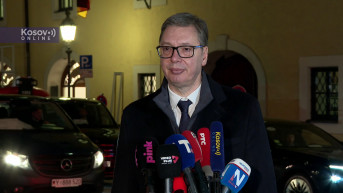
President of Serbia Aleksandar Vucic stated this evening that during his participation in the Munich Security Conference he raised the issue of the military alliance between Tirana, Zagreb, and Pristina, adding that he is still awaiting an answer as to the purpose of such an alliance. Someone, he emphasized, has given a “green light” for its formation.
“I raised the question in the meetings I held regarding the military alliance of Tirana, Zagreb, and Pristina. I am still waiting for anyone to answer the question: what is the purpose of that alliance? I have not yet heard a response from anyone. Perhaps I will receive one someday—before they move into action,” Vucic told journalists.
He stressed that he is deeply concerned by the silence and by the fact that everyone pretends not to understand when he raises the issue.
“The greatest threat to Serbia is the military alliance of Zagreb, Tirana, and Pristina,” Vucic underlined.
Asked how it is possible that his interlocutors do not understand, he replied that they “understand very well,” but remain silent because someone has given the “green light” for its creation.
“Someone had to give the green light for the formation of that alliance. No two states and one entity would ever make such a decision independently. Someone made that decision. I would rather not say who, because I do not wish to damage relations with a major power,” Vucic noted.
Instead of answers, he said, he is being told “fairy tales about military-technical cooperation.”
“The issue is not to whom you sell ammunition and weapons, but with whom you are in alliance, whose territories you defend, and whom you attack. That alliance concerns me greatly,” the President reiterated.
Speaking about the current global situation, Vucic said that Serbia is a small country and cannot dream of defense investments on the scale seen in Germany. However, he added, Serbia must invest in defense due to the formation of the alliance, which poses a significant security concern.
“I will soon attend a session of the Collegium of the General Staff and the Ministry of Defense. I will visit all defense industry factories, and we will invest substantial funds in them. We will continue exporting defense industry products, but a large portion will now be directed to the Serbian Armed Forces. Until now, between 10 and 18 percent of production was allocated to our army; from now on, that share will rise to between 30 and 40 percent,” Vucic announced.
On Merz’s Position Toward the Western Balkans: A Careful Choice of Words – “Close, Closer, EU Membership”
Vucic also reflected on the speech of German Chancellor Friedrich Merz and, regarding his stance on the accession of the Western Balkans to the EU, noted what he described as a careful choice of words—“close, closer, and in the EU.”
“That speaks to what we have already discussed: an EU of several speeds—first the single market, then something else, and only then full membership. Nevertheless, these are good signals for all of us,” Vucic observed.
He added that he does not believe Ukraine will immediately become a full member of the EU, but if that were to happen, Serbia would congratulate it—while noting that it remains to be seen with which territory Ukraine would enter the Union.
The Serbian President assessed Merz’s speech as comprehensive, highlighting the need for pragmatic relations with the United States.
He relayed that Merz criticized the American MAGA movement regarding tariffs, as that is not EU policy, as well as U.S. positions toward the World Trade Organization and climate change. Merz also, Vucic noted, warned that if the EU and the U.S. are not united, China will soon surpass America.
Vucic pointed out that Merz spoke very strongly and sharply against the Russian Federation, to an extent that surprised him, but also helped clarify Germany’s unequivocal anti-Russian stance.
“Not only does Germany strongly support Ukraine, Merz clearly stated that Russia is exhausted, but not sufficiently, because only profound exhaustion can lead to a Russian defeat. He also spoke of building a strong Europe and, for the first time, referred to Article 42 of the EU Treaty, under which member states must defend one another,” Vucic explained.
He added that Merz stated Germany would soon become the strongest military power in Europe.
“In reality, it already is. Two years ago, investments in the defense industry amounted to €2.7 trillion, and last year Germany invested around €3.2 trillion. The Germans use this to strengthen their overall industry. They work closely with Ukrainian engineers, and companies are developing new weapons systems. The German Ministry of Defense budget stands at €108 billion, excluding equipment orders worth €341 billion,” Vucic said.
He concluded that Germany seeks not only economic and political power, but also significant military strength within Europe.
Vucic also noted that Merz criticized the President of France for seeking dialogue with the Russian President, arguing that such talks should not take place until Russia is sufficiently weakened.
“I fear that we will not see an end to the war in Ukraine anytime soon. We may hope for peace elsewhere, but not there—not soon,” Vucic emphasized.
He stressed that the atmosphere at this year’s Munich Security Conference reflects the gravity of the global situation.
“I have attended many Munich conferences. Even when American vice presidents came in the past, I do not recall such crowds. Of course, today is the opening day, and the German Chancellor spoke; in a few minutes the French President will speak. I listened to the German Chancellor—there are many new developments in the world. I held meetings with Gerard Keown, Wang Yi, António Costa, and, very importantly, with the Foreign Minister of the People’s Republic of China. This evening I will attend a dinner with around 20 prime ministers, presidents, and influential figures, and then I will meet with Zeljka Cvijanovic. It has been a demanding day, but what matters is strengthening cooperation between Serbia and China in all areas. For us, it is crucial to advance technological progress in robotics and to learn more in the field of artificial intelligence,” Vucic said.
Commenting on his meeting with the President of the European Council, Vucic acknowledged that there are points of disagreement, as well as questions to which Belgrade still awaits answers.
Regarding recent polling data published by Politico, conducted in the United States, Canada, Germany, France, and the United Kingdom, indicating that 10 percent more respondents than last year believe a global war will break out within the next five years, Vucic remarked that everyone speaks only of war.
“You have seen more uniforms here than ever before. I have never seen even a tenth as many people in uniform at such a gathering. Everyone talks only about weapons and military power. Nuclear autonomy and Europe’s security are being mentioned constantly,” the Serbian President warned.
Asked about the statement of Denis Becirovic, the Bosniak member of the Presidency of Bosnia and Herzegovina, that “the authorities in the Republic of Srpska are attempting to destabilize Bosnia and Herzegovina and undermine the Dayton Agreement,” Vucic replied that this was nothing new and emphasized that Serbia seeks good relations with Bosnia and Herzegovina.
“Nothing new. We want good relations with Bosnia and Herzegovina. I am not even sure whether he was referring to the Republic of Srpska or Serbia—he usually refers to both—so I have nothing further to add,” Vucic concluded.

0 comments