
Vujinovic: Announcements of “Shota” production in Kosovo aimed at turning the KSF into an armed force
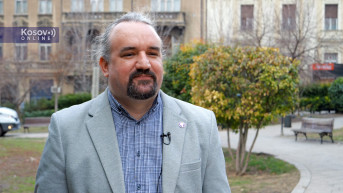
The announcement of the production of the armored combat vehicle “Shota” in Kosovo, according to Nikola Vujinovic, a security studies researcher, points to the strengthening of the Kosovo Security Force and the desire to turn it into a genuine armed force, which he notes is contrary to all agreements reached so far.
On the other hand, as he emphasizes, this also represents the operationalization of the “tripartite pact” between Albania, Kosovo, and Croatia, reached last year with the aim of strengthening armed forces.
He recalls that Kosovo’s caretaker defense minister Ejup Maqedonci announced in late 2025 that “Shota” would be produced in Kosovo, which is one of a series of announcements in recent months in the context of strengthening the KSF.
“For now, this remains at the level of announcements. We have also heard announcements about drone and ammunition factories, but operational steps somehow are not being implemented, probably due to political instability in Kosovo. Mr. Maqedonci pointed out that Croatia is one of the potential buyers of ‘Shota’, and we will see whether that will actually happen,” Vujinovic told Kosovo Online.
As he explains, “Shota” is an armored combat vehicle, similar to the “Milos” used by the Serbian Army, the “Despot” in the Republic of Srpska, or the “Hummer” in the United States.
“According to projections I had the opportunity to see, ‘Shota’ is stronger than both the ‘Despot’ and the ‘Milos’. Compared to the ‘Despot’, it has stronger armor, and compared to the ‘Milos’, stronger armament. The prototype of ‘Shota’ was presented by the Albanian company Timak in Paris in 2024, and since then we have had no information about the start of operational testing, let alone its introduction into the Albanian armed forces,” he said.
As a result of the defense cooperation agreement signed by Kosovo, Albania and Croatia in March last year, Vujinovic says it can be expected that Kosovo will produce some additional equipment, possibly infantry weapons or artillery ammunition.
“This raises the question of the purpose of this agreement, which we still do not fully understand. They are trying to present it as a multilateral agreement which, even though NATO is already present, is needed for Kosovo to become essentially and indirectly a member of NATO and thus enhance its security. It is not to be expected that complex combat systems will be produced in Kosovo, because under the government of Albin Kurti it has been completely deindustrialized,” Vujinovic points out.
As he adds, electricity outages occur on a daily basis in Kosovo, prices are high, and the demographic crisis is becoming increasingly evident.
Vujinovic assesses that once the production of “Shota” begins, it may, but does not necessarily have to, significantly affect Kosovo’s ranking on the Global Firepower list, which annually ranks military forces worldwide and on which Kosovo placed 138th out of 145 on the latest list.
“That list is compiled based on 60 individual indicators, ranging from oil production and electricity consumption to armaments. So to some extent it may have an impact, but not a major one, because Kosovo is facing enormous social, economic and structural problems that influence that list more significantly than, for example, military power. Australia, for instance, is ranked 17th, even though its military is essentially among the weaker ones. Serbia is ranked 63rd, Croatia 73rd, Albania 77th, so Kosovo is still far from any kind of respectability on that global firepower index,” our interlocutor noted.
Compared to last year, Albania has advanced by more than ten places on this list, and Vujinovic says that several factors contributed to this, including greater political stability, while noting that the ranking reflected developments from the first half of 2025, since it is evident that some political instability emerged in Albania toward the end of last year.
“This was also influenced by stronger relations, for example with Italy regarding the reception of migrants, as well as with various other NATO actors, and of course by the procurement of new weaponry and an increase in the military budget by at least ten percent,” he emphasized.


0 comments