
Muhadri: Initiative to rename Kosovo as Dardania justified in a historical sense
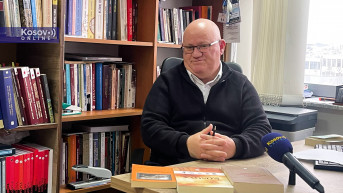
Historian Bedri Muhadri from the Historical Institute in Pristina believes that the civic initiative to rename Kosovo as Dardania is historically justified. As he points out, such practices have existed among other nations as well, citing the Polish people as an example, who have changed their country's name several times.
“Nations with their own history rightly seek and attempt to reclaim their identity. It is necessary to find a name that reflects identity and holds historical, political, and ethnic significance. I believe this civic initiative is justified historically. However, how things unfold in terms of modern political pragmatism, whether this is advisable, and when the circumstances for it will be created, are entirely different matters. This certainly requires clearer historical and scientific explanations,” Muhadri told Kosovo Online.
He explains that historical data and sources indicate that during antiquity, the territory of Kosovo, though not in its current borders but in a broader region, was called Dardania, and that the Dardanian tribe inhabiting this area was one of many Illyrian tribes.
“Dardania has its historical continuity. From prehistory, through the fall of the Roman Empire, to the Middle Ages, the territory of Kosovo was known as Dardania. In the 4th century BCE, Dardania included many economically developed cities of the time, such as Skopje, Nis, Pristina, and Ulpiana. It even formed its own kingdom, which flourished until it fell under Roman rule. The Roman Empire, upon conquering Dardania, encompassed a significant part of the Balkans. In 279 CE, under Emperor Diocletian, who established the Illyrian prefecture that included all Illyrian tribes, the region was divided into four provinces. One of these was Dardania, with Skopje as its capital,” Muhadri stated.
In his view, the historical continuity of “the people of Kosovo, who have lived from antiquity to today, had its identity foundation in Dardania.”
“In the Middle Ages, across the Balkans, new ethnic entities emerged – Albanian, Serbian, Bulgarian, and Romanian. Within this context, the Albanian people also formed their identity, as documented by historical and archaeological sources. The most recent archaeological evidence from Ulpiana was found in a Christian church mosaic floor, referencing Emperor Justinian and Dardania, from the period 527–557 CE. The Arber people are the successors of the Illyrian population, and we can say that Dardania, as an ethnic and geographical concept, existed until the Middle Ages,” Muhadri explained.
Afterward, as he adds, major upheavals occurred on the Balkans with the arrival of Slavic peoples, “who spread across the region, especially in the territories of Serbia and Kosovo.”
“In terms of the name Dardania and its historical continuity, we gradually lose documented sources. By the late 14th century, after the Battle of Kosovo in 1389, the toponym of this area becomes known as Kosovo. The battle occurred on the Kosovo Plain. The etymology of the word Kosovo in linguistic terms does not belong to the Albanian period. All records by the greatest scholars linguistically classify the term Kosovo as part of Slavic languages, not Albanian. Thus, Kosovo begins to appear in various records and maps, but not in the sense of the entire territory of Kosovo, rather as a portion, including Zvecan, Pristina, and Vucitrn. In 16th-century maps, Kosovo is mentioned as a territory traversed by certain routes,” Muhadri concluded.



0 comments