
Nastic: The creators of Kosovo are now giving lessons on international law
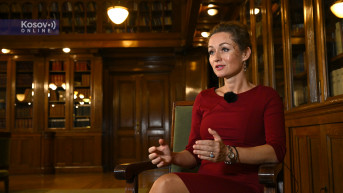
Zaklin Nastic, a member of the populist left-wing party "Sahra Wagenknecht Alliance" (BSW) in the German Bundestag, stated in an interview with Politika that the "catastrophic German government," along with NATO member states, had fueled new conflicts by creating Kosovo, leading to societal and economic collapse.
She points out that in July, she submitted a proposal to the parliament for the withdrawal of German soldiers from Kosovo, but her initiative was rejected.
The Sahra Wagenknecht Alliance (BSW), a party named after its leader, was founded in January and has already achieved double-digit results in recent elections in three states in eastern Germany.
As the third strongest force in each of these three regions, BSW now plays a crucial role: no government can be formed without them if traditional parties want to exclude the far-right Alternative for Germany (AfD).
The election results in Thuringia, Saxony, and Brandenburg, which saw a relatively high turnout, show that BSW is filling a gap in the country's political landscape that no other party has been able to occupy, says Zaklin Nastic, a BSW member of the Bundestag, who is known to the Serbian public for her principled stance on Kosovo and her support for respecting Serbia's territorial integrity. A former member of Die Linke (The Left), she is one of the founders of the Sahra Wagenknecht Alliance – a party that has attracted dissatisfied voters from both sides of the political spectrum.
"We are the only party in Germany that consistently advocates for peace. We oppose the stigmatization by the current government, which behaves paternalistically toward large parts of the population, particularly in eastern Germany. The elections showed that people are no longer willing to accept such a policy," Nastic told Politika.
According to her, BSW sharply criticizes the "catastrophic policies" of the Berlin government, which, she claims, are leading to societal and economic ruin.
"For example, irresponsible and harmful sanctions against Russia, along with the growing disregard for Germany's past when it comes to militarization and rearmament, are fostering a new desire for war in Germany and the West. We see increasing military budgets and louder calls for more arms deliveries to Ukraine," Nastic says.
However, she adds that the problem is not only financial but, above all, ideological.
"Germany and NATO states, which were among the first to violate international law by waging war against Yugoslavia and creating the artificial state of Kosovo, are now trying to give us lessons on international law. In light of these realities, it is important that BSW appeared on the ballot as a party opposing such policies. We advocate for peace and disarmament: against the newly announced stationing of American medium-range missiles in Germany and against subjugation to NATO and the United States. We want to halt social decay by investing in public infrastructure and guaranteeing social security," Nastic explained.
The leader of her party, Sahra Wagenknecht, has stated that the division between left and right only confuses voters. This troubles centrists, as BSW offers a mix of hard-right policies (on immigration and culture) and far-left ones (on social spending), with a touch of anti-Americanism and pro-Russian sympathies. Although they differ on economic issues, Alternative for Germany and the Sahra Wagenknecht Alliance seem to have more in common on foreign policy than what divides them. However, from the current perspective, it is far from enough to bring these two parties together ahead of next year’s parliamentary elections.
"We must view the high electoral results of AfD with great concern, as they have managed to ideologically establish themselves among many people as a so-called 'alternative,' partly due to the catastrophic policies of the German government, and they are setting the political agenda across the country. Particularly dangerous is their hypocrisy, as they support militarization and voted for NATO expansion in parliament. They also support sending German soldiers to Bosnia and Herzegovina, which is clearly aimed against Russia, China, and potentially Serbia. In July of this year, I submitted a proposal to parliament for the withdrawal of our soldiers from Kosovo and for Germany to revoke its recognition of Kosovo. AfD rejected that proposal," Zaklin Nastic concluded.



0 comments