
Nemec: Abolishing visas for the Serbs from Kosovo is not a political issue; there is a will in the European Parliament to resolve it quickly
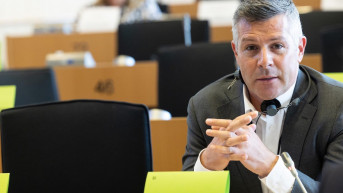
The issue of visa liberalization for the Serbs from Kosovo must be resolved quickly because European Parliament elections are approaching, and time is running out, Matjaz Nemec, the newly appointed rapporteur of the European Parliament for abolishing visas for the Serbs from Kosovo, says in an interview with Kosovo Online.
He emphasizes that there is a strong will to address this issue and adds that he will try to secure a majority in the European Parliament.
Nemec assesses that there is a significant willingness among political groups in the European Parliament to resolve the issue of visa liberalization for the Serbs with passports issued by the Coordination Directorate.
"It seems that this issue will be resolved quickly because time is running out. We have elections on June 9th, and there is a willingness from both the European Commission and the European Parliament to adopt this proposal on April 8th. I am confident in that, but at the same time, it depends on other groups in the European Parliament and their positions. However, there seems to be a great willingness to seize this opportunity because we have a short period of time to reach an agreement. That is our ambition, but we will see what the next steps in the European Parliament will be," Nemec says.
The report is expected to undergo internal discussions in the European Parliament on March 12th, with a deadline for submitting amendments by March 15th, while the European Parliament Committee on Civil Liberties, Justice, and Home Affairs will vote on April 8th.
"We have received support from all groups to do this in an extremely short period of time and at a great speed, to adopt the proposal at the last session in April. I hope we will get the necessary support in Strasbourg at the end of April," our interlocutor says.
Nemec also states that he doesn't know exactly how many people have passports issued by the Coordination Directorate.
"We don't need to have an exact number of passports because many citizens of Kosovo of Serbian nationality have taken advantage of the opportunity to change their personal addresses in Serbia. We don't know exactly how many people are involved and how exactly this decision will affect them," our interlocutor says.
The Government of Kosovo has publicly opposed the mentioned possibility of visa liberalization for the Serbs with passports issued by the Coordination Directorate on several occasions.
"This is not one of the topics in the dialogue between Belgrade and Pristina and is not mentioned, but we will have the opportunity to talk to authorities in Kosovo and Serbia, and we would like to persuade them that we must resolve this situation that discriminates against a significant percentage of Kosovo citizens. The important message would be that no one can be left behind because a small group of citizens may be discriminated against and will not have the opportunity to enjoy the same rights as other citizens coming from other parts of the Western Balkans," Nemec says.
The newly appointed rapporteur of the European Parliament for abolishing visas for the Serbs from Kosovo also states that visa abolition should not be a political issue.
"No one, absolutely no one in the authorities in Pristina or Belgrade, should use this issue for political purposes. We are primarily talking about the human rights of an important group of people who could and still are being discriminated against. This is assistance for a small group of citizens because we must keep in mind that since January 1, no other group of people from the Western Balkans has been discriminated against due to the visa liberalization situation. The Serbs from Kosovo are the exception, but we would like to avoid anyone being discriminated against in the region."
When asked what would happen if officials of the Kosovo Government continued to oppose the visa abolition for the Serbs from Kosovo, Nemec says the following.
"The dialogue in Brussels between Pristina and Belgrade is still ongoing. This is not a topic that is a part of the dialogue, and I hope no one will see this as an opportunity to make those discussions even more difficult. An agreement between Belgrade and Pristina within the framework of the dialogue will be reached in the future, so this is just temporary, and everyone should see it as assistance from the European Parliament and European institutions.
Regarding whether all parliamentary groups support this initiative, Nemec emphasizes that you cannot get 100% support for any topic in the European Parliament, but they will try to secure a majority.
"It's hard to say. For any issue, we can't expect to find 100% support, but we will try to garner a majority from all political groups in the European Parliament. There is a strong willingness to resolve this issue, but it also depends on the dialogue between different political factions in the European Parliament," Nemec says.


0 comments