
Nikolic: Bethlehem looked like a ghost town for Christmas; we still fear for Serbian citizen Alon Ohel
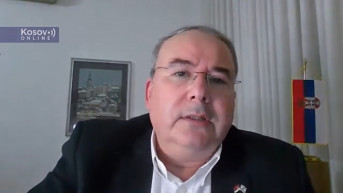
Honorary Consul of Serbia in Israel, Aleksandar Nikolic, says in an interview for Kosovo Online that due to the war events in the country, there was no organized celebration of the happiest Christian holiday in Bethlehem. The small Serbian community spent Christmas in their homes.
Consul Nikolic says that the fate of Serbian citizen Alon Ohel remains uncertain, and all diplomatic activities in the region are engaged in preventing the opening of a new hotspot in the northern part of the country.
Nikolic says that the conversation between the President of Serbia, Aleksandar Vucic, and the President of Israel, Isaac Herzog, was very positively evaluated in Israel. Additionally, the fact that Belgrade hosts top Israeli basketball clubs in European competitions is appreciated.
Bethlehem, a biblical city on the West Bank believed to be the birthplace of Jesus Christ, is annually visited by millions of tourists and pilgrims, especially during Christmas and Easter. However, this year, Manger Square in front of the Church of the Nativity appeared eerily empty, and Bethlehem seemed like a ghost town.
"The cheerful and colorful scenes of processions and orchestras during the happiest Christian holiday on the plateau in front of the Church of the Nativity built above the cave of the birthplace of Jesus Christ were absent. They were simply canceled. Bethlehem looked like a ghost town. The image reminded me of the time of the first Gulf War, those weeks preceding the air intervention over Iraq", Nikolic says.
According to him, the liturgy was led, as every year, by Patriarch Theophilos III of Jerusalem.
"The local population is left with a Christmas message from which they draw hope that the next holidays will never look like this again", Nikolic emphasizes.
Nikolic says that in Israel, the number of Christians is decreasing, attributing it to migration and low natural population growth.
"The statistical indicators are a result of both emigration and lower natural population growth compared to the Jews and Arabs of the Islamic faith. It should be added that Christians in Israel are concentrated in the Northern and Haifa districts, far from Bethlehem, which is significant when we talk about the annual celebration in Bethlehem", Nikolic notes. He adds that Christians in Israel make up 1.9 percent today, around 188,000, of which, he emphasizes, 75.3 percent are Arabs.
"On the West Bank, in areas under Palestinian authority, it is estimated that around 45,000 Christians live, of which half are Orthodox, under the ecclesiastical jurisdiction of the Jerusalem Patriarchate".
He says that the Serbs in Israel celebrated Christmas in their homes, with thoughts of families and friends in the homeland and the diaspora.
Nikolic states that there are around 2,500 citizens with Serbian passports in Israel, but the number of Orthodox Christians is much smaller, mostly consisting of diplomatic-consular staff of Serbia, specialists, doctoral and postdoctoral students in local scientific and university institutions, and athletes.
"Our citizens in Israel form a specific community. These are individuals of Jewish origin for whom emigration to Israel is, in fact, a repatriation to the homeland. It should be added that within the 2,500 of our citizens living in Israel, there is a certain number of Christian spouses, including our diplomatic-consular staff, doctoral and postdoctoral students in local scientific and university institutions, specialists who work temporarily or are in training, and athletes", Nikolic explains and recalls that in the early weeks of the war, near the Gaza Strip and the massive rocket attacks on Southern, Central, and the Tel Aviv District, thanks to the timely action of the Ministry of Foreign Affairs of Serbia and the Embassy in Tel Aviv, three emergency flights to Belgrade were organized, and everyone who wanted to evacuate did so.
He says that the fate of Serbian citizen Alon Ohel remains uncertain, who is still listed among the abducted civilians, and the Embassy of Serbia is doing everything to assist him.
"The most challenging problem is our citizen Alon Ohel, who is still among the abducted civilians, and hostages, and the International Red Cross has not been allowed to visit the kidnapped individuals and determine their health condition. Our Embassy, led by Ambassador Miroljub Petrovic, is in contact with the wonderful Ohel family, originally from Novi Sad, doing absolutely everything, even creating new channels to act imminently in the face of new circumstances, and we hope that it happens as soon as possible", Nikolic states.
The Honorary Consul of Serbia in Israel notes that the current security situation in the southern district is more favorable compared to the earlier period.
"The number of rocket attacks has decreased to a single-digit daily figure. Areas around the Gaza Strip are incomparably safer today. It is understood that the population is still in evacuation, but their visits to devastated kibbutzim along the green separation line along the Gaza Strip are becoming more frequent and organized. However, according to local military analysts, Or Heller from Channel 13 of Israeli TV and Nir Dvori from Channel 12 of Israeli TV, there is a latent danger of escalation of conflict with Hezbollah in the vicinity of the border with Lebanon", Nikolic states and adds that there is concern that from that direction, a repetition of October 7th, when Hamas groups invaded and committed brutal pathological acts in kibbutzim and smaller towns near the Gaza Strip during the Simchat Torah holiday, could occur.
"The recent days have been marked by an increased exchange of fire, both in the depth of both countries", Nikolic says.
He says that all diplomatic activities in the region are engaged in preventing the opening of a new hotspot in the northern part of the country.
"According to the assessments of the local establishment and institutes dealing with security and strategic issues, it is estimated that neither side, neither Hezbollah nor Israel, is interested in a broader escalation of the conflict. The problem, as directly stated by one of the leading analysts, Ehud Yaari, is that a situation in which a military conflict would end with both sides directly facing each other just a few meters apart along the demarcation lines would certainly pose an even more latent danger for the coming period. Thus, each side refers to the segments of adopted UN resolutions, especially 1701 from 2006, which they consider beneficial. In other words, all eyes are really focused on the north. The potential escalation of this conflict could indeed lead to the regionalization of the conflict, something that is not in anyone's interest, and there is certainly active diplomatic activity by all involved factors around it", Nikolic emphasizes.
According to him, officials in Israel, as well as Hebrew and English media, report very positively on the friendly relationship that Serbia has shown toward the country, and also on the recent meeting between the two presidents, Aleksandar Vucic and Isaac Herzog.
"In Israel, they highly appreciate the atmosphere in Serbia that has allowed three top local basketball clubs, the pride of Israel Maccabi from Tel Aviv and its eternal city rival Hapoel, as well as Jerusalem's Hapoel, to play their home games in our Belgrade in international competitions. The Israeli Security Agency (Shabak) would not easily give permission for the games to be played in our capital if it were not convinced that our facilities are more than sufficient and that we are capable of ensuring security at such events. On the other hand, the overall atmosphere is favorable, and I really don't remember such a large number of headlines in local media, both in Hebrew and English, that wrote extremely affirmatively about the spirit in Serbia, which understands the difficulties that Israel is facing, and in this case, they manifest in sports", Nikolic says.
He particularly emphasizes the importance of the recent conversation between the two presidents, Aleksandar Vucic and Isaac Herzog.
"President Herzog congratulated President Vucic on his election victory. Some of the current topics of bilateral relations at the highest level were discussed, but there was also an expressed desire to find a peaceful solution as soon as possible for the tragic conflict currently taking place around and within Israel", Nikolic says.


0 comments