
Nikovski: The Tripartite Pact from Tirana is a fragmentation of the region, leading to confrontations

Former Macedonian ambassador and analyst Risto Nikovski stated that the recently signed military cooperation agreements among several Western Balkan countries represent further fragmentation of the region and are leading to new confrontations.
“Absolutely, this is a new division and these are new confrontations. In my deep conviction, completely unnecessary, because we were pleased to see that almost all Balkan countries, both those already members of the Union and the six that are not, shared a Euro-Atlantic orientation. That was the first time in history that all were on the same path. However, the wrong policies pursued by Brussels, which left these six candidate countries in limbo for too long, are essentially the key to these new divisions and new confrontations. In the end, Brussels will again pay the price,” Nikovski stated.
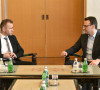
He believes the recently signed military agreements, first between Albania, Croatia, and Kosovo, and later between Serbia and Hungary, “are absolutely not coincidental” and that there is a “background” that is not yet clear.
But, he says, the clear sign that a “militarization process” is underway is explained not only by the US decision for NATO members to allocate 5% of their GDP to defense, but also by the EU’s intention to allocate several hundred million euros for the military industry.
He considers the military agreement between Albania, Croatia, and Kosovo to be concerning.
“That should worry us in the region. You know, when two countries sign a defense cooperation agreement, that is a normal thing. But when three countries sit at the table, that is already a pact, and it shows some sort of regrouping that is certainly not accidental and certainly has specific goals and intentions,” Nikovski emphasizes.
He is convinced that this represents a new fragmentation of the region, regardless of whether the Serbia-Hungary military cooperation agreement is a consequence of the trilateral agreement between Albania, Croatia, and Kosovo.
“In any case, this is a new fragmentation of the region, and in the current situation, since Macedonia and Montenegro are already part of NATO and are in some way covered from that point of view, only Bosnia and Herzegovina remains. All these latest moves should be seen as defensive, and you know that defense often comes down to aggression and attack. These agreements alarmingly lead to further divisions in the region,” the former Macedonian ambassador says.
He believes that the key conflict lies between Croatia and Serbia, but that Kosovo’s “tactics” are also concerning.
“The conflict will primarily be between Croatia and Serbia, because that is simply an enmity, and generally this trilateral, or de facto pact, can only be directed against Serbia. You know, the issue of Kosovo remains unresolved, there is complete stagnation, no progress, and the root of that is Kosovo’s unwillingness to fulfill its obligations and seek a solution with Serbia. Kurti is pursuing his own policy, often opposing and confronting the US, which is their mentor. How much of this is tactics and how much is substance, you can never be sure, but in any case, these are concerning developments, new divisions in the region that certainly won’t bring us anything good,” Nikovski explains.
He says the signed military agreements are part of a strategy that he believes originates from Croatia.
“In this particular case, the basis is certainly local and regional. I think the main root of that initiative is Croatia’s confrontation with Serbia, which has been deepening recently. We all witnessed the last elections in Croatia, Serbia was the ‘main villain.’ This is just a new alliance or pact to somehow challenge Serbia, to place it under some kind of containment or restriction,” Nikovski believes.
He reminds that there has been an emphasis on armament in the Western Balkans, led by Croatia and Serbia purchasing new military aircraft, but that such a trend will also affect countries like North Macedonia, which had not planned additional armament.
“This will, one way or another, force all of us, especially if NATO insists on allocating 5% of GDP for defense production. That will be devastating for Macedonia. And not just for Macedonia, but for many EU members as well. So, serious times lie ahead, dangerous times, and we will see what they bring. In any case, the trends are not positive,” Nikovski warns.

0 comments