
O'Brien: The decision of the Kosovo Government regarding the dinar calls into question its partnership with the US
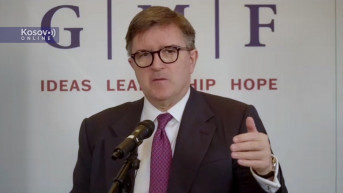
Assistant Secretary of State for European and Eurasian Affairs James O'Brien stated to Voice of America that the US was deeply concerned about the decision of the Kosovo Government to disallow the use of the dinar, and with this stance, the Kosovo Government had called into question its partnership with the United States. He said that Kosovo should retract this decision.
"I'm not making vague threats in public. I would say that if they don't treat us as partners, we won't treat the Kosovo Government as a partner," O'Brien said.
As he points out, although the United States advised the Kosovo Government against implementing such actions, it decided to proceed, disregarding the advice of key partners.
He emphasizes that all the problems that have arisen since the announcement of this decision were identified within the first 5-10 minutes after the public learned about it.
However, he adds, the Kosovo Government continued to implement this decision without warning, leaving a number of citizens unsure about how to pay for bread, rent, and electricity, which some had just started to pay.
"This is not a form of effective governance. We are very concerned because this shows the government's inability to serve its citizens, as well as the partnership. Being a part of Europe today means solving problems through dialogue with efficient planning and warning. This decision was announced hastily, without warning, and without attempting to use existing mechanisms to find answers to all the problems that may arise," he said.
When asked if the three-month transitional period was sufficient, O'Brien says that people need to know how they will pay their bills, and when reading the statement from the Central Bank of Kosovo, nowhere does it say that the use of the dinar will be allowed.
"It is said that an alternative will be offered. This had to be done before implementing the decision in cooperation with the affected communities and neighbors affected by the decision and honestly with the European Union and us. So, no, they should stop this immediately and then work on solving the specific problem they want to address, as modern European countries do," he points out.
He stated that he had had several conversations with Kosovo Prime Minister Albin Kurti in the period before the decision was announced and a brief conversation afterward, adding that Kurti had understood the concern and promised to work on it.
"But it's clear that he decided to approve the decision. If he doesn't treat us as a partner, it raises the question of whether we can consider this government a partner," he said.
When asked if the US also planned to impose sanctions as the EU had done if Pristina insisted on its position, the US official stated that they did not make vague threats publicly, but if they were not treated as a partner, they would not treat the Kosovo Government as a partner either.
He notes that the Community of Serb-majority municipalities would solve this problem by clarifying the issue of the job sent and the purposes it would serve.
"There are other ways to ensure this clarity, including through dialogue, and informal consultations, but decisions should not be announced in the middle of the night after your closest partners tell you it's a bad idea and bad governance," he emphasizes.
Asked about Kosovo-Serbia relations after the Ohrid agreements, O'Brien says that implementation belongs to each side and that both sides should take their actions independently of the other side.
"And now circumstances have been created that allow both sides to blame each other instead of working to ensure that their citizens are free and more advanced," O'Brien said.
He emphasized that Serbia had taken two important steps towards normalization or de facto recognition of Kosovo since October, through the implementation of license plates for cars and customs documents.
"These are goals that have long been sought and achieved, and I believe that other things will happen in that regard if we return to dialogue instead of acting outside it, as the Kosovo Government has decided to do," he said.
When asked to comment on the letter from Serbian Prime Minister Ana Brnabic to European Union officials in which, as stated, she had rejected the content of those agreements, O'Brien says he believes that the first version of the letter, which was rejected, has been withdrawn.
"What I am looking at are actions, de facto recognition. Normalization in these two key components has been done in recent months, and discussions are underway on other things that can be done if we work in the way modern European states do," he repeats.
Asked if Belgrade stood behind the events in Banjska on September 24, O'Brien says that Serbia dismissed the head of the intelligence service who was involved in it, withdrew troops near the border with Kosovo and that Washington expects Serbia to prosecute those responsible.
O'Brien also emphasizes that after the incident in Banjska, it was made clear that KFOR protects all people in Kosovo, including those in the north.
He states that they have called on both governments to be transparent and open with KFOR.
He also adds that after that incident, Belgrade took steps that lead to de facto recognition regarding customs and license plates.
"These are important steps that have resulted from the response and commitment to dialogue. Therefore, we want a commitment to working on practical solutions to these problems, rather than taking unilateral measures out of personal interests that concern your partners as much as your citizens," O'Brien concluded.


0 comments