
O'Brien: Now is the opportunity to propose a vision of how Serbs can live in Kosovo
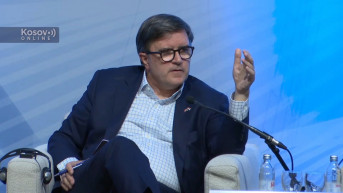
Assistant Secretary for Europe and Eurasia at the U.S. State Department, James O'Brien, spoke to RTS about the U.S.-Serbia strategic dialogue, emphasizing that the issue of Kosovo is one of the most sensitive, given that the governments of Serbia and the U.S. do not agree on this matter.
"The U.S.-Serbia strategic dialogue is an opportunity for our two governments to collaborate on programs that will be lasting. It is a sign of the maturity of our relations. President Vučić has highlighted his key topics, with six or seven issues on that list, and this will create a way for us to cooperate long-term," said O'Brien.
He assessed that the relations between Belgrade and Pristina are one of the most sensitive issues since the governments of Serbia and the U.S. disagree on this matter.
O'Brien emphasized that there is now an opportunity to propose a vision of how Serbs can live in Kosovo.
"Our position is such that there is an opportunity to propose a vision of how Serbs can live within Kosovo as a community, but also as full-fledged citizens of Kosovo. The strategic dialogue is an opportunity to ensure there is full understanding of the positions of all parties. The decisions will be up to the people of Serbia, and they will have to decide whether they are ready to take the steps that Europe expects, namely recognizing the borders. I think this dialogue will be one of the means by which we can avoid misunderstandings," highlighted O'Brien.
He noted that it often seemed that government work was not effective, but it is necessary to continue discussions to see what the real problems are.
With the change of administration, he adds, the U.S. will pay attention to the needs of Kosovo to succeed in its endeavors, but also to ensure that Serbs in these territories live well and of high quality, as is the case with communities across Europe who live in countries where they were not born.
"If we discuss all problems, we can solve them," O'Brien stated.
Regarding the formation of the CSM, O'Brien says that there is also an opportunity to realize it.
"Good work has been done in the past year or two within the framework of the dialogue under the auspices of the EU, when it comes to practical solutions, so that people can now obtain extracts from civil registers, marriage certificates, educational certificates, pension payment certificates, and everything else. We believe progress is visible in practice either in our strategic dialogue or through the dialogue under the auspices of the EU. The U.S. will provide all the support," concluded O'Brien.
He also touched on sanctions against NIS.
"We are not doing this to Serbia. We have imposed sanctions on more than 300 Russian companies. Oil pays and finances Russia's aggression against Ukraine. Russia bought NIS for a very small amount at the height of the financial crisis, and we would like that flow of resources to stop and have promised the Serbian government that the supply of oil to Serbia will not be interrupted, and we believe that Serbia will benefit from this. The only condition is that there is no outflow of money to Russia and we do not want Russia to manage this key company in Serbia. The Russian participation in this company should be zero," he said.
O'Brien: Create space where the voice of the Serbs in Kosovo, especially in the north, can be heard
O'Brien also spoke today in an interview with Kurir about Serbian-American relations and the issue of Kosovo, noting that he is aware of certain problems when it comes to the dialogue between Belgrade and Pristina.
"I am aware that there are certain problems, but here is what is crucial - both sides need it. Kosovo risks being isolated from all European integrations. When you travel from Serbia to Kosovo, it is clear that there are no conditions for major commercial investments. Investments are needed and both sides are natural partners in this, and this will come over time and with certain acquaintances, but work needs to be done on this," he stated.
He points out that between Kosovo and Serbia, the statement is that there is a normal European path to solve these issues.
"In recent years, leaders needed to agree on every small step, thanks to which each step had huge political significance. Today, with a more active European Union in the region, both countries understand that they can do certain things to facilitate the resolution of problems in Kosovo. This is necessary for their own European integration, not within the framework of any special negotiations. This should create a space where the voice of the Serbs in Kosovo, especially in the north, can be heard. In this context, the president encouraged me by saying that those responsible for violence in the north of Kosovo will be held accountable. We are also working with the authorities in Pristina to ensure accountability and the rule of law. So, we are working with both sides, but as far as Serbia is concerned, this will enable Serbs in Kosovo to have their own voice, knowing at the same time that they have the support of others, to also have a say in how they want to live," he believes.
Regarding U.S.-Serbian relations, there are two aspects, emphasizes O'Brien.
"One is related to Kosovo. We want the Serbs, as a community throughout Kosovo, especially in the north, to have their own voice. Not to speak in this or that way, as they are told in one capital or another, but to have rights as citizens in a democratic society. That is the measure for U.S. policy. As for the bilateral relationship, what we announced with the arrival of Assistant Secretary of State Richard Verma is that we will have a strategic dialogue with the Serbian government. We believe it is important to announce this now, at the end of the Biden administration, because we wanted to show that both Democratic and Republican administrations support strong bilateral relations. We do not want it to appear that one party or the other is taking responsibility, because in America both parties believe that a strong relationship is important both for our country and for Serbia. The future is bright, and we need to work on the existing issues," he emphasizes.
0 comments