
Odalovic: Kurti uses indictments to pressure Serbs, the biggest losers of his policy will be Albanians
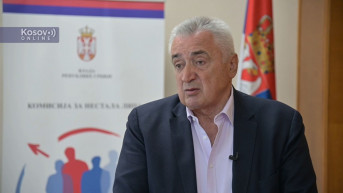
The President of the Commission on Missing Persons of the Government of Serbia, Veljko Odalovic, told Kosovo Online that Pristina still refuses to check any location suspected of potentially concealing the bodies of missing Serbs, and that fabricated indictments and secret lists are being used to pressure Serbs. He added that he himself has been targeted by “absurd” accusations that he was responsible for the killing of Fehmi Agani, whom he emphasizes was, unlike the KLA, a man who consistently supported dialogue.
Odalovic stresses that Pristina ignores all Serbian requests regarding missing persons because, in his view, resolving their fate would be further proof of the crimes committed against Serbs.
“We have not received a single piece of information from the Pristina side, absolutely none, except for requests to check certain locations in central Serbia where there are alleged relocated graves of Kosovo Albanians. That is something we, I will repeat once again, as responsible people, are doing, but Pristina ignores all our requests. Unfortunately, we cannot even enter the morgue in Pristina, where more than 300 bodies are located, among which, according to our information and estimates, at least one hundred are Serb bodies. Also, the locations we mentioned have not been opened, such as Livad Lake, for which we requested a detailed search after information that Serb bodies were thrown there. It is obvious that Pristina does not want to face the verification of those locations and the possible discovery of bodies, because that would be further proof in a series of crimes committed against Serbs,” Odalovic says.
He adds that the actions of the Pristina authorities resemble what was already seen in Croatia.
“Pristina today uses all kinds of methods. A wide range of tactics is used to pressure and create insecurity among Serbs, and it resembles models already seen in Croatia. This includes trials in absentia, secret indictments, arrests of people who come to administrative crossings to visit their homes, but also direct arrests of people in their homes, where they have continuously lived since 1999. In this way, insecurity is created among Serbs who remained to live in Kosovo and Metohija, but also among those who would like to return,” he says.
He states that Pristina uses such indictments to pressure Serbs, and that accusations against him personally have appeared on social media claiming he was allegedly responsible for the killing of Fehmi Agani.
“Indictments are raised on the principle of so-called command responsibility, without serious and quality evidence. It is enough that someone was present or held a certain position to be placed on a list and for an indictment to be brought against them, even to be tried in absentia. Today there are practically two types of indictments, for terrorism and for war crimes, which Pristina institutions use as a mechanism of pressure. They even mentioned me on social media, accusing me of being responsible for the killing of Fehmi Agani, which deeply affected me, because I knew him personally and considered him one of the more moderate politicians and a pacifist, together with Ibrahim Rugova. He never advocated war or conflicts,” Odalovic says.
He states that over the years he has not changed his views or policies and has no problem looking anyone in the eye.
“If I am responsible for anything, I am ready to appear before any court and answer any question. I know what I have done throughout my life and I have no reason to feel uncomfortable or unable to look anyone in the eye. I tell my Albanian friends that I have remained the same person they knew. I have not changed my views or policies. I am saying the same things I used to say,” Odalovic said.
Regarding Agani himself, he notes that he was a man who sincerely believed in dialogue.
“He participated in many talks with Belgrade. I had the opportunity to meet him during work on the ‘3+3’ education agreement. That day, when we came to the National Library to sign the agreement, I saw that he was a man who sincerely believed in dialogue and in solving problems peacefully. However, someone did not like that and the KLA was activated. The campaigns being conducted against me today are absurd and unacceptable. I have spent my entire life and working career in Kosovo and Metohija, among my neighbors and people who know me, and I cannot accept being portrayed as something I am not. I have never hidden where I worked or what I did. I spent 18 months in Kacanik, among 40,000 Albanians. I made many friends and, as far as I know, not a single enemy. For years I was also in the ‘Pristina’ boxing club, where almost all boxers were Albanians. These are people I am still in contact with today, and I am proud of that. In all the positions I held, I never had a problem with Albanians, nor, as far as I know, did I ever do anything bad to anyone. That is why I do not want to carry a label that has nothing to do with me. If I had been close to any crime, I would certainly have tried to prevent it, regardless of the risk,” he says.
He assesses that the biggest losers of the policy currently led by Albin Kurti will be the Albanians themselves.
“Today, however, such stories are spread through social networks and are used to further raise tensions and create insecurity among people who held certain positions. I remain available to everyone, including my neighbors who today try to link me on social networks to the killing of Fehmi Agani. I also knew Pajazit Nushi, who led the Pristina Working Group on Missing Persons. These were people who thought about the future. When they were removed from public life, we got war, crimes and destruction that we all suffered. The biggest problem is that those who committed the largest number of crimes were never held accountable. It is overlooked that in 1999 and 2004 there were two pogroms against Serbs in the presence of the international community. People were expelled from their homes who had done nothing to anyone. The policy currently pursued by Albin Kurti destroys all bridges and eliminates any possibility of a future. The biggest losers of such a policy will be the Albanians themselves, whether they are aware of it or not. Destroying relations with Serbs, with the Serb community and with people who were expelled from Kosovo and Metohija leads only to further destabilization,” he states.
Commenting on the work of the Joint Working Group on Missing Persons, he notes that there has unfortunately been no progress.
“Unfortunately, there are no results. There may be some progress in the Joint Commission in Brussels and in the attempt by the chair of that part of the joint commission to delegate certain topics that Belgrade and Pristina would agree on to the Joint Commission, so to speak, which could help us. We agreed that the first priority would be support in searching international archives, because we believe that they contain a large number of potential documents that could clarify circumstances, facts, and the fate of a number of missing persons. That is something to which we have made a major contribution,” the President of the Commission on Missing Persons says.
He adds that Pristina shows no willingness, which is one of the reasons why the Working Group meeting scheduled for March 11 in Pristina did not take place.
“We are actively participating, we have concrete proposals and initiatives, unlike Pristina, which unfortunately shows no willingness, nor anything beyond formal participation last time that could encourage the families of Albanians, Serbs and all others who are waiting for the results of our work. When it comes to the Working Group, it is unfortunately blocked. The session was supposed to be held on March 11 in Pristina, according to a previously agreed and harmonized agenda. However, I was again not allowed to enter Kosovo and Metohija, as the head of the Working Group, and such a meeting without the leadership is completely meaningless. I hope that the International Committee of the Red Cross will have the strength, together with the European Commission, to enable the continuation of this mechanism, so that at the Working Group we can consider all topics important to families, exchange information provided by families, and have concrete answers to the tasks set before us,” Odalovic concludes.
0 comments