
Odalovic: Pristina, as well as Zagreb, obstructs the resolution of the issue of the missing Serbs in every way
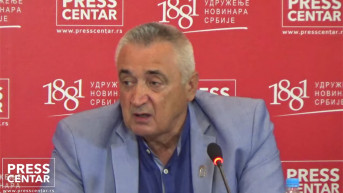
The President of the Commission for Missing Persons, Veljko Odalovic, said today, at the conference on the occasion of the International Day of the Disappeared, that Pristina, as well as Zagreb, were not interested in the Serbian victims of the conflict and work according to the same model, in order to obstruct the resolution of the issue of the missing Serbs in every way.
Odalovic said at the meeting held at the IJAS Press Center in Belgrade that a year since the last conference, on the International Day of the Disappeared, he could not boast of the results and that during that time there had only been three identifications of the missing persons on the territory of Bosnia and Herzegovina, which, as he said, indicated that the process of solving the issue of missing persons was at a critical stage.
He assesses that it is only the lack of political will of the authorities in the region, which have obligations to international agreements, especially Zagreb and Pristina, that the process takes place in a civilized and humane manner.
"Serbian victims are not talked about, they are not mentioned in Zagreb, or in Kosovo, as we can see from the statements of Albin Kuri, and Serbian victims are marginalized in Bosnia and Herzegovina as well. We have the legitimate right that wherever any victim was killed, died, or buried, to work on it. In the area of Kosovo and Metohija, they don't want to deal with it; Kurti and the authorities in Zagreb simply don't want to deal with it," Odalovic said.
He stated that there had been 980 identifications in the last 20 years concerning the Serbian victims and Serbian search lists in Croatia and in the last five years only 35, which, he emphasizes, is only seven a year on average.
On the other hand, he points out that there were a total of 382 identifications in Kosovo, and only 30 of them in the last ten years.
"It only speaks of the removal of those that need to be done and which is an obligation. And during that time, Serbia faced displaced graves, and every location that was shown was checked and investigated; where we found the remains, we performed exhumation and handed over families. We have faced that problem responsibly as a responsible state, and I only ask that the others have the same approach," Odalovic said.
According to his words, 481 bodies sailed down the Sava and Danube rivers to Serbia, and each one was exhumed by Serbian competent authorities in the presence of representatives of the Croatian and Bosnian commissions.
Odalovic points out that the morgues in Croatia are full and that there are more than 950 bodies, of which at least 400 are Serb bodies, while there are more than 350 bodies in the morgue in Pristina, of which at least 80 are Serb bodies.
"We don't have access to any morgue, but we have a blockade by Pristina of the entire process in Brussels when this process was approached in good faith and with the intention to gain strength in Brussels. There we experienced a total blockade and the agreed Declaration was the light that we shared with you and we believed that it would be acted upon. We had three meetings after that in Brussels where Pristina would not discuss the joint plan, activities, and commission to continue working as written in the Declaration," Odalovic said.
No one is dealing with the Brussels and Washington Agreements, says Odalovic, emphasizing that it is the lack of will of the international community to resist Albin Kurti or "some other Albin Kurti".
Odalovic points out that the issue of the missing is a question that the authorities in Pristina and the international community remember today or when it is necessary to use that issue as pressure on Serbia.
"We ask that our colleagues call us when they carry out actions, as we do; these are commitments that the states have taken. To have a relationship as written, we have signed commitments. This issue will either begin to be resolved or it will be lost," Odaloviv warns, stressing that the courts and prosecutions in the region must be involved in the issue of the missing.
He reminded that the Deputy Prime Minister of Kosovo, Besnik Bislimi, had stated that Pristina would not open graves with Serb victims because it would be evidence of their crimes.
On the other hand, he explains that the process of solving the issue of the missing in Croatia is blocking "their request for some kind of information that they assume we have", although, as he says, Serbia has searched everything it could and searched the archives.
"The Croatian model is now being applied by Pristina as well. Since Croatia is obstructing the entire process, they are now doing the same in Pristina, whether they are their advisers or mentors, I have no idea what they are doing, but the situation is mostly the same," Odalovic said.


0 comments