
Orav: The EU wants healthcare and education structures to continue, their status to be resolved through dialogue
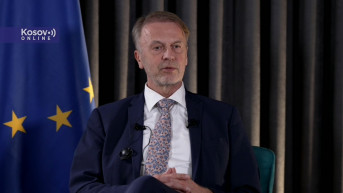
The outgoing EU Ambassador to Kosovo, Aivo Orav, stated in a farewell interview with a group of Serbian-language media outlets that March 14 could go down in history as an important date in relations between the Government and the European Union. However, he warned that the key challenge remains the implementation of the agreement, stressing that the Serbian community must be closely consulted throughout the process. Orav also spoke about the Law on Foreigners, the future of the University in North Mitrovica, dialogue, trust, and the reasons why both Serbs and Albanians are leaving Kosovo.
“I hope that March 14 will enter Kosovo’s history, because I believe it represents a peak achievement—the agreement between the Government and the European Union. I have seen public reactions, and it appears that everyone is satisfied with this agreement. Above all, the Government is satisfied. We have also heard that the Serbian community, if not the happiest, at least accepts this agreement. I consider it a good agreement for Kosovo and a significant success,” Orav said.
He emphasized that the question of implementation always remains.
“Let us see how things will develop. These are only the first days and weeks. The EU Special Representative, Mr. Sorensen, mentioned Prime Minister Kurti’s plans regarding the integration of parallel structures in healthcare and education. He also stressed that there should be no disruption in the provision of these services and that, if at any point changes begin, time will be needed and the local Serbian community must be consulted—in very close cooperation with the EU Special Representative and within the framework of the dialogue,” he stated.
Taking into account all agreements previously reached during the dialogue, he assessed that this arrangement represents a consensus among those involved in the process.
“If there is something that has already been agreed upon, it should be taken into account, but I cannot go into details,” the outgoing EU ambassador added.
Without a Signed Agreement
He pointed out that agreements can be achieved in various ways.
“When we say ‘agreement,’ people often imagine several individuals sitting at a table, reviewing documents, and ultimately signing them. However, agreements can be reached in different ways. In this case, nothing was put in writing. Prime Minister Kurti spoke about what had previously been agreed, and Mr. Sorensen also referred to prior understandings,” Orav explained.
Expert Group
The outgoing EU ambassador said that after the second postponement of the full implementation of the Law on Foreigners on January 15, an expert group met regularly. The group included experts from the Kosovo Government and from the embassies of the Quint countries.
“In the meantime, two meetings were also held between Prime Minister Kurti and ambassadors accredited in Kosovo, where the process was reviewed and further steps discussed. This was an agreement between the European Union and the Government of Kosovo. The working group included representatives of the Government of Kosovo and Quint embassies. This is a Kosovo law, and we are dealing with its implementation. The European Union does not approach this from a top-down position, instructing someone how to implement the law. The laws have been adopted and must be implemented—that is the point. The outcome of this agreement is that the Government of Kosovo now has the possibility to fully implement this law,” he stated.
He noted that certain challenges and issues requiring additional steps had been identified.
“For example, Serbian ID cards should be accepted for the registration of certain civil statuses, such as marriage. It is expected that there will be no obstruction or disruption in the functioning of healthcare and education. Serbia will also work on this. Another important issue is residence permits. It is expected that the Kosovo Government will receive a list of individuals working in these institutions in order to create the technical conditions for issuing residence permits. In the meantime, Peter Sorensen, the EU Special Representative for dialogue, has spoken with representatives in Belgrade. I have personally been in contact with political leaders of the Kosovo Serbs and informed them about what the Kosovo Government concluded on March 14,” he said.
Implementation Mechanisms
Orav emphasized that there have been ups and downs in interactions between Kosovo and the European Union, but that trust remains key.
“The most important mechanism is trust. There have been ups and downs in relations between Kosovo and the EU, but as an EU representative, I can say that I feel trust and confidence both in the Government of Kosovo and in the Serbian community and its leaders. If there is commitment and if promises have been made, I believe there is an intention to implement them in good faith. I would not speculate on what will happen if obligations are not fulfilled. We will see. But I strongly hope that all parties involved will implement this law and work toward a better, multiethnic Kosovo,” he said.
He added that the agreement on the Law on Foreigners is a positive step, but that individuals must first apply for residence and work permits.
“This is a positive step, but people must apply for residence and work permits. This will be done based on a list submitted to the Kosovo Government. At the moment, such a list does not exist. I would like to encourage all those responsible to submit it. The list is being compiled as agreed, the process goes through my office, and then we forward it to the Government. This agreement does not cover every individual case in detail, as it primarily concerns the full implementation of the Law on Foreigners, along with two additional steps: recognition of ID cards and residence permits for students and employees in education,” he noted.
University in North Mitrovica
Commenting on the situation regarding the university in North Mitrovica, Orav said that the University of Pristina cannot decide its fate.
“As for the university, there is a letter that has been sent, but a letter is not a decision. There is a legal procedure, and we will see how things develop. The University of Pristina is not the body that can decide what will happen with the University in Mitrovica. If there were an official decision, that would be a different matter, but again, there is none. As for healthcare and education, that is a matter for my colleague Mr. Sorensen. When he spoke about the integration of education, he emphasized that it will take time, that there must be no disruption, and that consultations with the local Serbian community are necessary, within the dialogue,” he stated.
Who Guarantees Implementation?
Asked who will guarantee implementation, Orav said it is important that the Government provides all conditions for the process, alongside a monitoring mechanism.
“The guarantee lies in what Prime Minister Kurti and EU representatives have publicly stated—this was said on camera. There is a three-month deadline, which some may consider insufficient. It is important that the Government provides all necessary conditions. There is also a monitoring mechanism. Within my team, there is a unit for freedom of movement, ready to monitor developments. In the past, people sometimes received no response or were rejected without explanation when applying for documents. Now it is clearly stated that there must be a written record—every request must receive a response, and every rejection must be explained. We expect more efficient administration, although bureaucracy always requires patience. If something goes wrong, we hope it can be corrected and that the process will proceed smoothly,” he said.
Community of Serb-majority Municipalities
Speaking about the establishment of the Community of Serb-majority Municipalities, he stated that the EU cannot wait indefinitely.
“The Community has not disappeared. It may be discussed less now, but it remains an obligation undertaken by the Government of Kosovo. The question is how it will be implemented in practice. The EU has long held the position that the statute should be sent to the Constitutional Court, but this has not happened. We cannot wait forever. Practical solutions must be found through dialogue. I do not know the details; that is a matter for Mr. Sorensen,” he said.
To Be Resolved Through Dialogue
He added that the EU wants healthcare and education structures to continue, but their status must be resolved through dialogue.
“The European Union wants healthcare and education structures to continue operating, but their status must be resolved through dialogue. These are complex issues requiring time, analysis, and discussions among various stakeholders. There are no quick solutions. What matters is direct communication and resolving issues through cooperation. The EU is ready to assist, but the key role lies with local institutions and communities,” he stressed.
Direct Communication
He underlined the need for direct communication between the Serbian community and the Government.
“Minister Krasniqi invited Serbian mayors to a meeting, and it was not easy for them to attend. We, as diplomats, worked hard on this. The mayors showed courage and determination by participating. The Government must earn the trust of the Serbian community. We cannot solve all the world’s problems, nor those of Kosovo. What is important is to maintain direct communication and address issues directly. I strongly encourage both the Kosovo Government and the mayors to continue their contacts,” he said.
Lifting of EU Measures
Commenting on the lifting of EU measures, Orav described it as the right decision.
“If 27 member states decided to lift the measures, they believe the Government of Kosovo deserved it. If I were to say otherwise, I would be going against all 27 countries. It was the correct decision. Even sanctions against Russia and Belarus are reviewed every six months,” he said.
He noted that the situation with Kosovo had been exceptional.
“We needed consensus to lift the measures, and I have never seen such a case with other countries. There were local elections, inclusive and democratic; Serbs took over municipal buildings from which the police had been withdrawn.
There are always problems, perhaps something was overlooked, but the financial measures were lifted and that was the right decision. We are ready to turn a new page with Kosovo. The measures are lifted—full stop. Reintroducing them would again require consensus, which is very difficult,” he said.
Both Serbs and Albanians Are Leaving Kosovo
He pointed out that both Serbs and Albanians are leaving Kosovo, underscoring the need for a clear European perspective.
“When Kosovo gained independence, it was clear that this is a multiethnic society. I know that many Serbs are leaving, but many Albanians as well, for different reasons. That is why it is important for Kosovo to have a clear vision and opportunities to move toward the EU. After the March 14 meeting, I believe there is greater willingness within the Government to move in that direction. The President has not yet been elected, and there may be early elections. The Prime Minister is under pressure and criticism from the opposition. I have also heard positive statements from President Vučić regarding this agreement, and he is under pressure as well. I have the impression that the Serbian community wants to move forward. There is an opportunity for the Western Balkan countries to progress. Considering global developments, it is important to bring them closer to the EU,” he said.
Question for Serbs, Not the EU
Asked why, apart from North Mitrovica, there are no Serbs in urban areas in Kosovo after 1999, Orav said this is not a question for the EU.
“I believe this is more a question for the Serbs themselves than for the EU. If there is a desire to live elsewhere, the initiative must come from them. In the past 19 months, this issue has never come to my desk, and I do not see how the EU should address it,” he said.
EU Supports Constitutional Court Decisions
He also commented on Constitutional Court decisions, often criticized in public discourse.“The EU’s position is clear: if the court has made a decision, it must be implemented. Full stop,” Orav stated.

comments