
Osmani on dialogue and the CSM: Signature of the US President is more important than Serbia's
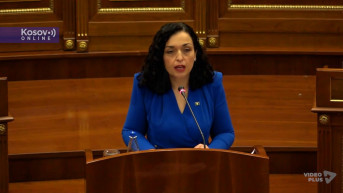
In her annual address to the Kosovo Assembly, President Vjosa Osmani discussed the dialogue between Belgrade and Pristina, stating that if Serbia does not fulfill its obligations, Kosovo will proceed with its part of the agreement under guarantees for NATO membership. She emphasized that negotiations regarding the Community of Serb Municipalities (CSM) should be conducted with the U.S., rather than being left to EU envoy Miroslav Lajcak or "bureaucrats from countries that do not recognize Kosovo."
Osmani pointed out that over a year after the events in Banjska, Serbia has yet to be held accountable, according to Reporteri.
"Dialogue with Serbia, under EU leadership, has unfortunately been entirely unbalanced, with Kosovo being unfairly treated and continuous concessions made to Serbia. The fact that Serbia, the aggressor state, faces no measures, while the victim does, is the clearest evidence of this imbalance. This approach must change for those who genuinely seek long-term peace and stability in the region. However, this does not mean we should not also consider how to improve the situation," Osmani stated.
On the topic of the CSM, she revealed that when she proposed negotiating this issue with the U.S. rather than leaving it to Slovak EU envoy Miroslav Lajcak, she faced "low-level attacks."
Osmani expressed her distrust of bureaucrats from countries that do not recognize Kosovo, stating that she places her trust in Kosovo and the U.S. She clarified that she never advocated for the establishment of the CSM but proposed that Kosovo should draft a framework that safeguards the constitution, sovereignty, and functionality of the state.
"I regret to say that my proposals to improve this process were met with disinformation and unworthy attacks within Kosovo. To clarify, when I suggested initiating discussions on the CSM framework with the U.S. to avoid leaving this issue to Lajcak or others who do not believe in Kosovo's independence, it never meant I was advocating for the establishment of the CSM. It meant I trusted ourselves and the U.S. more than some bureaucrats from states that do not recognize Kosovo. I believed that a statute protecting our constitution, sovereignty, borders, and state functionality would be better drafted by those with the mandate to protect Kosovo than by foreign experts who have never supported the project of a free and sovereign Kosovo," Osmani said.
She added that her proposal was attacked, with claims that she had sold Kosovo's interests.
Osmani rejected allegations that she advocated for a unilateral agreement, clarifying her position: the implementation of agreements only makes sense if both sides comply, and if one side withdraws, the other is not obligated to proceed.
She further explained her recent statement, emphasizing that if Serbia ultimately fails to implement its part of the agreement, Kosovo should seek written guarantees from allies, ensuring NATO membership and support for further recognitions in return for implementing its own commitments.
"What I said was that the implementation of agreements only makes sense if both parties comply. If one withdraws, the other is not legally obligated to proceed. Furthermore, if it becomes evident that Serbia will not fulfill its obligations, as I strongly believe will happen, we should negotiate with allies about implementing our part in exchange for guarantees, including NATO membership, security guarantees, and support for further recognitions. To be clear: the signature of the U.S. president is more important than Serbia's. I hope this is clear," Osmani declared.
She also called for the strengthening of alliances with Kosovo's partners during her speech.
"In these challenging times globally, where fragmentation and divisions are becoming more apparent, loyalty to constitutional principles should unite us. Today, security is an essential prerequisite for prosperity, economic development, and collective dignity. On this path, the maturity and development of our state are best demonstrated when our policies reflect what is right, not what is politically convenient," Osmani said.
She highlighted Kosovo's progress in global diplomacy, emphasizing its relationship with the U.S. and European partners, and Kosovo's recent participation in summits and organizations, including NATO-related meetings in the U.S.
"No nation has succeeded alone, and no country has thrived in isolation. The importance of maintaining and strengthening alliances is invaluable. History shows that weakening alliances and partnerships is a strategic mistake," she added.
Osmani criticized those who mock or attack allies, asserting that such actions do not honor Kosovo. She reaffirmed the commitment of Kosovo's security and defense institutions to protect territorial integrity in full cooperation with security allies.
The Alliance for the Future of Kosovo boycotted Osmani’s address, and the Democratic Party of Kosovo (DPK) announced it would not attend the session, accusing her of failing to fulfill her constitutional role.
In a statement, the DPK criticized Osmani for failing to secure international recognition or membership in global organizations for Kosovo. They also accused her of remaining silent on EU measures against Kosovo and showing bias towards Prime Minister Albin Kurti.

0 comments