
Parmelin: A solution to Belgrade–Pristina relations lies in dialogue, normalization, and practical progress
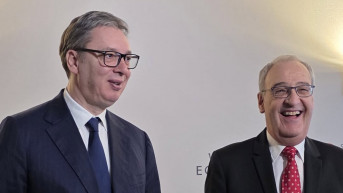
The President of the Swiss Confederation, Guy Parmelin, stated that a solution to relations between Belgrade and Pristina lies in dialogue, normalization, and practical progress that improves the daily lives of people on both sides.
Ahead of his visit to Belgrade, Parmelin said in an interview with Blic that Switzerland, regarding the dialogue between Kosovo and Serbia, offers an informal joint mediation process.
“Switzerland’s long-standing position is that the solution lies in dialogue, normalization and practical progress that improves everyday life for people on both sides. To support the EU-facilitated dialogue process, my country offers both sides an informal joint mediation process. By creating such opportunities for dialogue, Switzerland can contribute to finding solutions. The stability of this region and European integration are priorities of our foreign policy,” Parmelin said for Blic.
The Swiss president emphasized that KFOR is an important factor of stability, noting that 215 Swiss soldiers are currently deployed in the Swisscoy contingent within the KFOR mission.
“This is our contribution to this joint international effort. The mandate runs until December 31, 2026. The Swiss Federal Council has submitted a request to the Swiss parliament for Swisscoy to remain active in Kosovo until 2029. Parliament will decide soon,” he said.
He added that Switzerland sees Serbia as its most important partner in the Western Balkans and that, during his upcoming visit to Belgrade, he would like to discuss concrete ways to deepen cooperation in areas where both sides see potential, particularly in the economy, skills development, technology and resilience in a changing international environment.
He assessed that relations between the two countries are moving toward closer and more diversified cooperation and that, economically, Serbia is Switzerland’s most important partner in the Western Balkans.
“Between January 2015 and September 2025, Swiss investments in Serbia amounted to 2.3 billion euros. Trade relations have steadily grown over the past five years, making Switzerland one of Serbia’s key economic partners. Last year, trade volume exceeded one billion euros for the first time. In terms of trade in services, Switzerland is Serbia’s fourth-largest partner globally. There is still potential to expand cooperation, particularly in IT, technology-based sectors and renewable energy. Serbia’s startup ecosystem is developing rapidly, and real estate is also a new sector where Swiss investments are currently entering the country. Around 600 Swiss companies are already present in Serbia,” Parmelin said.
He also noted that Expo 2027, for which Switzerland was among the first countries to confirm participation, is an excellent platform to showcase what the two countries can achieve together, adding that he sees strong potential in innovation-driven sectors such as digital services, ICT, advanced industry, green and energy solutions, urban resilience, education and skills, and healthcare innovation.
He stressed that he is impressed by the economic progress achieved in Balkan countries over the past two decades and that promoting strong economic ties is one of the goals of his visit to Serbia and North Macedonia.
“This progress would not have been possible without a certain level of stability. At the same time, this stability is an ongoing process that ultimately depends on mutual goodwill,” Parmelin said.
He also pointed out that the large Serbian diaspora in Switzerland has enriched Swiss society in countless ways through hard work and an entrepreneurial spirit.
“Our diversity is key to our dynamism and resilience. The diaspora connects people, brings entrepreneurial energy, maintains family and cultural ties and helps build mutual understanding,” the Swiss president concluded.
0 comments