
Pavkovic: We can expect a response from European and American officials to Pristina's moves

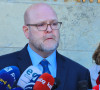
Milos Pavkovic from the Center for European Policy stated to Kosovo Online that the US and the EU were extensively considering how to penalize unilateral actions by Kosovo Prime Minister Albin Kurti regarding the decision of the CBK to abolish transactions in dinars.
He emphasized that Washington and Brussels were deeply disappointed with Kurti's moves, suggesting the possibility of a new package of restrictive measures against Pristina.
"The EU, the Quint states, and the US are dissatisfied with Kurti and his government's behavior due to all the escalations they provoke, so we can expect a response from both Brussels and Washington. We followed James O'Brien's statements last week, where he even questioned the partnership between the US and Kosovo. So, the situation at the moment is alarming in the context of dialogue and the relationship between Belgrade and Pristina, as well as the Kosovo government's relationship with Serbs in the north. It demands a clear political response from the EU and the US, which I expect we will see in the near future. What will it be? For now, we don't have specific indications. We saw that the EU introduced a package of restrictive measures to the government in Pristina back in June last year, which did not positively affect the course of events. Now we can expect perhaps stricter and more concrete sanctions directly against individuals in the Kosovo government. It depends on the mood of the member states, and of course, America," our interlocutor said.
He emphasizes that part of the first package of EU restrictive measures was the suspension of certain funds from pre-accession funds for Kosovo, which indirectly affected the citizens.
"I think the EU will take care not to introduce restrictive measures that will affect the entire population, so the European Commission will look to introduce another package of measures that will affect specific individuals. It is important to mention that the EU recently announced a Growth Plan for the Western Balkans. This is around six billion euros in direct financial aid intended for Kosovo as part of the Western Balkans. The entire fund can be blocked for Kosovo if it does not respect clear criteria that will take into account good neighborly relations and dialogue with Belgrade. This is a form of indirect measures, so the growth plan can be blocked for Kosovo as long as it does not show a willingness to dialogue. The other thing is that the path to EU membership for Pristina can also be conditioned by progress in the dialogue, just as Serbia's path is conditioned by Chapter 35. These are some mechanisms that the EU can use, and there are always additional sanctions that can be much harsher, and they are already part of the dialogue in Brussels and Washington," Pavkovic stated.
He points out that although there are mechanisms, the problem for the EU is the lack of unity in implementing these measures.
"There were examples in the first package of measures, which envisaged a ban on high-level political meetings, where certain EU member states directly violated those measures. This happened with Croatia, Estonia, and even Albania, which directly violated those measures and invited meetings with the highest Kosovo officials, from the Prime Minister to the President. Such actions further diminished the credibility of the EU. The essence is that the European Union cannot act alone in such measures; it must be supported by the US. Only in that case could they yield results," Pavkovic concluded.

0 comments