
Perisic: Kurti wants to abolish Serbian municipalities and call into question the formation of the CSM
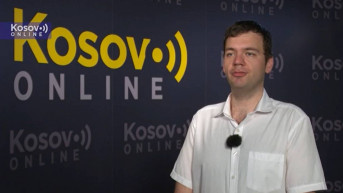
Nikola Perisic from the Center for Social Research assessed that the demolition of garages in North Mitrovica, with the assistance of the Kosovo police, represents a continuation of pressure on the Serbian community and part of what he claims is a broader policy by Pristina aimed at weakening the competences of municipalities with a Serbian majority. Speaking to Kosovo Online, he warned that such moves could further deepen tensions and even jeopardize the dialogue between Belgrade and Pristina.
Perisic points out that the incident in which representatives of the company Trepca South, with police assistance, demolished 23 garages in North Mitrovica reflects the policy of Prime Minister Albin Kurti since he took over the leadership of the Pristina institutions.
“His ultimate goal is increasingly evident in the fact that he essentially seeks to eliminate the existence of Serbian municipalities, that is, municipalities where Serbs are the majority population, and to integrate them in various ways into the so-called Kosovo institutions. It is clear that by doing so, he effectively wants to abandon the Brussels Agreement, which envisaged the Community of Serb Municipalities, that is, a form of autonomy in all those municipalities located in the north of Kosovo, where Serbs make up the majority population,” he said.
He explains that the consequences of all this could be far-reaching, primarily in terms of continued tensions between the Albanian and Serbian populations.
“It is clear that all these incidents and the entire rhetoric that Kurti promotes in his public appearances negatively affect coexistence between the Serbian and Albanian communities, which should be the ultimate goal of various agreements and arrangements we have seen in the past, and it is certain that future conduct of international institutions and organizations, as well as agreements between the Serbian and Albanian sides, should move in that direction,” Perisic said.
Daily obstructions coming from the central level, according to him, could also call into question the Brussels dialogue itself.
“We see that for years things have been at a standstill and are very difficult to move forward, given this kind of approach coming from the Albanian side. Now, in this specific example in Kosovska Mitrovica, we see how it becomes unclear which institution is responsible for what, because, as Serbs from Kosovska Mitrovica pointed out, they correctly recognized that the Kosovo police acted, even though in this specific case it is not within their competence, but should be handled by certain local bodies. This interference by institutions at the central level, if Kosovo can be classified as such, effectively exerts pressure on the local level,” he said.
Perisic believes that such individual incidents could become a pattern in the coming months in order to further provoke instability, which he says is needed by Prime Minister Albin Kurti.
“Keep in mind that the institutions themselves are in a kind of crisis, as we have seen several electoral processes repeated, and there are very pronounced divisions among Albanian political parties in Kosovo, which have resulted in the likely inability to elect a new president. All of this does not work in Kurti’s favor at the moment. That is why certain isolated incidents suit him, as they both divert attention from legal and political problems and attempt to restore his rating, which has declined recently. All of this shows that he needs to react negatively and as sharply as possible toward the Serbian community in order to gain the sympathy of the Albanian population,” he said.
Perisic notes that international actors have the greatest power when it comes to responding to and influencing socio-political developments in Kosovo.
“We have seen over the years how important a proactive role by such organizations is. However, given everything happening at the global level, it seems that the European Union, which is in a way responsible for the Belgrade-Pristina dialogue, as well as other international actors and major world powers, currently lack the capacity and space to deal with developments in Kosovo. Still, all this should serve as a warning to them that if they do not seriously address this issue, there could be an escalation of violence in the coming period, and any kind of conflict on the European continent would not be favorable for major world and European states. Therefore, I hope their approach will change in the coming period and that they will genuinely seek a solution acceptable to both sides to some extent. In the current balance of power, we see a certain level of anarchy that the Albanian side is using to exert additional pressure on the Serbian community,” he said.
In such circumstances, Perisic notes, international actors issue statements and condemnations, but without concrete action.
“My hope is that everything that has happened in the recent period will serve as a warning that the global public must address this issue more seriously and, above all, insist on what was agreed in previous agreements. Here I primarily refer to the Brussels Agreement, which envisaged the Community of Serb Municipalities. That is, the Albanian side must fully implement everything it undertook as an obligation when those agreements were signed. At the same time, a long-term perspective is needed, and now that nearly 13 years have passed, some new solutions in the form of international agreements should be offered to create the necessary conditions for at least a minimum level of respect for human rights that have been violated when it comes to the Serbian population,” he said.
Perisic added that it is completely unacceptable that in the 21st century we are discussing the endangerment of basic rights that are part of everyday life.
“Let us recall the right to healthcare and other rights related to goods, the expression of political views and other fundamental human rights that have been threatened in the previous period. That is why it is necessary to insist on implementing these elements, and only then can we talk about a compromise solution, which is also necessary when it comes to resolving the status of Kosovo,” Perisic concluded.



0 comments