
Petkovic: Victory of the Serb List in the elections is a guarantee for the survival of Serbs; Pristina has long been only simulating dialogue
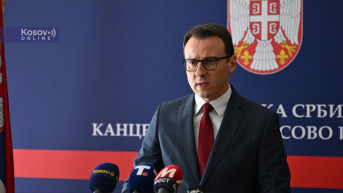
The Director of the Office for Kosovo and Metohija, Petar Petkovic, stated that the Brussels dialogue has become a place where Pristina has long been only simulating negotiations, since its representatives are not interested in agreements or seeking compromise solutions. He stressed that the establishment of the Community of Serb-Majority Municipalities (CSM) is a matter of survival for Serbs in Kosovo. On the upcoming local elections, Petkovic underlined that the Serb List’s victory in all 10 Serb municipalities is of crucial importance and called on the Serbian people to firmly stand behind the party.
“Dialogue in Brussels has long become a place where Pristina only simulates negotiations, as representatives of the Provisional Institutions of Self-Government have no interest in reaching agreements or compromise. If Pristina has been refusing for 12 years to fulfill its primary obligation—the formation of the ASM—it is clear that the regime in Pristina is not ready to meet its commitments from the dialogue,” Petkovic said in an interview for Novosti.
He added that this has become particularly evident since Albin Kurti came to power, openly showing hostility toward dialogue and the normalization process.
“In his chauvinistic politics of hatred, Kurti has gone even further when it comes to Serbs. Through unlawful closure of Serbian institutions, persecution of the Serbian population, and a wide spectrum of institutional violence, the Serbian people under Kurti’s regime have found themselves in the worst situation ever,” he noted.
Petkovic emphasized that, for this reason, the establishment of the ASM is not only about obligations undertaken but also about the survival of Serbs in Kosovo.
“Although we are facing serious problems and challenges regarding our southern province, as a state and as a people we must arm ourselves with patience, since there is no shortcut to the kind of compromise solution that would be in line with our national interests. Our struggle for Kosovo and Metohija is not a 100-meter race, but a marathon. To even think about succeeding in such a race, you need unbreakable inner motivation and determination. That does not mean I believe the question of Kosovo and Metohija should be left for our grandchildren. On the contrary. I believe it is the duty of our generation to resolve it, and I hope that with our own determination and some shifting geopolitical circumstances, it will be possible in the foreseeable future,” Petkovic stated.
Asked whether, given the EU’s weakness in the dialogue, a just and compromise solution is even possible without returning the issue to the international framework with the UN Security Council in the lead role, Petkovic recalled that moving the dialogue from the UN to the EU was the result of a series of unfortunate circumstances and poor decisions by the then DOS government.
He also pointed out that the EU should be neutral on Kosovo’s status, since five of its member states do not recognize it, but that in practice the EU often behaves otherwise.
“Let me remind you that unfortunately, 22 EU member states recognized the unilaterally declared independence of so-called Kosovo, while in the UN we have a majority of non-recognizers in the General Assembly, as well as two permanent Security Council members with veto power who support Serbia in defending its territorial integrity and sovereignty. Serbia’s position today, thanks to President Aleksandar Vucic, is stronger in the UN General Assembly, since 28 member states of this global body have withdrawn their recognition of so-called Kosovo. Since 2011, Belgrade has been negotiating under EU mediation, but many others in the world want to have their say on Kosovo and Metohija, and this fact will have to be taken into account if, at some point, there is a chance for a comprehensive solution in line with UN Security Council Resolution 1244,” Petkovic said.
Looking ahead to the local elections on October 12, Petkovic emphasized that the Serb List’s victory in all 10 Serb municipalities is of decisive importance for the survival of Serbs.
“Yesterday, the election campaign for the local elections in Kosovo and Metohija officially began, and the Serb List symbolically marked the start by launching a digital clock counting down to the removal of Kurti’s gauleiters from the Serb municipalities in northern Kosovo. A victory of the Serb List in all 10 Serb-majority municipalities is crucial for the survival of Serbs, and our people understand well that only the Serb List’s mayors can ensure survival and further development. To continue all important projects in the interest of the Serbian people, it is necessary to demonstrate full unity and solidarity through a strong and convincing victory of the Serb List,” Petkovic said.
He noted that Kurti’s relentless attempts to suppress the Serb List demonstrate who is truly fighting wholeheartedly for the interests of the Serbian people. For this reason, Petkovic added, official Belgrade “with all its strength” supports the Serb List in the upcoming elections as the only legitimate representative of the Serbian people in Kosovo.
“the Serb List has shown exceptional political resilience, and the test of time has proven its full loyalty to the Serbian people and its interests and values. One could write a book about all of Kurti’s attempts to harm the Serb List. That is why my message to the Serbian people is to stand firmly behind the Serb List, which is like a political oak tree that no winds or storms can uproot,” Petkovic said.
He reiterated that the goal of all Kurti’s attacks is to expel Serbs or subjugate them to Pristina.
“Kurti has developed an inferiority complex because during the war of 1998–1999 he was unable to fight Serbia and the Serbian people with weapons. That is why he constantly feels the need to prove himself as a faithful fighter for so-called independent ‘Kosovo,’ and his obsessive ambition is to complete the Albanian separatist project in Kosovo and Metohija. This is, in a sense, a policy of continuity, but the means Kurti uses show that we are facing a dangerous combination of a long-standing ideology of hatred and a whole series of personal pathological motivations,” Petkovic warned.
Asked how firm the guarantees are that Serbs will be able to participate freely in the electoral process, he replied that with Kurti in power in Pristina there are none, since he has consistently worked for years on undermining the political rights and capacity of the Serbian people in Kosovo. Therefore, it should not be expected that he will act differently in the future, especially now when he is fighting for his political survival.
“the Serb List has entered the campaign ready and is marching confidently toward election day, despite all the problems it faces from Kurti’s regime,” Petkovic added.
Asked whether Pristina’s ongoing seizures of Serbian enterprises and property in Kosovo can be stopped, Petkovic reminded that this issue has been present since 2000, but that Serbia is doing everything it can to help the Serbs.
“As a state, together with our representatives on the ground, we are doing everything to help our people, whose right to work and many other rights have been denied by Pristina’s unilateral and unlawful actions. No worker has been, nor will be, left without their entitlements, which are paid directly by Serbia, and they are paid on time. In addition, 5,000 of our most socially vulnerable unemployed Serbs from Kosovo and Metohija already receive monthly financial aid from Serbia in the amount of 20,000 dinars, and starting in October, another 5,000 will be included in this program. These are concrete, tangible measures of support to ensure that our people remain and survive in their ancestral homes. In healthcare alone, we have opened more than 1,500 jobs in recent years, as well as in other fields wherever possible, and we will continue with financial aid packages and the creation of new jobs in the future,” Petkovic listed.
He noted that the political situation is such that only the international community, namely the states with the greatest influence in Pristina, can stop “Kurti’s rampage.”
“On the other hand, thanks to President Vucic and Serbia’s economic stability, we are able to help our people more than ever before, which is why today we have the strongest financial support measures,” Petkovic said.
Asked what Pristina’s accelerated armament and creation of a so-called Kosovo army—contrary to agreements and UN Security Council Resolution 1244—as well as its military pacts with Tirana and Zagreb, means for the security of Serbs and peace in the region, Petkovic responded that “this dangerous and unlawful armament of Pristina and the creation of odd regional military alliances” can only be interpreted as a threat to Serbia and the Serbian people.
He stressed that the region needs more cooperation and confidence-building if it is to reduce the gap with the more developed parts of Europe—not mere rhetoric, but something that President Vucic and the Serbian Government have already been working on in very concrete ways.
“Yet we witness a kind of absurdity: when Serbia calls for regional cooperation, some in the region react as if it were an alarm, and even greater panic seems to be provoked when Serbia steps out of the imposed role of ‘villain.’ In such circumstances, certain factors bring up Kosovo and Metohija as the soft underbelly where Serbia must be struck to diminish its development ambitions. The dangerous and unlawful armament of Pristina and the creation of odd regional military alliances cannot be interpreted as anything but a threat to Serbia and the Serbian people. This is certainly not a comfortable situation, but it will serve as a call for stronger internal cohesion and even more determined work toward building a progressive and prosperous Serbia,” Petkovic concluded, adding that part of that progress will also be displayed at the military parade in Belgrade on September 20.

0 comments