
Raska–Prizren Diocese: The call to demolish the Christ the Saviour Church constitutes hate speech
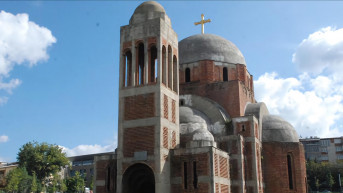
The Raska–Prizren Diocese has expressed deep concern and condemned attorney Tomë Gashi’s call for the demolition of the Christ the Saviour Church in Pristina.
The Diocese states that Gashi’s remark “is not merely an opinion on urban planning, but constitutes a direct call for the destruction of a religious site and, as such, represents a grave form of hate speech and incitement to hostility against the Serbian Orthodox Church (SOC) as a historic religious community and its spiritual and cultural heritage in Kosovo and Metohija.”
“The Christ the Saviour Church in the center of Pristina is the cathedral church of the SOC. Its construction began in the 1990s and was halted by the armed conflict in 1999. Since then, this holy site has become one of the most frequently attacked religious buildings in Europe. Immediately after the war, an attempt was made to demolish it with explosives, which fortunately failed. The church has since been repeatedly set on fire, desecrated, covered in graffiti, and misused as a public toilet or as a venue for inappropriate music video recordings. Religious services have repeatedly been banned or obstructed by the authorities, while clergy and believers have on numerous occasions been prevented from freely celebrating the Holy Liturgy, even on major feast days and despite clear pastoral need,” the Diocese’s statement reads.
The statement further emphasizes that the Diocese has previously noted that both the Christ the Saviour Church and the land on which it stands are duly registered as property of the SOC in the cadastral and land registry books.
“There is no legally binding court decision annulling the Church’s property rights, nor any ruling declaring the church an illegal structure. On the contrary, existing court decisions recognize the SOC as the lawful user of this land until all proceedings are finalized. In this light, the claim that the church is ‘on someone else’s land’ is not only untrue but dangerous, as it serves to morally justify calls for demolition and thus legitimizes the idea that a religious community may be denied the right to worship through the physical destruction of its holy site.”
The Diocese stresses that Gashi’s call for demolition is not an isolated incident but reflects a broader atmosphere of ethnic hostility present in parts of Kosovo’s public discourse and media.
“In recent years, certain public figures—including some historians and commentators—have openly advocated for the demolition or ‘repurposing’ of the Christ the Saviour Church, portraying it as a ‘violent’ or ‘illegitimate’ structure and denying its character as a place of worship. These repeated public calls have been accompanied and encouraged by concrete attacks, desecrations, and institutional obstructions. The latest statement by Mr Gashi therefore represents a further radicalization of the long-standing narrative that denies the legitimacy of the Serbian Orthodox Church’s presence in the very center of Pristina.
This pattern of public rhetoric fully confirms the findings of the latest report on monitoring hate speech in the media space of Kosovo and Metohija for the period April–June 2025, prepared by the Association of Journalists of Kosovo with UN support. That report documents the regular use of ethnically and religiously charged rhetoric in both Albanian and Serbian media to normalize exclusionary narratives, demonize communities, and portray certain groups as obstacles to ‘majority interests.’ It highlights that while explicit calls for violence are relatively rare, emotionally charged language, sweeping historical generalizations, and accusations targeting ethnic and religious identity have a widespread and destructive impact on democratic dialogue and social cohesion. The report identifies ‘negative acts,’ ‘exclusionary rhetoric,’ and ‘demonization or dehumanization’ as forms of speech that go beyond legitimate criticism and aim to present a community as illegitimate and unwelcome in public space,” the Diocese stated.
Gashi’s Call for Demolition Is Not Innocent Rhetoric
“Mr Gashi’s demand that a consecrated Orthodox church under construction ‘must be demolished,’ accompanied by the claim that it is supposedly a product of ‘occupation’ and has no right to exist after ‘liberation,’ is a textbook example of such exclusionary rhetoric. Such language communicates a message that, according to this logic, there is no place in Pristina for any visible symbol of the Serbian Orthodox community, and that the very existence of this church represents an ‘injustice’ that must be ‘corrected’ by its removal.
In the sensitive post-conflict context of Kosovo and Metohija—where since 1999 more than 150 Serbian Orthodox churches and monasteries have been destroyed or damaged, and tens of thousands of Serbs expelled from their homes—such calls cannot be viewed as harmless rhetoric or ignored. On the contrary, they directly contribute to a climate in which renewed attacks on religious sites become increasingly likely and more easily ‘justified,’” the statement reads.
Statements Contrary to Fundamental Guarantees of Freedom of Religion
“From the perspective of international human rights standards, such statements are in open contradiction with fundamental guarantees of freedom of religion, protection of cultural heritage, and the principle of non-discrimination. The European Convention on Human Rights, the Framework Convention for the Protection of National Minorities, and UNESCO instruments on safeguarding cultural heritage obligate political authorities to protect religious sites and not to tolerate any incitement that may lead to their destruction.
Kosovo’s own legal and institutional framework—including the competences of the Ombudsperson, the Independent Media Commission, the Press Council of Kosovo, and the Office for Good Governance—has been formally established to prevent hate speech and protect human rights. Yet the repeated public calls for the demolition of the Christ the Saviour Church, now voiced even by a publicly engaged lawyer, reveal how wide the gap remains between normative obligations and actual practice.”
Appeal to Institutions in Kosovo
The Raska–Prizren Diocese therefore issues a strong appeal to institutions in Kosovo, professional bar associations, civil society organizations, and the international community to respond clearly and responsibly to this latest manifestation of hate speech. Silence in the face of such statements would be understood as tacit approval and would further endanger not only the Christ the Saviour Church but also the very principle that all religious communities in Kosovo and Metohija have the right to equal protection, respect, and security.
The Diocese emphasizes that the Christ the Saviour Church in Pristina, as duly registered property and a consecrated place of worship of the SOC, must be protected from any attempt at demolition or seizure, and that the religious freedoms of its clergy and faithful, as well as the preservation of the entire Serbian Orthodox heritage in Kosovo and Metohija, must be unequivocally and effectively guaranteed in law and in practice, the statement concludes.


0 comments