
Simic: Implementation of the Law on Foreigners leads to administrative ethnic cleansing of Serbs in Kosovo
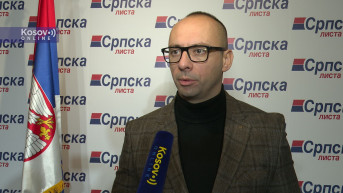
Member of the Presidency of the Serb List Igor Simic stated that the implementation of the existing Law on Foreigners, in the manner announced from March 15, without any amendments, could lead to the ethnic cleansing of Serbs from Kosovo. He added that the Serb List had to once again fight for every one of its guaranteed rights in the parliamentary elections held on December 28.
As Simic points out, as in the previous two electoral processes in February and October, the Serb List began and completed the process by having to fight for every right, including the publication of final results.
“We had the paradox that results were published for all parties, while for the Serb List, which was also part of that single electoral process, the results were not published, but the court had to do so instead of the Central Election Commission, once again showing that this is no longer an independent institution conducting elections, but a political body attempting to prevent Serbs from exercising their right to choose their political representatives in Kosovo institutions,” Simic told Tanjug TV.
He explained that complaints over manipulation during the counting of votes in the parliamentary elections were filed by Albanian parties, whose candidates were “stealing votes from one another” and adding votes to themselves.
“To explain to the wider public, in Kosovo and Metohija, the electoral system allows direct voting for candidates, so-called open lists, and candidates from Albanian parties were taking votes from one another and adding them to themselves in order to enter parliament, that is, to obtain a mandate. This is now being handled as a case before the Supreme Court, and it is expected that in the coming days this process will be completed and the final results proclaimed,” Simic said.
Simic describes the implementation of the Law on Foreigners, which begins on March 15, as administrative ethnic cleansing in the literal sense.
“In the north of Kosovo and Metohija alone, more than 7,000 people cannot obtain Kosovo documents. In other words, more than 7,000 people in Kosovo, primarily in the four northern municipalities, will not be able to live in their homes with their families and children. A similar situation exists in the south as well. Citizens in central Serbia must know that if this law is implemented in this form from March 15, around 10,000 women, children, and men living in Kosovo, who were born here and whose children were born here, will be stopped at the administrative crossings of Merdare, Jarinje, and Brnjak and will be prevented from reaching their homes in central Kosovo, in the north, in Metohija, and in the Pomoravlje region. In other words, what extremists failed to do with weapons for 27 years and expel the Serbs who remained, Kurti has decided to do by implementing this law, with the clear goal of expelling Serbs, but also paralyzing our educational and health institutions and preventing their normal functioning, that is, denying Serbs the right to education and health care,” Simic emphasized.
This law, Simic believes, aims to persecute Serbs, because, on the one hand, obtaining Kosovo documents is made impossible in various ways, and on the other hand, internally displaced persons, as well as Serbs from central Serbia, are prevented from freely coming to Kosovo.
“They will ask you where you are going. If you say you are going to see a doctor, they will say that the doctor is illegal because he does not have a Kosovo license, and they will prevent you from entering. If you say you want to visit Serbian monasteries, they will tell you that the Serbian Orthodox Church is not officially registered in Kosovo and that you are visiting illegal monasteries. And please do not fall for Pristina’s propaganda that everything is perfect and that they have opened some information centers. They held an information session on the implementation of these laws by gathering only Albanians, Albanian officials. The entire process and dialogue were conducted in Albanian, all documents were in Albanian, with the Albanian state flag in the room,” Simic explained.
Simic stresses that since it became known that these laws would be implemented, the Serb List has held 49 meetings with international representatives, from ambassadors present in Kosovo to representatives from Brussels, Washington, and other centers of Western Europe, as well as with members of KFOR and NATO.
“What we managed to do was to clearly explain what is at stake and what Kurti is doing. A good number of them acknowledge this, and some even say publicly: ‘When we came here, for us it seemed normal that certain laws were being applied, and then we realized that they prevent you from obtaining documents that allow you to live here, that they prevent the normal functioning of health and educational institutions, because they want to shut down Serbian schools and hospitals.’ That is the plan. Today, they will ban a doctor from Nis from coming to operate on a child in Gracanica, Gnjilane, Pasjane, or Kosovska Mitrovica, demanding a license. After some time, they will enter schools and ask under which curriculum teaching is conducted, harass teachers, professors, and doctors. Without health care and education, there is no life for Serbs in Kosovo and Metohija. That is ethnic cleansing without a single shot fired. You do not need to send 5,000 heavily armed special forces members, it is enough to send 50 and punish a doctor for operating on a child,” Simic said.
According to him, through communication with citizens and via local and municipal boards, the Serb List has obtained concrete data, including the names and surnames of people who cannot obtain Kosovo documents.
“We are not saying that Serbs are enthusiastic, but they understand that this is a necessity in order to survive. There are situations where the father and mother have Kosovo documents, but their child cannot obtain them. There are cases where anyone born outside Kosovo and Metohija, because they happened to be in Belgrade or Novi Sad due to complications during childbirth, cannot obtain Kosovo documents. When you try to obtain temporary documents, they ask where you work and where you receive your salary from. If you say it is a Serbian institution, social assistance, or a scholarship from central Serbia, they say it is illegal. If you submit a marriage certificate from Serbia, they say they do not recognize it and demand a certificate of single marital status, which you cannot obtain unless you get divorced. These are the reasons they use,” Simic said.
In conclusion, Simic warned that the implementation of the law in this form could lead to the ethnic cleansing of Serbs.
“In a very perfidious way, they have found a means to eliminate Serbs, reduce them to the level of a statistical error, and ensure that schools, kindergartens, universities, and health institutions do not function in Kosovo and Metohija, institutions on which life literally depends. I remind you that the three pillars on which the Serbian people in Kosovo and Metohija rest and survive are education, health care, and the Serbian Orthodox Church,” Simic concluded.

0 comments