
Stano: EU institutions are starting with Belgrade and Pristina to implement the agreement from Ohrid
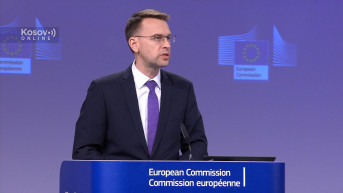
In the coming days, the institutions of the European Union, with the support of EU leaders, would take the first steps towards the implementation of the Ohrid Agreement together with Kosovo and Serbia, European Commission spokesperson, Peter Stano, told the Beta News Agency in Brussels.
The spokesperson of the High EU Representative, Borrell, explained that Belgrade and Pristina were contractually obliged to implement the Ohrid agreement and the annex and made it clear that if they did not do so, then they were abandoning the path to the European Union.
Stano reminded that Borrell had stated that he would "advise the two parties in carrying out their work" in the implementation of the Agreement on the path to the normalization of relations between Kosovo and Serbia, including the implementation annex.
The European Commission spokesperson underlined that "the international reputation and trust in Kosovo and Serbia will now be at stake, so they should show themselves as trustworthy partners for the EU and therefore it is necessary to implement what they promised".
He pointed out that the provisions of the agreement and the annex would be incorporated into Chapter 35 of the EU-Serbia negotiations on membership and the program of the EU Special Group on normalization with Kosovo.
"This means", he made it known, "that the two parties will be contractually obliged to implement those provisions if they want to progress towards the EU, and non-implementation means abandoning the path towards the European Union".
Stano pointed out that Borrell had informed the EU leaders about the talks in Ohrid last week and said that Kosovo and Serbia now had to put into practice what they had reached an agreement on.
And, as he pointed out, "Borrell showed again that any speculations about the signing or validity of the Ohrid agreement are worthless, and everything that has happened in the dialogue so far has proven that the importance of the agreement is measured by the degree of its implementation, not by the signature."
The High EU Representative, Stano pointed out, "made it very clear that the Ohrid agreement had been finalized, that it had to be implemented, and that there was no room for choosing what was wanted and what was not."
Borrell's media representative stated that last Thursday the EU leaders had called on Kosovo and Serbia to quickly and in good faith fulfill their obligations undertaken at the meeting in Ohrid and emphasized that "Kosovo and Serbia have fully committed to implementing all the items of the agreement and the annex".
Beta News Agency asked Stano to say what the EU Special Envoy Miroslav Lajcak had meant, who stated that "we need to focus and start with the issues that Serbia and Kosovo can do and that they can do immediately."
Borrell's spokesperson replied that "both sides know very well what they need to agree on and implement because they expressly accepted it in the Ohrid agreement and the EU will certainly help them, but it is not the EU that will propose specific solutions, while the obligations have been clearly undertaken".
"And both sides know," he added, "that there will be very unfavorable consequences if this is not done, because it is part of the agreement, just as there will be very favorable consequences if the agreement is implemented."
Borrell told reporters that "in the annex to the agreement, it was clearly stated that Kosovo undertook to immediately commit to the establishment of the Association/Community of Serb-majority Municipalities", the Belgrade negotiation team drafted a proposal for the status of the CSM, but whether Pristina is doing anything to that end, the question of Beta News Agency followed.
Stano replied that the Kosovo side was very well acquainted with how to reach an agreement, a solution for the Community/Association of Serb-majority Municipalities.
And, as he specified, "The EU has presented it completely clear in the Ohrid Agreement and the annex, and it is the two parties that must implement it." The EU had provided a platform for dialogue, and everything had to be implemented within that framework."
"If the Serb List thinks that it should not go to the elections, that is its matter"
Beta News Agency asked diplomatic sources in the EU to explain whether the fact that the leading political force of the Serbs in Kosovo, the Serb List, had refused to participate in the scheduled local elections, was seen as a problem for the first steps towards the formation of the CSM, demanding that the CSM be formed and the Special Police Forces of Pristina be withdrawn from the north of Kosovo.
Diplomats in the EU replied that "the EU regrets that the Serb List did not use its democratic right to participate in the municipal elections", but they also noted that it had been "an internal matter, obviously political, of the Kosovo Serbs themselves, a question of democratic determinations and actions".
"If the Serb List believes that it should not go to the election, that is their internal matter, but the obligations from the Ohrid Agreement remain, they must be implemented by agreement," it was said.
Diplomats in Brussels were asked to refer to Borrell's statement that "it is Kosovo's obligation to establish specific solutions and guarantees in order to guarantee a valid level for the self-government of the Serbian community in Kosovo", i.e. what principles had been established, and whether the CSM would have any executive powers.
The answer was that "it must definitely be resolved through dialogue because all open issues must be discussed and solutions found for them. Pristina and Belgrade will get there, and the EU will help them in everything".
To Beta's remark that Pristina and Belgrade in Ohrid also committed to solving the problem of missing persons, not to mention the very painful issue of around 200,000 exiled, refugee Serbs from Kosovo and their property, diplomatic sources in Brussels retorted that "everything that is an open problem, and the two sides put it on the dialogue table, must be solved, even though it is not explicitly stated in the Ohrid agreement."
It is because, they concluded, only solutions to all open issues would give the final desired outcome, which was the normalization of relations between the two parties.



0 comments