
Starovic: Rise of Antisemitism in Europe, Serbia supports institutions preserving Holocaust Memory
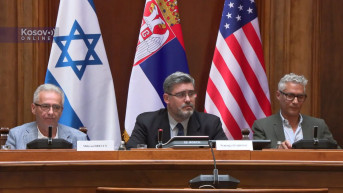
Serbia’s Minister for European Integration and Head of the Serbian Delegation to the International Holocaust Remembrance Alliance (IHRA), Nemanja Starovic, highlighted today the growing antisemitism in Europe, emphasizing that the Jewish community in Serbia is not under threat and that the country provides unequivocal support to all institutions and organizations that globally preserve the memory of the Holocaust.
Speaking at a panel on combating antisemitism during the conference “Belgrade Strategic Dialogue – Partnership of Serbia, Israel, and the USA,” Starovic stressed that one cannot remain deaf and mute to what is happening in the region, noting that neo-Nazi sentiments and positions have metastasized to the point of normalization—referring to a recent concert by Marko Perkovic Thompson in Zagreb.
Starovic recalled that Serbia has been a member of IHRA since 2011, a very important international organization consisting of only 35 countries that are seriously committed to preserving the memory of the Holocaust, preventing the distortion of truth, and protecting memorials and locations significant to the culture of remembrance and the fight against antisemitism.
He added that accession to IHRA was a rigorous process, as each country seeking membership must transparently demonstrate its commitment to IHRA’s goals—which Serbia successfully did.
The minister pointed out that in 2017, Serbia began implementing legislation aimed at fully eliminating the consequences of the Holocaust, becoming the first and so far only country to fully implement the Terezin Declaration, which calls for the restitution of property to Holocaust victims.
He also reported that last month’s IHRA plenary session was marked by a focus on the growing antisemitism in Europe.
“There was the least discussion about the Holocaust; the emphasis was mainly on the rise of antisemitism. I am proud that Serbia fully supported the final declaration, which offered support to institutions preserving Holocaust memory that are increasingly facing threats due to rising antisemitism. Unfortunately, some European countries held different views and attempted to relativize the text of the declaration—but unsuccessfully,” said Starovic.
He listed various sources of antisemitism, one of which is traditional Christian antisemitism expressed through far-right activities, which he noted is not present in Serbia.
“This type of antisemitism is virtually non-existent in Serbia, and if it does exist, it is on the margins. There is no threat to the safety of members of the Jewish community in Serbia,” he said.
He also mentioned Islamic or Arab antisemitism, linked to radical Islam, citing the example of a “convert” who embraced Islam, became radicalized, and carried out a terrorist attack on the Israeli Embassy in Serbia, injuring a member of the Serbian Gendarmerie who managed to neutralize him.
“This is an imported phenomenon, but what concerns me is a third source of antisemitism—a product of the modern age—that comes from another direction, from the left or anarchist circles, increasingly evident especially at universities in the USA and Western Europe, and to some extent imported into our own country. It is cloaked in political anti-Zionism but is essentially unadulterated antisemitism. Unfortunately, following global trends, it has become increasingly visible here too, as seen in recent months through various student plenums and groups occupying faculties and expressing antisemitic positions and views, which must be condemned,” said Starovic.
He warned that no one should remain deaf or mute to what is happening in the surrounding region.
“We cannot ignore the fact that neo-Nazi sentiments and views in our region have metastasized to the point of becoming fully normalized. At a disgraceful event in Zagreb a few days ago, more than 500,000 people gathered and shouted in unison the quintessential Nazi slogan ‘Za dom spremni,’ which is banned even under Croatian law. It is tragic that, despite being legally prohibited, this has become completely normalized,” Starovic pointed out.
By comparison, he said that the equivalent of what happened in Zagreb would be a gathering of 10 million people in Berlin shouting “Heil Hitler” or “Sieg Heil.”
“We must not allow anything similar to metastasize, develop, and then become normalized in our countries,” said the minister, adding that he has sent a letter to the chair of IHRA, informing them about this event in an EU member state and requesting a response.
“Such outbursts and manifestations of neo-Nazism must not be acceptable or normalized because otherwise, they will influence new generations, and neo-Nazism has a tendency to spread once it metastasizes,” concluded Starovic.
Nikolic: Serbia’s Timely Reaction on October 7, 2023, Attracted Unprecedented Attention from the Israeli Public
The Consul of Serbia in Israel, Aleksandar Nikolic, emphasized that Serbia’s timely response to the events of October 7, 2023, received unprecedented attention from the Israeli public.
"The Israeli public perceives itself in terms of a division of time — before and after October 7, 2023. That day marked the greatest tragedy and suffering of the Jewish people since the Holocaust. In that context, the national spirit is being shaped. The reaction of our state — timely and eminent, led by President Aleksandar Vucic — undoubtedly drew extraordinary attention in the Israeli public. It was referenced on a weekly basis," Nikolic stated.
He admitted that he does not recall a time when Serbia was written about with such high praise and empathy.
He emphasized that this also has measurable consequences, such as three billion euros of investments by Israeli citizens in Serbia — not only in real estate, but increasingly in renewable energy sources.
He underlined that there are few nations with the capacity to understand the history of antisemitism like the Serbian people, who, like the Jewish people, have also endured great suffering.
Drecun: Antisemitism is Not Rooted in Serbian Society
The Chair of the Committee on Defense and Internal Affairs of the National Assembly of Serbia, Milovan Drecun, stressed that antisemitism is not rooted in Serbian society.
He added, however, that Israel’s decision to recognize the independence of Kosovo contributed to a rise in antisemitism in Serbia.
"We expect that Israel will reconsider its decision to recognize Kosovo in the near future and that it will refrain from doing anything that could strengthen the capacity of that false state — especially any planning of military cooperation with Kosovo — as that would be catastrophic," Drecun warned.


comments