
Surlic: For the citizens of Serbia, cultural heritage is the first three questions when it comes to the dialogue between Belgrade and Pristina
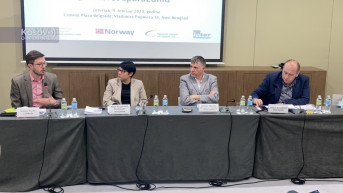
At the panel "What is missing in the negotiations on normalization" held in Belgrade, assistant professor at the Faculty of Political Sciences, Stefan Surlic, pointed out that "the issue of cultural heritage is in the first three questions when the citizens of Serbia declare what they think should be in the dialogue between Belgrade and Pristina one of the key themes".
Surlic spoke on the panel about the protection of cultural heritage, stressing that there had to be a legally binding document that would resolve the issue.
He stated that the issue of cultural heritage was in the first three questions when citizens of Serbia declared what Kosovo meant to them, that is, what they thought should be one of the key topics in the dialogue between Belgrade and Pristina.
"It is a support of 67 to 86 percent, where the citizens of Serbia generally see it as an issue that must be resolved in the normalization of relations," Surlic says.
However, he points out, research in Kosovo shows that only nine percent of citizens support the status of cultural heritage as one of the issues for solving the problems of Belgrade and Pristina.
According to him, politicians in Belgrade will not offer a concession on the issue of cultural heritage for the final agreement.
"Belgrade is not interested in cultural heritage being some kind of concession in the final agreement, which would be offered by Pristina or international actors, because it is understood that some European model for cultural heritage should be applied 'per se', and not be a topic dialogue," he said.
In Pristina, Surlic points out, they see the Serbian Orthodox Church only as a political actor.
"Based on these narratives, we conclude that it is necessary to separate cultural heritage from the process, which we now call the dialogue on the European plan, and if the unofficial version, which we could see in the media, just mentions cultural heritage and that its status is defined," Surlic said.
He adds that when it comes to cultural heritage, the European plan requires that some sustainable European model be implemented.
He reminded that Ahtisaari's package had not offered good conditions for the preservation of cultural heritage, while the Kosovo authorities claimed the opposite, claiming that "Ahtisaari" was the maximum, although, he estimated, it had not been fully implemented.
He stated that according to Ahtisaari's plan, the Serbian Orthodox Church had the right to manage and reconstruct its property and premises, and said that this rule was violated every day, referring to the patriarch's ban on entry into Kosovo.
"I suggest that the dialogue process be moved, at least as far as the Serbian Orthodox Church is concerned, and for that to be a completely parallel process, which will also be taken over by the EU since we do not clearly see the desire of either Belgrade or Pristina for European representatives to deal with this topic; in a dialogue with Serbian Orthodox Church are discussing a sustainable solution," he pointed out.
From the Civic Initiative, Maja Stojanovic pointed out that topics that had been left out of the dialogue between Belgrade and Pristina, and which were of crucial importance for the normalization of relations, should be discussed with civil society.
She assessed that organizations that dealt with victims were largely neglected.
She added that the topic of the missing was being used to stop dialogue and make any agreement impossible, instead of raising these issues to determine the fate of the missing on both sides.
She expressed her fear that even if the Franco-German proposal was accepted, the issue of victims would not be resolved, which would essentially lead to peace and a reduction in the intensity of nationalism.
Issues that are also not mentioned in the European plan are topics related to the protection of property, which was discussed by Dusan Radakovic from the Non-Governmental Organization ACDC.
"About 6,000 gravestones, about 250 Serbian Orthodox cemeteries were destroyed and damaged, and in more than 50 cemeteries there is not a single whole monument, according to UNHCR data from 2000. 27,500 houses and 5,900 apartments of the Serbs and non-Albanians were destroyed in total, 33,500 residential units," he said,
He pointed out that the victims had not received compensation, and Pristina was working on additional land confiscation.
He stated that property had been taken from the Serbs in Kosovo in order to build a "police station" on 48 hectares, but in fact, he said it had been about a base from where you could see all of Kopaonik and Sjenica in Serbia.


0 comments