
Tanaskovic: National unity regarding Kosovo is a fundamental precondition for any success
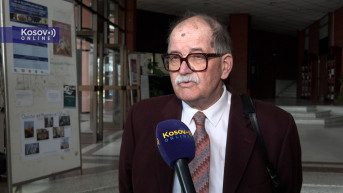
Former Ambassador of Serbia to UNESCO, Darko Tanaskovic, assessed that there was no national unity regarding Kosovo, which should be a fundamental precondition for any success, including the preservation of Serbian cultural heritage in Kosovo.
"The seizure of Serbian cultural heritage has been going on for a long time. In a way, it started back in the former Yugoslavia through attempts to falsify history and gradually propagate the myth, in a negative sense, that a large part of the cultural heritage in Kosovo and Metohija originally or fundamentally belongs to some chimerical Albanian population, mostly Catholic, before the Nemanjic dynasty conquered all of that and built monasteries on that basis. In a more intensive form, it has been going on since the Albanian struggle for independent Kosovo took on institutional forms, especially when armed conflicts occurred," Tanaskovic said for Kosovo Online within the framework of the Scientific Conference "Kosovo and Metohija, History and Cultural Heritage" held at the Theological Faculty in Belgrade.
He emphasizes that the foundations of this were laid back in the former Yugoslavia, where, as he says, there was "undeserved positive discrimination of everything that contributed to affirming the statehood of Albanians in the autonomous province where they lived as a minority in Yugoslavia."
"Something similar was happening with Muslims in Bosnia and Herzegovina, but that is a different issue; they were one of the constituent peoples," our interlocutor explains.
Tanaskovic emphasized that attempts to alienate Serbian cultural heritage continued, and systematic efforts were being made in Pristina.
"During my tenure as the Permanent Representative of Serbia to UNESCO, we managed fortunately to prevent Kosovo's attempt, with the help of its sponsors and allies in the international community, to become a member of UNESCO, which would have been catastrophic for our cultural and spiritual heritage in Kosovo and Metohija. Since that period, the implementation, and operationalization of the strategy of Serbianization of Kosovo and Metohija as alienation of Serbian cultural heritage from the Serbs, its partial destruction, Albanization, and Kosovoization continue, I cannot say with undiminished intensity, but it continues very systematically. This is systematically worked on in Pristina, but also in the world, in those circles that support Kosovo, which advise and participate very actively in the media-propaganda dissemination of the thesis that the cultural heritage in Kosovo and Metohija, its most significant part, by its nature, as stated in the draft law that in 2015 could not pass through the Kosovo Assembly on cultural heritage, is, in fact, the property of the state of Kosovo," Tanaskovic reminds.
According to him, there are three main ways in which the process of alienating Serbian cultural heritage unfolds. One is physical assault, destruction, desecration, and profanation, leaving it to the ravages of time, and hindering any reconstruction work through administrative obstacles.
The second aspect is the Albanization of cultural heritage, through historical falsifications, an attempt is made to depict it as originally and fundamentally Albanian cultural heritage, mostly Catholic, which was later Serbianized and became Orthodox, Tanaskovic explains.
"And the third, in my opinion, the most perfidious and long-term dangerous way is to declare cultural heritage of universal value in Kosovo and Metohija, which is largely Serbian and Orthodox, as the property of the so-called state of Kosovo, which then takes care of it as the cultural property of all inhabitants of Kosovo, as well as of the world cultural heritage, which finds resonance in organizations such as UNESCO because in UNESCO, cultural heritage of humanity is classified according to territorial affiliation, not according to cultural-historical identity or national affiliation," he warns.
As he says, the idea is that Kosovo might eventually be admitted to UNESCO as a state because only states can be members of UNESCO, and then it would take care of the heritage of universal value in that territory while neglecting or putting into the background the fact that it is Serbian cultural heritage.
He also recalled the words of Patriarch Porfirije, who spoke in Prokuplje two days ago, emphasizing that the Serbian side must speak only the truth, but also recalling that he once interrupted talks about a possible referendum and emphasized that there was no referendum on the truth and that the "referendum was held in 1389." It is important how to convey this truth most effectively so that it reaches those to whom it can and should reach in the international community, under the condition, "but also without it," that it first reaches the consciousness of all Serbs.
"Because, unfortunately, it doesn't reach there, and we have heard that there may be the biggest enemies of the Kosovo oath. We do not have national unity regarding Kosovo and Metohija, which should be a fundamental precondition for any success. But we must fight regardless of not having it; we must fight, and so far we have been relatively successful. My idea is to find ways to make our communication of truth as effective as possible without questioning the truth itself, and that is not easy to explain to the Serbs because they believe that any way of 'packaging' the truth about Kosovo and Metohija so that it will be acceptable in the world already represents betrayal and catering to tendencies of denial," Tanaskovic said.
He shared his experience from a conversation with former UNMIK chief Bernard Kouchner, which took place after the March Pogrom in 2004.
"He then quite frankly and - what is worst - openly said, because cynicism rules the planet, 'Ambassador, see what they have done now, the Albanians have given you a gift, and you just need to package that gift appropriately and send it to the right addresses.' I told him that first, we need to unpack the gifts that they sent as untruth packaged in the guise of truth, but I agree that we must tell our truth packaged in the right way. We should talk very openly, reasonably, and without emotions about this packaging in order to act even better and stronger in the fight for our truth, which I think is close to reality," Tanaskovic emphasized.
0 comments