
Tanaskovic: Useful for Serbia to present its view to the CoE members in a non-paper despite the majority recognizing Kosovo
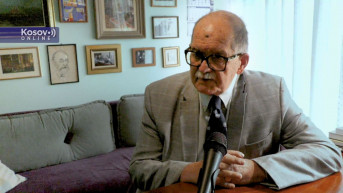
Retired professor and diplomat Darko Tanaskovic told Kosovo Online that although Serbia cannot expect great understanding regarding Kosovo in the Council of Europe, as the majority of member states have recognized its independence, it is still useful for Serbia to present its view of the situation through a non-paper to all Council of Europe members in a reasoned, clear, and unambiguous manner. He says this situation arose due to what seems like countless violations of international law and the harsh, discriminatory application of double standards by "friends of Kosovo" compared to Serbia.
"Scripta manent! (Written things remain). This is important also because of the steps Serbia intends to take in the event of Kosovo's admission to the Council. How can Serbia sit equally in an international organization with a part of its territory? So as not to be said they didn't know, although, of course, everyone knows everything well. Admitting 'Kosovo' as a state to the Council of Europe is by no means neutral for the Council's status itself, its future activities, and its credibility. As for the arguments of our side, I think they don't need to be reiterated. I believe it would be worthwhile to somehow communicate that those who have recognized the unilaterally declared independence of 'Kosovo' are not worthwhile to convince that it cannot be a state in international legal terms because they knowingly violated that right, but rather emphasize that, even if it were a state, which it is not for Serbia, for many reasons based on the accepted criteria of the Council of Europe, it would not meet the conditions for membership due to the scandalous and irresponsible behavior of the temporary authorities in Pristina. That is the aspect that Dora Bakoyannis 'forgot' suddenly," Tanaskovic stated.
He explains that a "non-paper" is a frequently used, most informal form of external diplomatic communication or diplomatic briefing and is used in bilateral diplomacy, with the recipient of such messages not obliged to respond.
"It is expected, however, that they take note of it, consider it. Thus, the 'non-paper' we are talking about is addressed to all Council of Europe member states, and not the Council. However, since everyone will receive it, it is practically addressed to this international body as a whole. Although Serbia cannot expect great understanding regarding 'Kosovo' in the Council of Europe, as the majority of member states have recognized its independence, and the most influential ones are determined to, in violation of the Statute, procedures, and spirit of the Council, by accepting "Kosovo" take a step towards the affirmation of the international subjectivity of this, legally and factually, (occupied) protectorate. It is still useful for Serbia to clearly, logically, and unequivocally present its view of the situation, which has arisen from, who knows how many violations of international law and the harsh, discriminatory application of double standards by 'friends of Kosovo' compared to Serbia, to all members of the Council of Europe," Tanaskovic said.
He believes that Serbia's diplomatic-consular representations continuously plan and systematically work in countries where they are accredited on updating Belgrade's arguments to the hosts, which does not only include foreign ministries and government departments, i.e., official institutions, but the broadest spectrum and all layers of the public.
"Without such ongoing engagement, no campaign can yield results, although, towards decisive sessions and events, it naturally must be focused and coordinated. It is important to act towards the sponsors and co-sponsors of the initiative for 'Kosovo's' admission, then to reliably inform about the position of each individual state, in order to prepare diplomatic approaches and tactics at the session where the final decision will be made, and it is necessary, of course, to pay special attention to states that are assessed to be potentially against 'Kosovo's' admission, although they have recognized it, because abstention is better than a positive vote," Tanaskovic stated.
He notes that there are 12 states in the Council of Europe that have not recognized Kosovo.
"Serbia's maneuvering room is minimal, but, as Ivo Andric once said, there is always room for maneuver in diplomacy," Tanaskovic concluded.
0 comments