
Terras: Dialogue must be encouraged, Picula: Reviving talks would boost EU accession hopes
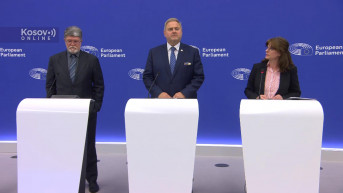
The European Parliament’s Standing Rapporteur for Kosovo, Riho Terras, stated today that the dialogue between Belgrade and Pristina is crucial and that both sides must be encouraged to engage, especially given their previous agreement to participate. Meanwhile, the EP’s Standing Rapporteur for Serbia, Tonino Picula, described the dialogue as being “in crisis,” noting that it "barely exists" at present, and that reviving it would enhance both countries’ hopes of joining the European Union.
At a joint press conference with Picula, Terras was asked whether a strategy exists to revive the dialogue. He responded that there is always room for improvement and expressed hope that Peter Sørensen, the new EU Special Envoy, will bring fresh ideas to the Belgrade–Pristina talks.
“The European Parliament can play a role—for instance, by inviting MPs from national parliaments to the EP. I don’t know what the best method would be, but the dialogue is important. We must work to encourage both sides to re-engage, because both have agreed to take part. We have political consent; now it needs to be set in motion,” Terras emphasized.
Picula remarked that the dialogue is essentially at a standstill.
“I don’t know how realistic it is—or if it's even wise—to invoke Dayton, where leaders were put in one room under U.S. auspices. I don’t know what can lead to a legally binding agreement between Belgrade and Pristina, but I do know that the dialogue today barely exists. It's in crisis. High Representative Kaja Kallas has said she will wait another year to see if there’s progress, and if not, she’s ready to consider other options,” he said.
He welcomed the appointment of Peter Sørensen, describing him as an experienced diplomat ready to reinvigorate the process. “We are ready to support him, because this benefits the people of Kosovo and Serbia. Reviving the dialogue would improve both countries’ EU prospects,” said Picula.
Terras: Five EU Non-Recognizers Should Recognize Kosovo, Sanctions Must Be Lifted
Speaking after the adoption of his Kosovo report in the European Parliament, Terras said it passed with 61% support, calling it a solid outcome given that five EU member states still do not recognize Kosovo. He reiterated his call for sanctions on Pristina to be lifted, labeling them “unjust.”
“It is unfortunate that five EU countries still don’t recognize Kosovo even after 23 years,” Terras said.
He explained that the report—covering 2023–2024—was a response to the European Commission's assessment and based on his own visit to Pristina and Mitrovica, where he met with representatives from the government, opposition, civil society, and business community.
“Everywhere I went, it was clear: Kosovo’s goal is EU membership. This message was consistent from both the government and opposition. I believe Kosovo has made meaningful progress in economic development, the fight against corruption, and rule of law,” he said.
Still, he acknowledged that more must be done, particularly in the fight against corruption.
He stressed that dialogue with Serbia is crucial for both Kosovo and the region. “We as the EU must stop imposing punitive measures on Kosovo. These are unfair and do not reward Kosovo's efforts. The way we are acting is simply not right.”
On security, Terras warned that “a vacuum will always be filled—if the EU is absent, China and Russia will step in.” He urged the five EU non-recognizers to take the step they avoided 25 years ago.
Asked what could be done to persuade them, Terras admitted he had no definitive answer but said he planned to meet with those countries’ ambassadors in Brussels to discuss obstacles to recognition.
“Not recognizing Kosovo after 25 years is absurd. Each country has its logic, but whether that logic still holds today—that is the question. Politics is about persuasion, and that’s what I plan to do,” Terras said.
Picula: Serbia Says EU Is Its Goal, But Reality Shows Otherwise
In his address, Picula said the EP report on Serbia reflects the current reality in the country and is the result of extensive work to assess the quality of Serbia’s EU accession process and the everyday conditions its citizens face.
“Serbia is an EU candidate country. Its leadership claims EU membership is a top priority, even stating it will be ready to join before 2027. However, reality shows otherwise,” said Picula.
He stressed there are no shortcuts to EU membership, which is based on adherence to democracy and the Copenhagen criteria, particularly alignment with EU foreign policy.
“Serbia continues to refuse alignment with the EU’s foreign and security policy and refuses to impose sanctions on Russia. Normalization of relations with Kosovo is also a key issue,” he said.
He criticized Serbian President Aleksandar Vucic’s visit to Moscow, where he was expected to attend the military parade hosted by Vladimir Putin.
“Anyone claiming to lead a democratic country with European ambitions cannot be seen marching with Putin on Red Square. This visit will shrink the political space in the EU for those who have so far described Serbia’s position as moderate. The ‘Serbian World’ and the EU are incompatible,” Picula declared.
He said the report also raises critical concerns over human rights, rule of law, media freedom, and the electoral system in Serbia.
Referring to the tragic collapse of a building canopy in Novi Sad that killed 16 people and sparked student-led protests, Picula said:
“Serbian society is deeply polarized and currently not capable of taking the necessary steps to advance toward the EU.”
He confirmed the EU remains ready to help Serbia and to continue monitoring developments, acknowledging Serbia’s importance in the Western Balkans due to its size and influence.
Asked what the EU can do when a prime minister of an EU member state also visits Moscow, Picula said Serbia–EU relations are at a crossroads.
“I wish President Vucic a safe trip to Moscow and back. There was talk of opening Cluster 3 for Serbia—I don’t know if it’s ready or not—but Vucic has now sent the EU a clear message. Serbia, in its current form, is not ready to proceed toward membership,” Picula said.
He concluded that visiting Moscow is a clear alignment with Putin, who uses Victory Day to justify his actions in Ukraine.
“As for Serbia’s EU prospects—whether we freeze or formally halt the process remains to be seen,” he said.
Commenting on Slovak Prime Minister Robert Fico, Picula said the EU must decide whether to tolerate his Moscow trip, or whether it is time to send a clear signal to Bratislava.
On Republic of Srpska and the alleged protection of Milorad Dodik by Serbia, Picula said:
“It’s illogical for law-abiding citizens to tolerate impunity for those who break the law. This situation cannot last forever.”
He noted that Bosnia and Herzegovina’s path is even more difficult, with accession talks currently stalled.
“Bosnia and Herzegovina must decide whether it is a country that respects the rule of law and court decisions—or one where hate speech continues unchecked. That is for the Peace Implementation Council to act on, not the EU,” Picula concluded.
0 comments