
"Thunderous silence": A minute of silence for media freedom in Kosovo
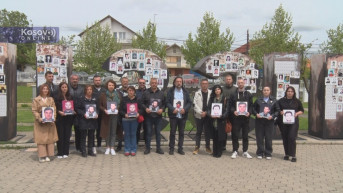
About the atmosphere surrounding World Press Freedom Day, one of the points in today's Declaration by the Association of Journalists of Serbia demands that Kosovo institutions and the international administration in Kosovo urgently form an International Expert Commission to investigate the murders and abductions of journalists in Kosovo from 1998 to 2005. More than two decades have passed, and the word "urgent" becomes increasingly meaningless over time, while the fate of 19 tragic cases still awaits clarification.
The Association of Journalists of Serbia (UNS) submitted proposals for two resolutions to the European Federation of Journalists (EFJ) a few days ago - on investigations into the murders of journalists in Kosovo and on an independent Public Service in the Serbian language in Kosovo, but it was previously announced that due to "discrimination," they would not participate in the EFJ assembly in late May in Pristina.
A rather controversial start for topics that are inherently difficult and controversial, notes one of our interlocutors.
In addition to the demand for the formation of an international expert Commission, the resolutions also call for cooperation between the prosecutor's offices of Belgrade and Pristina, the determination of responsibility of EULEX and UNMIK, and even for the Special Court for War Crimes in Kosovo to open investigations into the killed and missing journalists.
However, as predicted by the former president of the Association of Journalists of Serbia, that resolution will be adopted before the demand for a Public Service in the Serbian language in Kosovo, which is not surprising given that journalists are still denied entry to Kosovo, translations into Serbian are withheld, and in numerous other ways, they are hindered from doing their job. On the other hand, for those who fueled the fire with false reporting, there are no consequences.
Does media freedom for journalists in Kosovo mean the freedom to be silent, to not understand, the freedom to disappear and not be heard?
This year, dialogue has suffered everywhere in the world, our colleagues have suffered, conversations with people, everything we cherish as the most important values of humanity, assesses the president of the Association of Journalists of Serbia, Zivojin Rakocevic.
"Does it make sense to say that today is a black day for this profession, if we know that an entire community and profession are afraid to use their native language in Kosovo and Metohija, if today, after 20 years, we realize that some of our colleagues are revising the tragic events of March 17 as if nothing happened?" asked Rakocevic at the commemoration of World Press Freedom Day in front of the Cultural Center in Gracanica.
President of the Association of Journalists of Kosovo and Metohija (AJKM) Ivana Vanovac reminded of the "thunderous silence" in which the rights of journalists and Serbian editorial offices in Kosovo are being violated.
"It's the silence in which Kosovo's media are experiencing what they're experiencing, where the legislator tries to silently enact laws that will mean the disappearance of Serbian media in Kosovo. It's the silence in which Serbs in Kosovo read Serbian newspapers they don't have. It's the silence in which you can freely forget about objectivity, integrity, about everything that constitutes quality journalistic content, because you don't have to answer for it," said Vanovac. Kosovo currently has the highest number of unresolved cases of murders and kidnappings of journalists, reminds Kosovo Online President of the Commission for Investigation of Murders of Journalists Veran Matic and adds that it is "dramatic" that international institutions and foreign governments do not treat it as a serious problem that requires resolution.
There is already a problem with the upcoming EFJ assembly, or rather the problem lies with UNS, which has decided not to participate, says Matic, adding that he cannot fully understand why a resolution is being proposed and its adoption demanded when it is known that participation in the assembly is necessary to propose a resolution.
"It is probably possible for another delegate from another association to propose it, but that seems to me to be somewhat controversial from the start regarding the resolution. I think these topics should not have any additional controversy because they are inherently difficult," emphasizes our interlocutor.
The International Expert Commission to investigate the murders of journalists was first mentioned at the 2018 meeting in Pristina and Gracanica attended by both UNS and the Association of Journalists of Kosovo under the auspices of the OSCE and then-President of Kosovo Hashim Thaci, says Matic.
"That the commission receives an international mandate, but that it is recognized by both the interim authorities and Serbian authorities, and that efforts are made not to waste time. Because Kosovo currently has the highest number of unresolved cases of murders and kidnappings of journalists. And that's dramatic, that international institutions and foreign governments do not treat it as a serious problem requiring resolution because as time passes, there is less chance that it will be resolved," he warns.
However, he believes that resolutions, in themselves, do not bring anything.
"I think that regarding the concept of investigating the murders of journalists, it is very important that there is consensus among journalists from Kosovo from any association, and UNS, and NUNS. Because if there is no certain kind of agreement within the journalistic community, then we will not achieve what we want as an outcome - that is, the formation of a certain body, because the pressure will not be persuasive, it will fall into the patterns of politics and what does not lead to the solution of this case," says Matic.
It is very important, he emphasizes, to start the process of discovering what really happened, and within that work, aspects of the responsibility of different institutions for inaction and obstruction will certainly be touched upon.
"It is certainly a big problem when it comes to those who ruled Kosovo - both UNMIK and EULEX, why they did not have proper records of killed journalists, nor did they collect documentation in that file on murdered journalists. These are all things that should not be at the forefront now, so as not to hinder the processes," he assesses and adds that it is crucial to establish cooperation between prosecutors, which is "prescribed and possible," although now "frozen." "I think there is a reason why there is no longer insistence on investigating the murders of journalists in Kosovo, and that is because the West simply turns a blind eye to the truth that in that territory - where they claim that human rights and democracy thrive - so many journalists have been killed, and that even today the situation for journalists there is not better, especially if you are a Serbian journalist in Kosovo," says journalist and former president of UNS Vladimir Radomirovic for Kosovo Online.
"But it is very likely that such a resolution - if UNS is not present - probably will not pass," Radomirovic assesses.
He recalls that there are already resolutions on investigating the murders of journalists in Kosovo, and that in 2018, when he was president of the UNS, the first resolution was adopted.
"However, neither then in 2018, nor later - when another resolution was adopted - there were no consequences in terms of the European Federation of Journalists launching any initiative, insisting in Brussels and New York through the International Federation of Journalists to initiate international investigations, to finally establish who is responsible for the murders of journalists in Kosovo that occurred from 1998 to 2005 and which are largely connected to the activities of the KLA, or its successors after the war. These were the murders of journalists who actually became targets of these criminals and terrorists, and that is why it is important to uncover all the circumstances because Kosovo is the territory in Europe where the most journalists have perished," Radomirovic states.
From this perspective, Radomirovic assesses that there is a reason why there is no longer insistence on investigating the murders of journalists in Kosovo.
"That is because the West simply avoids facing the truth and turns a blind eye to the fact that in that territory of Kosovo - where they claim that human rights and democracy thrive - so many journalists have been killed, and even today, the situation for journalists there is not better, especially if you are a Serbian journalist in Kosovo, the situation is difficult and that is not seen in the West. And certainly, during this EFJ assembly, great attention will be given to Ukrainian journalists who have effectively been granted asylum in Kosovo and who have been living there for several years now, and they will be the stars of that assembly. So, the story will go in another direction again, and the journalists who were killed in Kosovo will be forgotten," says our interlocutor. Commenting on the chances of the proposed resolutions being adopted, Radomirovic assesses that the resolution on the murders of journalists has more chances than the one on the Public Service in the Serbian language.
"We have already had resolutions on the topic of the murders of journalists that have been adopted before, and the issue of channels in the Serbian language is something that the people representing the UNS today have been asking for a long time, but I do not see the need for the UNS to deal with the fact that the Ahtisaari Plan should be applied and to recognize the Constitution of Kosovo. This should be dealt with by those who recognize the Constitution of Kosovo, and the UNS should not recognize the Constitution of Kosovo," he concludes.


0 comments