
Matic: Commission for Investigating Murders of Journalists in Kosovo must have an international mandate
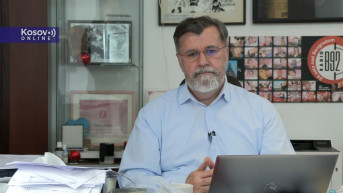
Kosovo is currently the area with the highest number of unresolved cases of journalist murders and kidnappings, Veran Matic, President of the Commission for Investigating Murders of Journalists, says for Kosovo Online, adding that it is "dramatic" that international institutions and foreign governments do not treat this as a serious problem that requires resolution.
There is already a problem with the upcoming EFJ Assembly, specifically the issue that the Journalists' Association of Serbia has, which decided not to participate, Matic says, adding that he cannot fully understand why there is an effort to pass a resolution and demand its adoption when it is known that participation in the assembly is necessary to propose a resolution.
"It is possible that another delegate from a different association may propose it, but that seems to me a bit controversial from the start regarding the resolution. I think these topics should not have any additional controversy because they are inherently difficult," our interviewee emphasizes.
The International Expert Commission to investigate journalist murders was first mentioned at a meeting in 2018 in Pristina and Gracanica, attended by the Journalists' Association of Serbia and the Journalists' Association of Kosovo under the auspices of the OSCE and then-President of Kosovo Hashim Thaci, Matic says.
Such a commission, according to him, is the only way to achieve several things.
"To investigate why there were no investigations or why investigations were unsuccessful if there were any? What happened to the documentation related to each of these murders? How could families be compensated? Why weren't these murders treated as crimes? Why weren't these murders treated as journalist murders but as ordinary murders, kidnappings, etc.?" Matic says, adding that a neutral, serious commission should also address these issues, as well as collecting documentation and developing concepts for future investigations.
He reminds that "years are passing by," and it will take a lot of time to normalize relations between institutions in Serbia and Kosovo to potentially work together on these investigations, adding that he doubts that even then, the focus and priority will be on the journalist investigations.
"That the commission receives an international mandate, recognized by both interim and Serbian authorities, and that the work is initiated without wasting time, because Kosovo currently has the highest number of unresolved cases of journalist murders and kidnappings. It is dramatic that international institutions and foreign governments do not treat this as a serious problem requiring resolution because, as time passes, there is less chance of resolving it," he warns.
However, he believes that resolutions, in and of themselves, do not achieve anything.
"We have the Lisbon and Zagreb resolutions. The Zagreb resolution was also adopted somewhat difficultly, with the Journalists' Association of Kosovo being neutral at the time. I think that consensus among journalists from Kosovo from any association, as well as the Journalists' Association of Serbia and the Independent Journalists Association of Serbia, is crucial regarding the concept of investigating journalist murders, because if there is no consensus within the journalistic community, we will not achieve what we want as an outcome – the formation of a specific body, because the pressure won't be convincing, it will fall into the patterns of politics and things that do not lead to resolving this case," Matic notes.
He adds that during the establishment of the Commission for Investigating Murders of Journalists in Serbia, similar dilemmas arose.
"I think we shouldn't prejudge anyone's guilt and demand everything immediately. At this moment, it is very important to form an institution that will start dealing with this, which will start investigating what happened to the missing people, how they were killed, and where the existing documentation is. We have part of the documentation in Serbia because Serbia had jurisdiction over those murders until June 1999 – at that time, there were six of them. Part of the documentation is with UNMIK and EULEX. It would be very important to concentrate the documentation in one place," Matic says.
It is crucial, he emphasizes, to start the process of uncovering what really happened, and within that work, aspects of the responsibility of different institutions due to inaction and obstruction will certainly be touched upon.
"It is a big problem when it comes to those who governed Kosovo – both UNMIK and EULEX – why they did not have proper records of killed journalists or collect documentation in that file on killed journalists. These are all things that should not be put in the forefront now to avoid hindering the processes," he assesses, adding that it is crucial to establish cooperation between prosecutors, which is "prescribed and possible," although it is now "frozen."
Matic reminds that part of the documentation has been collected in Serbia, but he stresses that all these documents only make sense when combined. He says there are many obstacles, but political will is important.
"I think the path to obtaining an international commission lies in strong lobbying in the EU, in Brussels, in the Council of Europe, in all institutions where there are mandates that could be related to this topic: certainly in the US with the help of our partners in the Committee to Protect Journalists, which is a strong lobbying organization; in Europe with the International Federation of Journalists mentioned in these resolutions," Matic says.
He believes it is important to create an atmosphere among key political factors that it is important to establish such a commission, and then, he says, everything will be easier.
"It is also very important for journalist associations and organizations to work on creating that consensus. It is worst when it comes to being outvoted and when it turns into a political issue because then things fail, no matter what resolution you bring," he assesses.
He also believes that the role of the Special Court for War Crimes in Kosovo can be useful, as can the role of the International Criminal Tribunal for the former Yugoslavia for numerous cases of missing persons in Bosnia and Herzegovina, Croatia, etc.
"The court's archive is truly rich. Investigators dealing with war crimes have collected an impressive archive of documentation from Serbia, Croatia, etc. I am sure that a good investigator who knows what to look for could find certain documentation in those archives that could help in some cases. It would be important to involve the court and the prosecutor's office if possible," Matic suggests.
He also believes that the court has more possibilities to protect information it receives, especially those that should not be reported to regular or interim prosecutors in Kosovo, given the history of witness murders in Kosovo.

0 comments