
Trifunovic: Kurti’s government is extremist, lives of Serbs in Kosovo at risk
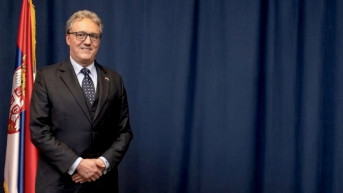
Ivan Trifunovic, Serbia’s ambassador to Switzerland, stated that the government of Kosovo Prime Minister Albin Kurti is extremist and seeks to rid itself of the Serbian community, warning that the lives of Serbs in Kosovo are at risk. In an interview with the portal 20 Minuten, ahead of the visit of Swiss President Guy Parmelin to Serbia, Trifunovic said that the essence of the Kosovo conflict lies in what is currently happening to the Serbian community there.
“Whether Serbia recognizes Kosovo or not is a political question, but it is not decisive for people’s daily lives. Kurti’s government is extremist. Ultimately, it seeks to get rid of the Serbian community. He has said this openly—after the war in Croatia, Serbs disappeared, ‘and there is no problem.’ The Kosovo constitution includes a threshold for minority rights; he wants to push the Serbs below that threshold in order to strip them of veto rights,” Trifunovic said.
The ambassador stressed that he had personally been to Kosovo and witnessed the situation on the ground.
“I spoke with many Serbs, including those who do not support Aleksandar Vucic. Their lives are at risk. Police enter schools and hospitals. ‘You are now part of Kosovo—you cannot have a Serbian school.’ This is exactly what Slobodan Milosevic did to Albanians. There is no education, there is police intimidation, and arbitrary arrests,” Trifunovic stated.
He provided a concrete example of how authorities in Kosovo arrest Serbs:
“A man from Serbia comes for a visit. Someone says: ‘I vaguely remember seeing him in 1999 with the Serbian police.’ Six months of pre-trial detention. No evidence, then: ‘you can go home.’ He spent half a year in prison. Even worse, some people have been sentenced to long prison terms on the basis of weak evidence. Even Albanian opposition leaders say about Kurti: what he is doing to Serbs is unacceptable. The mayor of Peja, Gazmend Muhaxheri, compared Kurti’s actions in Serbian municipalities with Milosevic’s actions in 1989 in Kosovo,” Trifunovic said.
Speaking about a solution, Trifunovic recalled the Brussels Agreement of 2013.
“It provides that municipalities with a Serb majority can form an Association, with defined powers in education and healthcare. That has never been implemented. Kurti does not want this. He then says: ‘First Serbia must recognize Kosovo as an independent state.’ But that was never agreed. If I were an Albanian politician, I would acknowledge that they have ‘de facto’ won with NATO’s help. It would be wiser to accommodate the small Serbian minority. Instead, their rights have been reduced,” the ambassador said.
He also emphasized that arrests must stop.
“One Serbian government representative said that the KLA is a terrorist organization. He was arrested—clearly for something that falls under freedom of speech. And it is not even an extreme statement. The U.S. Department of State considered the KLA a terrorist organization until 1998. Three of its senior leaders are currently on trial in The Hague for war crimes and crimes against humanity. So why did that man in Kosovo end up in prison for that statement? Feel free to write: if Kurti’s authorities consider that opinion a criminal offense, they should say so openly. Do they intend to arrest every Serbian official or diplomat who says that the KLA was a terrorist organization—including me?” Trifunovic asked.
He then described the situation of Serbs in Kosovo:
“In North Mitrovica I saw Serbian flags, completely torn by weather conditions, put up ten years ago. I asked local Serbs: why don’t you replace them? ‘If we put up new ones, we’ll end up in prison.’ On the other side of the river: a huge Albanian flag. How does that make sense? I told the U.S. ambassador that I would personally go and put up new Serbian flags, as a U.S. citizen. He advised me against it, because he knows how the Kosovo police operate and did not want to complicate the situation by having to extract an American citizen,” the ambassador said.
Asked whether he communicates with the Kosovo ambassador in Bern, Trifunovic said he does not consider him an official ambassador because Serbia does not recognize Kosovo as a state, but that he always greets him politely.
“He seems like a reasonable and pleasant man. I greet him politely and exchange a few words. Some Serbs have criticized me for that. I do not consider him an official ambassador, because we do not recognize Kosovo as a state, but in a certain sense he is a colleague. What puzzles me is that he is also a Swiss citizen. How can someone who is a Swiss citizen be an ambassador of another country in Switzerland? To me that makes no sense, and in most countries that would not be possible—but that is a matter for the Swiss government,” Trifunovic noted.
He added that it is equally puzzling that Albin Kurti regularly travels to Switzerland to raise funds and campaign for his party.
“Moreover, he encourages the Albanian diaspora to vote in a certain way in Swiss elections. Some might see this as interference in Switzerland’s internal affairs. Again, what he does in Switzerland is not entirely our concern. But since his policy directly and negatively affects us, it draws our attention,” Trifunovic said.
Asked whether he could imagine a “Serbian-Kosovar barbecue gathering within a Swiss framework,” Trifunovic said such an informal event could take place.
“I believe that a joint appearance of Serbian and Albanian groups in Switzerland would be a good thing, as long as people treat each other with respect and decency. Something similar happened: at the residence of the EU ambassador I had lunch with representatives from across the Western Balkans. A representative of Kosovo was there as well—without titles or labels—and we sat at the same table. I have nothing against that.
Private diaspora groups in Switzerland would have even more room for such initiatives,” he said.
Regarding the first state visit of a Swiss president to Serbia in 18 years, Trifunovic said it is very important.
“It is very important and somewhat surprising for occasional observers. The Swiss president has a one-year mandate and usually undertakes one or two major foreign visits, so priorities must be set. Traditional close partners such as Germany and Austria, major countries like China, and strategic economic partners such as Saudi Arabia typically take precedence. And now Serbia—after 18 years. Many of my ambassadorial colleagues asked me: how did you manage that? Why Serbia?” he said.
He stressed that many factors connect Serbia and Switzerland.
“Two small neutral countries seeking their place in the current geopolitical upheaval. Switzerland once had like-minded partners in Finland and Sweden, but now we hear that even Norway and Iceland are considering closer ties with the European Union and leaving EFTA. For small neutral countries, a rules-based international order has always been essential. Multilateralism has been and remains important for both. Switzerland has taken over the chairmanship of the OSCE—a body broader than the EU or NATO—which makes it useful. Another factor is the economy. Finally, the large Serbian diaspora in Switzerland represents a strong link. There is also an interesting detail: Serbia is part of Switzerland’s constituency at the World Bank,” Trifunovic said.
Asked how similar the concepts of neutrality in Switzerland and Serbia are, he said there are nuances, but that they are very similar in military terms.
“We will not become a member of NATO. We cooperate closely and train with NATO, and we will soon have a joint exercise. We have also had exercises with China, but on a much smaller scale. We are trying to remain balanced and, while moving closer to NATO, we maintain neutrality,” Trifunovic said.
He reiterated that Serbia’s strategic goal is the European Union, while maintaining good relations with all partners.
“We have very good relations with Arab countries and with Africa. We still rely on the legacy of former Yugoslavia and Non-Aligned Movement of Josip Broz Tito. We had many African students in Belgrade; today, many of them hold high positions in their countries. You go, for example, to Ghana—and suddenly someone speaks Serbian,” the ambassador said.
Speaking about the President of Serbia, Trifunovic said that Aleksandar Vucic is not a “strongman.”
“He is not a saint either, but he is a responsible statesman who puts the interests of his country first.”

0 comments