
Vucic: Court did not want to undermine KLA’s credibility
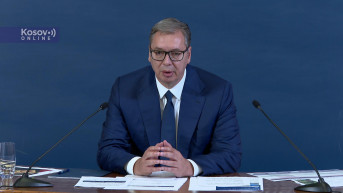
Serbian President Aleksandar Vucic said that the Court had not wanted to undermine the credibility of the KLA and had not found the former KLA leaders guilty of systematic attacks against the civilian population or crimes against humanity. Vucic said that the Serbian people should not react to the judgment with any euphoria, but should wait patiently and carefully consider the messages sent today, which, he said, best demonstrated the double standards and hypocrisy Serbia faced.
At the beginning of his address, Vucic stressed that preserving peace and stability was of crucial importance to Serbia, adding that nothing was more important.
“I believe that the fact that emotions remain so intense even 27, 30 and 35 years after the conflicts in the former Yugoslavia shows that a great deal of injustice was done, but also that none of us were sufficiently prepared to confront our own mistakes and the crimes committed in our name. Nevertheless, I believe that, going forward, the solution lies in talks, greater understanding and dialogue with everyone,” the Serbian President said.
He pointed out that the first-instance judgment had been delivered before a Kosovo court.
“They created that special mechanism under pressure from the international community in order to avoid the establishment of an ad hoc tribunal against Serbs and the Serbian people,” Vucic stressed.
He recalled that four individuals had today been sentenced at first instance before what he called the “court of so-called Kosovo” to 25, 25, 18 and 13 years respectively, or a total of 81 years.
“What is important is to point out the following facts. First and foremost, the Trial Panel did not establish beyond reasonable doubt the existence of a widespread or systematic attack against the civilian population. As a court of so-called Kosovo, they did not want to undermine the credibility of the KLA and, of course, they did not address the merits of the issue concerning the formation of forces aimed at seceding Kosovo from Serbia and the FRY. As regards today’s first-instance judgment, the indictment contained ten counts, six of which concerned crimes against humanity. On all six counts—persecution, imprisonment, other inhumane acts, torture, murder and enforced disappearance—they were not found guilty,” Vucic explained.
Regarding the counts of the indictment relating to war crimes, he added that they encompassed the unlawful deprivation of liberty of at least 385 persons, cruel treatment of at least 49 persons, torture of at least 303 persons and the killing of 96 persons. Individual criminal responsibility was established for those crimes.
He explained that they had been acquitted on all six counts relating to crimes against humanity because the Court found that the attacks had been directed against individuals rather than the broader population. He also said that the indictment had not encompassed what he described as the gravest crimes against Serbs committed after June 10, 1999, because it was considered that, following KFOR’s arrival, acts committed after that date did not constitute war crimes.
He listed the “Yellow House” case as not being part of the indictment, nor the KLA’s objective of achieving Kosovo’s independence, which, he said, constituted a separate and unprecedented crime. Nor, he said, did the indictment cover the abduction of Serbs in Orahovac, the abduction of miners at Belacevac, the killing of Serbs at Lake Radonjic, the crime in Klecka between July and August 1998, the killing of a Serbian family in Djakovica on June 12, 1999, the disappearance of Serbs in the villages of Zac, Klina and Vucitrn, the killing of Father Hariton, the killing of Marica Miric in front of her mother, the killing of children in Bistrica, or the “March Pogrom.”
“None of that was taken into consideration, and they were not found guilty on those six counts concerning the most serious criminal offenses. It is important that we have no reason either to celebrate or to grieve,” the Serbian President said.
Vucic also said that, in addition to the Appeals Panel as the second-instance body, there was, in the case of the Kosovo Specialist Chambers, what he described as a third instance—the Constitutional Court.
“Even if the judgment is upheld, which I find difficult to believe, there is also a third level, the so-called Constitutional Court of Kosovo, which can return the case for first-instance adjudication if it finds that a right has been violated. That is why we should not react to this judgment with any euphoria, but should wait patiently and carefully understand the messages sent today,” Vucic said.
He pointed to the reactions of Albin Kurti, Albanian President Bajram Begaj, Montenegrin Government Minister Nik Gjeloshaj, Albanian politicians from North Macedonia and the Croatian Ministry of Foreign Affairs, which, according to Vucic, by describing the judgment as unjust and praising the KLA, best demonstrated the problems and the extent of the hypocrisy Serbia faced.
He also noted that, following the delivery of the judgment today, there had been attacks by disgruntled Albanians against EULEX in Pristina, as well as against the Dutch authorities in The Hague.
“Of course, there will be no strong reaction to that,” Vucic said, adding that none of those who, he said, had always been pushed by various powers into conflicts against Serbs intended to abandon the policy of belittling and denying crimes of every kind committed against the Serbian people.
He stressed that Serbs would have to work even harder to preserve the culture of remembrance of their victims because, he said, no one else would remember or mention them.
“This is a major lesson for us about the double standards in the world around us. You can have a final and binding judgment, but Serbs will always be criminals, while others will be heroes. Everyone will be allowed that except Serbs, who must not stand up and raise their heads—and if they do raise them, they should, metaphorically speaking, have their heads cut off,” Vucic said.
He said Serbia’s message was one of peace, restraint, dialogue and stability.
“That is what serves Serbia’s interests best, regardless of everything we were able to see, learn and understand today. Many things did not surprise us, while some did, particularly the silence and hypocrisy of the international community,” Vucic stressed.
International community made a mistake by allowing dialogue to be interrupted
The President also said that he believed the international community had made a mistake by allowing the dialogue with Pristina to be interrupted because some had attempted to resolve matters in Kosovo through acts of violence.
“And it worked well for them because they had substantial support from abroad. We believe that dialogue is always a better solution than any conflict or anything else, and we want the dialogue to resume. We will also always want to talk to everyone in our neighborhood, regardless of what they say or think about us, but not by serving them—rather, by respecting each other’s interests,” Vucic said.
Serbia, he added, would extend a hand to everyone.
“If they want it, they want it; if not, so be it. We must respond soberly. There is no reason for celebration, sadness or anything of the sort. I think today has shown us very clearly what many in our neighborhood think about us, about Serbian victims and about our people—how little they genuinely care about Serbian victims and how they have never cared about them, because historically those victims are not supposed to exist. We must fight to prevent our past from being completely rewritten. If they completely rewrite our past, they will also determine our future,” Vucic warned.
He also noted that media outlets in Kosovo and elsewhere in the region had not carried headlines such as “monster sentenced to 25 years.”
“Not one. Every Serb, in every one of their headlines, from Zagreb, Sarajevo and Podgorica to Pristina, is always a monster or an executioner. There is no third expression. There is no third noun they use. Either a monster or an executioner. ‘Unjust judgment,’ ‘unjust conviction’—that is the narrative they have been using for 25 or 30 years. We are the executioners and monsters, while they are unjustly convicted, regardless of what crimes they committed or how grave those crimes were,” Vucic said.
Asked whether he expected anyone else who had committed crimes against Serbs to be arrested and prosecuted, Vucic replied that even these judgments remained highly uncertain.
“In the end, the court of so-called Kosovo makes the decision. After this whole circus, it is clear to everyone what the final judgment will be. This is merely an indication of how grave the crimes committed against the Serbian people were, and that is important,” Vucic stressed.
He said Serbia’s role was to establish the facts, context and circumstances in which the judgment had been delivered, rather than to accept or reject anything.
Vucic noted that over the past several days he had spoken with representatives of KFOR and NATO, as well as with US officials today, and had asked them to provide full protection to the Serbian population in Kosovo.
“I believe that protection will be provided. My warmest regards to our wonderful people in Kosovo and Metohija. Thank you for preserving the Serbian name and identity on sacred Serbian land,” Vucic concluded.
Hashim Thaci and Jakup Krasniqi were sentenced at first instance today to 25 years’ imprisonment each for war crimes. Kadri Veseli was sentenced to 18 years, while Rexhep Selimi received a 13-year prison sentence.
The judgment prompted dissatisfaction among Albanians both in The Hague and in Kosovo, where messages were sent describing the judgment as unjust and unacceptable.


0 comments