
Vucic: EU is Serbia’s strategic commitment; Von der Leyen: The right moment for Serbia to accelerate its EU path
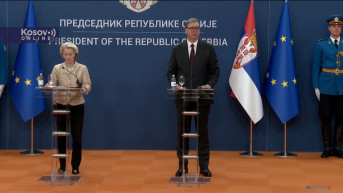
Serbian President Aleksandar Vucic said today, after meeting with European Commission President Ursula von der Leyen, that EU membership remains Serbia’s strategic commitment and foreign policy priority. He said part of their talks focused on the need to preserve peace and stability, as well as on the Belgrade–Pristina dialogue, expressing confidence that the dialogue would continue in a constructive spirit. European Commission President Ursula von der Leyen emphasized that now is the right moment for Serbia to take concrete steps toward EU membership.
“For Serbia, EU membership is a strategic commitment and a foreign policy priority, and that will certainly not change until the next elections, and I believe not even after. Since the outbreak of the conflict in Ukraine, we haven’t opened a single chapter or cluster. It seems to me we have done some things recently, but much still lies ahead. We must also discuss within our own country the direction of our policies,” Vucic said at a joint press conference. He added that he believes the progress made on voter registries and other reforms will receive a positive assessment from the European Commission.
Vucic said that he and von der Leyen discussed energy issues, the need to preserve peace and stability, and the Belgrade–Pristina dialogue.
“Part of the conversation naturally concerned the dialogue between Belgrade and Pristina. I believe it will be possible for it to continue in a constructive tone. But, as the saying goes, it takes two to tango,” the Serbian President stressed.
He pointed out that Serbia is facing a difficult situation in the energy sector, noting that when the oil company NIS is under US sanctions, that “de facto” means it is also under European sanctions.
“I hope that on all issues crucial for Serbia’s energy security we will have the EU’s support and assistance,” Vucic said.
Vucic added that, although he was not overly optimistic, he handed von der Leyen a letter requesting that Serbia be exempted from EU customs duties and quotas on steel.
“I know that only Norway, Iceland, and Liechtenstein can currently enjoy such exemptions, but I asked and believe the European Commission will find a way to ease the situation at least somewhat for candidate countries. The winter ahead won’t be easy for us, we have secured large reserves of oil and gas, but it will be a politically difficult winter as well. On that issue, we will cooperate closely with the EU, I hope successfully,” he said.
Vucic highlighted that the European Union is Serbia’s largest investor and trade partner, with 54.5% of Serbian exports going to the EU, mainly to Germany, Italy, Romania, and Hungary, which together account for 48.5% of Serbia’s exports to the EU.
He added that 60% of all investments in Serbia come from EU countries.
The president recalled that he has never made optimistic predictions about when Serbia might join the EU, that those came from previous EU officials, none of whom, he said, “really meant it” when they mentioned 2025, and Serbia itself wasn’t ready.
“I can’t promise anything except that we’ll work hard to fulfill our reform agenda, and I hope we’ll have the EU’s support and that Brussels will hear us. It is not always easy to present everything to Serbian citizens, but we know what our key issues are, we may not open them today, but we will have to in the coming months,” Vucic said.
He thanked von der Leyen for her support.
“We will continue to develop energy infrastructure, build interconnectors with North Macedonia and Romania, strengthen Serbia in terms of diversifying energy sources, and see how to economically empower the country,” the president stated.
He expressed special gratitude to the President of the European Commission for visiting Serbia on multiple occasions, not only in Belgrade but also in poorer towns, supporting less-developed areas of the country.
“I am also grateful that she came to Belgrade at this moment, which is neither simple nor easy for Serbia, and I hope we will meet again before the end of the year, as we will need to analyze everything that is happening, especially regarding energy issues, and jointly seek solutions,” President Vucic said.
Von der Leyen: The right moment for Serbia to take concrete steps toward accession
European Commission President Ursula von der Leyen said this is the right moment for Serbia to take concrete steps toward EU membership.
“Thank you for an open and honest discussion. We live in a fragmented world, where the gap between democracies and autocracies is widening. Our stance stands for freedom, not repression, for diplomacy instead of aggression,” she said.
Von der Leyen recalled that Serbia chose to join the EU more than two decades ago, calling it “a heartfelt decision and the will of the Serbian people.”
“We expect Serbia to move twice as fast on its EU path. EU membership is a promise of peace, prosperity, and security, especially in times of crisis,” she stressed.
She recalled that this was evident during the 2022 energy crisis caused by Russia’s aggression against Ukraine.
“We faced it together, and the EU provided the same measures to candidate countries as to member states, which is proof that the EU is a reliable partner. We are connecting Serbia to European energy markets, ensuring that citizens’ homes will be warm this winter,” von der Leyen said.
She noted that major projects such as the Trans-Balkan Energy Corridor and the Serbia–Bulgaria gas interconnector are underway.
“We are ready to continue investing. We have invited Serbia to join the common gas procurement mechanism,” she added.
Von der Leyen emphasized that progress in the rule of law, media freedom, and electoral reform must be the first concrete step in Serbia’s EU path.
She welcomed progress on the voter registry and media regulator (REM), noting the effort made by civil society and the opposition, but underlining that “implementation is key.” She said she had invited Vucic to visit Brussels in a month to review progress.
“We need to see greater alignment with EU foreign policy, including sanctions against Russia. I welcome the fact that Serbia’s foreign policy alignment with the EU has reached 61%. We want to be able to count on Serbia as a reliable partner,” she said.
Von der Leyen acknowledged that EU accession is a long process, which is why the EU has enabled gradual integration.
In this context, she mentioned the Western Balkans Growth Plan, under which Serbia, she said, has received over 100 million euros in investments, with more to come.
“Within the Growth Plan, you have established a Supervisory Board that includes representatives of civil society, as well as government representatives. I believe such a board is an excellent signal, sending a strong message of trust and cooperation,” she emphasized.
Von der Leyen stated that, within the Growth Plan, efforts are being made to integrate Serbia into a single payment area, which will facilitate and reduce the cost of money transfers and have a significant impact on both the business sector and citizens.
“This demonstrates Europe’s commitment, which exists not only in words but also in deeds. Now we want to see Serbia show the same commitment in practice,” von der Leyen stated.
Message to investors – If you choose the Western Balkans, you choose Europe
Asked about potential new EU investments in the region, which she called for during her visit to Montenegro yesterday, von der Leyen replied that her message to investors is that now is the right time for investments in the Western Balkans.
“If you choose the Western Balkans, you choose Europe. That is the principle of our Growth Plan. It opens up parts of the single market as if the countries were already EU members. We invest in the Western Balkans, and in return, reforms are implemented, ensuring a fair and unified market,” she said.
Von der Leyen stressed that this is a huge opportunity, for both EU countries, whose market is expanding, and for Western Balkan companies, which gain access to the EU single market.
“There are many opportunities for investors who choose the Western Balkans,” she said.
Responding to journalists’ questions, Vucic thanked von der Leyen for listening to his requests regarding steel quotas and sanctions on NIS, expressing confidence that a joint working group with the EU will be formed to address Serbia’s energy challenges.
“We are not negotiating with a potential buyer because we are not the owners, and I have said a thousand times that we are not communists. We are waiting for the owner, if needed and if the sanctions remain, which is likely, to decide with whom they want to negotiate. What we saw in discussions with the Russians shows that the situation is not easy. What was encouraging is that they understood this, and I believe they will act accordingly, that we cannot allow any disruption of the energy market or insufficient supply,” the President of Serbia reiterated.
Asked how Belgrade responds to Brussels’ criticism regarding its relations with Moscow, and whether it has been determined if Russian services are behind the combat camp for foreigners near Loznica, Vucic said that the presence of three Russian citizens in the Suncana Reka camp has been established, but he cannot confirm it involves Russian services.
“We have established their presence, but I cannot claim it is Russian services, nor do we have confirmation of that – three Russian citizens at the Suncana Reka camp between Loznica and Mali Zvornik. We also detained individuals of Serbian nationality who were available. They provided information about other people involved; the investigation continues,” Vucic said, adding that Serbia similarly detained 11 individuals related to incidents in Paris and two individuals connected to incidents in Germany involving a rally of one opposition leader, where someone threw paint intending to accuse someone from the authorities.
0 comments