
Vucic: International law has collapsed; We are living in a lawless world
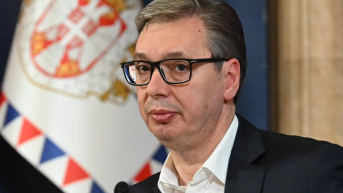
Serbian President Aleksandar Vucic said today that international law has collapsed and that we are living in a “lawless world,” stressing that the vast majority of the world understands what a major mistake was made by recognizing Kosovo.
He said he is ashamed of the hypocrisy of some who, when asked to compare the cases of Kosovo and Greenland, respond that the two are not the same because no genocide was carried out in Greenland.
“No genocide was committed in Kosovo either. I am certain that the majority know what a grave mistake they made by recognizing and pursuing the recognition of Kosovo. The fact that they do not want to admit it is another matter. The difference between what you did with Bill Clinton’s America in 1999 and what you continued to do, and what Donald Trump is doing now, is that Trump does it more openly and says—‘I need this.’ You fabricated humanitarian catastrophes, tried to find Leibniz’s sufficient reason to translate that into action and achieve economic and political goals,” Vucic told Informer.
He stated that international law has collapsed in all respects, but that it is now “at least more honestly framed.”
“At least they lie to us less than they did 25 years ago. Back then they invented things and lied. Now they do not invent. If you ask whether this is better—today is better, because it is more honest. You know you are dealing with a lawless world, whereas before it was a concealed lawless world, in which you had to tell the bandit that he was a savior,” Vucic said.
Difficult Talks on NIS; Hopes for Extension of Operating License
The President also emphasized that talks regarding Naftna industrija Srbije (NIS) are difficult and that he expects a letter on the agreement of future owners to be sent to the U.S. Office of Foreign Assets Control (OFAC) within the next two days, so that the institution can decide—before 23 January—on extending the company’s operating license.
He recalled that this week he held many important talks with potential partners, including representatives of MOL Group, as well as in Abu Dhabi with another potential partner.
“These are not simple talks for us. The best solution for us would have been for Serbia to take over NIS, but the alternative was either to seize someone’s property or to agree with the process under way. That option did not exist, even though we wanted it and had the funds prepared. Accordingly, I believe we will have positive results, but I cannot say with one-hundred-percent certainty that the matter is resolved, because there are issues on which Serbia does not want to leave room for outcomes that would not be aligned with citizens’ interests—above all the operation of the refinery. We must ensure operational security, because as a small country in the region we cannot be without a refinery,” Vucic said.
He noted that when the refinery is not operating, it affects economic growth and workers in Pancevo.
“There are other matters I do not want to inform citizens about before talks are concluded. I hope partners will understand that we are a sovereign, independent country and that we must make decisions sovereignly while respecting others’ capital. Somewhere we must protect Serbia’s vital interests,” Vucic said.
He expressed hope that the letter would be forwarded to OFAC so that NIS’s operating license can be extended.
“Today, after 100 days during which not a single drop of oil flowed through the Adriatic pipeline, we have managed to ensure supply security. We demonstrated seriousness in not seizing what is someone else’s property, even though we had to pay a high price for all this due to mistakes by previous management,” Vucic added.
He explained that the key points of the future agreement are clear ownership relations, the structure of the future company, ownership percentages and stakes for each company, and the business plan. All of this must be sent to OFAC within the next two days so that a decision on extending NIS’s operating license can be made before 23 January.
“We do not yet have a complete agreement on this; I hope an agreement will be reached,” Vucic said.
More Than 60 Meetings in Davos
Speaking about the World Economic Forum in Davos, he said he expects more than 60 different meetings.
“Who knows what it will look like in Davos, because for the first time the U.S. president will be attending, along with many high-ranking officials from other countries. This will be the 12th time I am going there. That makes me one of about 80 people worldwide who have been invited more than ten times. Davos is an ideal place to meet many people—conversations that would otherwise take six months. We will discuss key issues with global and economic leaders,” Vucic announced.
0 comments