
Vucic: Kosovo is part of Serbia in accordance with the UN Charter and Resolution 1244; We will continue working on de-recognition
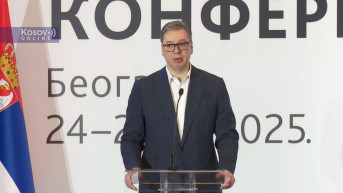
At the Ambassadors’ Conference in Belgrade, Serbian President Aleksandar Vucic stressed that ambassadors must represent Serbia’s policy. At a time when a new wave of recognitions has begun, that policy is clear: for Serbia, Kosovo is part of Serbia—it was so and it will remain so—in accordance with the UN Charter and UN Security Council Resolution 1244.
Addressing Serbia’s ambassadors around the world, he emphasized that an ambassadorial post cannot be a matter of personal comfort, but rather perseverance in a daily struggle for Serbia’s interests.
“When I say this, I mean a real struggle, not currying favor with the host country. Your task is not to please a minister or some official of an organization, but to do your job in the interest of Serbia. Please always bear in mind, when implementing policy, that while you may add a personal touch, the policy you represent must be the policy of Serbia,” he said.
Vucic noted that many feel uncomfortable speaking about the Kosovo issue, adding that regardless of what others say or cite, no agreement has been respected—neither by Pristina, nor by the EU, nor by the United States.
“For us, Kosovo and Metohija is part of Serbia; that is how it was and how it will be, in accordance with the UN Charter and Resolution 1244. I know it is not pleasant to have to speak about this, but that is the reality and neither you nor they will change it. Please let there be no debates or discussions about this. Everywhere it will be a factor, because they have launched a new wave of recognition of Kosovo’s independence,” he explained.
He pointed out that Sudan and Syria recognized Kosovo under the influence of Türkiye and Saudi Arabia.
“We should have no illusions about the need for good relations with those countries, but we should not hide or pretend we do not understand what this is about—namely, others’ pretensions to our territory and to the entire regional space,” Vucic stressed.
He underscored the need for unity and clarity, noting that Serbia does not want conflicts and will continue to talk and strive to resolve its problems.
“We will have to keep working and continue the hard, demanding effort of de-recognition. We have certain things in our safe, and it is only a matter of time before we present and disclose them. We refrained from disclosure so as not to hurt anyone. But we no longer have reasons for that, as we are pressed against the wall. We will fight for our own,” he said.
Vucic added that, in line with major global changes, the role of state representatives is also changing.
“In the past, ambassadors served to establish closer and faster contacts. Today, there is no need for that because of new technologies. Your job increasingly involves shaping policy by influencing people in those countries in various ways. Only someone who loves the job and is fully dedicated to it can do it,” he explained.
He noted that there is often fierce competition for ambassadorial posts in wealthy European countries, while until recently almost no one wanted postings in South America or Africa.
“That is a hard message for all of us, because it shows that people are not thinking about Serbia. Times are changing, and countries that were once unimportant to us are becoming increasingly important. We must strengthen our presence in Asia, Africa, and South and Central America. This is due to growth rates on those continents, which are much higher than in Europe and Central America,” he said.
Vucic emphasized the need to strengthen embassies in China and Japan, and to open an embassy in Vietnam and other countries.
Key Objectives: Preserving Peace and Stability, Territorial Integrity, Economic Growth, and the Path to the EU
Vucic stated that Serbia’s first and most important objective is preserving peace and stability—an objective that, he noted, will be the hardest to achieve in the period ahead, and therefore the most important.
“Every day it becomes harder to preserve peace,” Vucic said.
He illustrated how circumstances are changing by citing the conflict in Ukraine: allies initially said they would not deliver weapons to Kyiv, only equipment; yet deliveries progressed from light arms to short-range weapons and then to the most advanced systems for striking targets in Russia. He also observed that Russian targets changed during the operation itself.
“It is quite clear that even if this were to stop tomorrow—and Serbia appreciates the efforts of U.S. President Donald Trump in that direction—an open conflict between Europe and Russia would continue,” Vucic warned.
He added that this is also visible in the region, when sudden meetings take place between Pristina, Tirana, and Zagreb—meetings that many dismiss.
“Why did they sign an agreement on cooperation and a military alliance? Why did they expand it with Slovenia, and why are they trying to draw Bulgaria into these processes? It is certainly not for newspaper headlines… When I spoke with the NATO Secretary General and everyone in the EU, they all shrugged their shoulders… And we see the consequences—from professed respect for the UN Charter and Resolution 1244 to unequivocal U.S. arming of Albanians in Kosovo and Metohija. Not to mention Türkiye,” Vucic said.
He stressed that the goal is the direct endangerment of Serbia—its territorial integrity—and attacks on civilians and Serbia’s military-police structures.
“There is no other goal,” President Vucic underlined.
He also mentioned Croatia’s rearmament, pointing to a permanent campaign against Serbia, the Serbian people, and Serbia’s representatives.
“Against whom is this directed—whom are they protecting themselves from? They are a NATO member, and NATO is presumably strong enough at any moment to defeat a small Serbia, even though they know our policy is not to attack anyone in the region. So why the armament? Against Austria? It won’t be,” Vucic said.
Serbia, he continued, has understood all this and must therefore strengthen itself; as it builds capacity and its economy grows, it cannot be endangered.
“That is why it is important to talk everywhere and resolve problems through dialogue. It will not be easy, but we must preserve peace. We lost generations in the last century; it is time to have a century of peace, stability, and security for our citizens,” Vucic said.
As a second objective, he reiterated the fight for Serbia’s territorial integrity.
“There are no special talks about that objective, except about how to regulate our relations—not on the principle of mutual recognition of states, but on improving people’s lives. However, there must be no deviation from the Constitution and Serbia’s territorial integrity,” Vucic said.
He also listed accelerating Serbia’s economic activity as a key objective, which will require increasing the presence of Serbian diplomats in Asian, African, and Latin American countries—especially those ready to fight for attracting investment.
Serbia’s goal, he emphasized, is EU membership, while noting that limits must exist.
“Serbia is on the European path. We must do everything to move forward on that path. Continue that work, but boundaries must exist. The boundary of humiliation is the final boundary,” Vucic said, referring in particular to pressures from Brussels regarding the selection of REM members.
UN General Assembly Vote on the Srebrenica Resolution
The President recalled the vote on the Srebrenica Resolution at the UN General Assembly, stating that thanks to the self-sacrificing work of Serbian diplomacy, Serbia prevailed over major powers.
“They did not ask us when they adopted a resolution against our people, branding them as genocidal. They did not consult us on whether we could accept anything. I am speaking of a European power that found Rwanda as a co-sponsor, presumably to boast given all the terrible things that happened in that country in the past… Thanks to the enormous engagement of all who worked diligently and selflessly, we showed that a small country can oppose and defeat big ones. This is the first major defeat for most EU countries—excluding a few—and the United States, despite pressure on smaller countries worldwide. Through tremendous struggle, strength, and energy, we achieved a great victory, regardless of how they calculate it,” Vucic said.
Lack of Support in Difficult Times
The President added that Serbia had expected major advances from the U.S. administration, but that such advances have not been felt so far.
“Tariffs, sanctions on NIS—none of this served Serbia’s interests. When times were hard, we did not receive support from other powers, neither from the East nor from the EU. Any of them could have said: we are here with you. But none did. Everyone had their own reasons for pressure, expecting more from Serbia—demanding much and giving nothing,” Vucic emphasized.
He said Serbia understood the message and is aware it cannot stand alone, which is why it remains on the European path.
“But this is a lesson for us: we must take care of ourselves, even be selfish, strive to do as much as possible for our citizens, and not worry about whether someone else will be pleased with us or not. I do not care what they think of us, and it is good that they showed what they think and what they want for us in the hardest moments for our country,” Vucic said.
He asked ambassadors and consuls to present all technical problems in the functioning of diplomatic-consular missions during the conference so that solutions could be sought together.
Djuric: The Ambassadors’ Conference Is an Opportunity to Jointly Define the Way Forward
Opening the conference, Serbia’s Foreign Minister Marko Djuric noted that we live at the intersection of eras—a situation few generations experience—placing special responsibility on Serbian diplomats as events unfold at lightning speed, in line with the adage that sometimes decades pass without anything happening, and then weeks occur in which decades happen.
“In such a time, holding a gathering like this is both a necessity and an opportunity to assess the circumstances we face and, through joint effort, define the way forward,” Djuric said.
He recalled 2019, when at a pre-election rally in Novi Sad—although he expected a speech focused on “domestic politics”—he instead heard a strategic, programmatic address by President Aleksandar Vucic.
“I heard an address that succinctly summed up the national program of our time: preserving stability as an imperative; preserving independence in internal and foreign policy; economic development at the center of policy; care for preserving the demographic structure; and safeguarding the identity and cultural heritage of the Serbian people. It is a policy clearly oriented toward the future. Instead of promises, President Vucic—without realizing it—set the Serbian national program of our era,” Minister Djuric said.


0 comments