
Vucic: Sincere support for Slovakia’s territorial integrity; Pellegrini: Serbia is key to preserving peace in the region
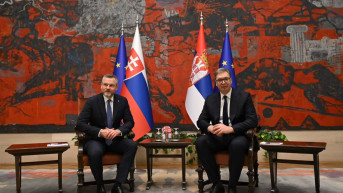
After meeting with Slovak President Peter Pellegrini, Serbian President Aleksandar Vucic said today that Bratislava’s support for Serbia’s European path is sincere, unequivocal, and courageous at a time when such positions are not easy to voice. Vucic also expressed gratitude to Slovakia for respecting Serbia’s territorial integrity, international public law, and the Charter of the United Nations. President Pellegrini stressed that Serbia is crucial to maintaining peace and stability in the Western Balkans.
At a joint press conference, Vucic said the two presidents discussed all key aspects of cooperation, bilateral relations, the enhancement of economic ties, and concrete issues such as the position of the Slovak community in Serbia.
“We discussed Serbia’s European path, once again expressing gratitude to Slovakia for respecting Serbia’s territorial integrity, international public law, and the UN Charter—principles on which Slovakia can always count on Serbia’s support,” Vucic emphasized.
He added that they also addressed global issues and agreed that preserving peace and stability is of paramount interest to both Serbia and Slovakia in today’s turbulent times.
“We must help one another and work closely to safeguard peace, which is of great importance for our numerically small but dignified and proud nations,” the Serbian president said.
Vucic extended special thanks to Slovakia for what he described as its unequivocal, sincere, and full support for Serbia’s EU path.
“I am deeply grateful to President Pellegrini and Prime Minister Robert Fico for their sincere, open, and courageous support at a time when this is not easy and when many prefer not to speak publicly. People in Serbia greatly appreciate this. Slovakia is among the most popular countries in Serbia, and people in Serbia genuinely like Slovaks and Slovakia. We are bound by a long tradition and historical closeness, and we are ready to continue working together. Slovakia will always have in Serbia a devoted, loyal, and sincere friend—just as we have in you today, in these difficult times in Europe,” Vucic said.
He noted that the two sides agreed to continue military-technical cooperation and cooperation between their defense industries, observing that Slovakia is very strong in this area and that Serbia is not weak either—expressing confidence that this would yield good results.
Vucic also said they discussed energy issues and greater engagement of Slovak companies in Serbia, particularly in renewable energy. He explained that Serbia currently lacks sufficient expertise in nuclear energy—without which there will not be enough electricity in the future—and that Slovakia produces its cleanest power from nuclear plants. They therefore discussed opportunities for Serbian experts to gain knowledge and experience in Slovakia.
He added that Serbia would do everything possible to attract additional Slovak investment and announced that the two presidents would visit the Slovak community in Vojvodina tomorrow.
“It is a great honor to host you in Serbia, because there is no need to explain how close our peoples are. We view Slovaks as sisters and brothers and will always treat them as such,” Vucic said.
Pellegrini: Serbia Is Key to Maintaining Peace and Stability in the Western Balkans
President Pellegrini emphasized that Serbia is crucial to maintaining peace and stability in the Western Balkans, underscoring that Slovakia is a friend of Serbia and will continue to support its European path.
“Our government’s position is that once conditions are met, the doors to membership must be opened. We reject the introduction of political games into accession negotiations, the imposition of illogical conditions, and processes not based on the same requirements we ourselves had to meet,” Pellegrini said.
He added that Slovakia—and he personally as president—would voice opposition if political games or extra-procedural conditions were introduced into the accession process.
“If Serbia meets the conditions, it must have the right to become a member,” Pellegrini underlined.
He warned that if the EU continues an approach that is not always fair toward Western Balkan countries, there is a risk that the region’s population will lose interest in accession.
“I will be brief and clear—Serbia has Slovakia’s support,” Pellegrini said.
He noted that Serbia and Slovakia enjoy excellent relations, unburdened by problems and based on respect and trust. He welcomed the planned joint visit to the Slovak minority in Vojvodina and thanked Serbia for supporting projects of the Slovak minority.
Pellegrini said Serbia is Slovakia’s most important economic partner in the region, with cooperation reaching €1.2 billion annually, confirming that the defense industry is one of the pillars of that cooperation.
“Slovakia has doubled its production, which requires close cooperation with Serbia, which supplies goods we need. Without Serbia’s assistance, we would not be able to realize our production,” he added.
He also said that Slovakia, which operates nuclear power plants, is making its experience available to Serbia and invited President Vucic to visit Slovakia at the earliest opportunity to continue discussions.
“We are facing enormous geopolitical challenges and a loss of competitiveness. Multilateralism is eroding—yet Slovakia needs it to pursue its interests. We want peace, not only in our neighborhood but globally. There are many conflicts today, and the situation is dangerous,” Pellegrini observed, adding that Slovakia supports diplomatic solutions and welcomed U.S. President Donald Trump’s efforts to resolve the conflict in Ukraine.
“We hope that conflict will be concluded in 2026. Slovakia will gladly help with Ukraine’s reconstruction, as will Serbia,” Pellegrini said.
Responding to journalists’ questions on Cluster 3, Pellegrini said the EU is playing with the trust of Western Balkan citizens and that delaying the opening of Cluster 3 in Serbia’s negotiations is a political game by some member states.
“I know I will be criticized for this, but I am always frank. If someone meets the conditions, they should be allowed to open clusters. The Union should act on facts, conditions, and criteria—not inject excessive politics—because citizens of this region will lose trust in our project, which would be a major mistake. On this issue, the EU is not acting in line with its standards; there is too much politics, as seen in its approach to Serbia. That is why our prime minister was very clear at the last summit,” Pellegrini said.
Vucic once again expressed gratitude for Slovakia’s consistent and strong support.
“Their voice is always heard, and people in Serbia notice it,” he said.
He noted that everyone in Serbia knows the reason the EU did not open Cluster 3.
“Since the war in Ukraine, we have not opened a single chapter… Something would always arise, the goalposts would move. In the meantime, we even amended the Constitution in the area of the judiciary—as a cornerstone of faster progress—yet no chapter was opened. Political obedience was demanded of us the entire time. We remain on the EU path, committed to it, and we hope that with the support of friends we will manage to make progress,” Vucic said.
He acknowledged, however, that he does not expect major changes from the EU on this issue.
“All the small countries around us have been used to contain Serbia. When Serbia grows stronger, the big players use the small ones to spread anti-Serbian propaganda and scare their populations—claiming others are good and fine except us. We will not easily reverse that situation, but we must respect our friends and focus on ourselves—on economic growth and living standards. Within Cluster 3, we have already opened five chapters, with three remaining, so this was a political message,” Vucic said.
He concluded that Serbia must continue to work to preserve peace, noting that in just six to nine months this would prove to be the key and most important decision.


0 comments