
Vucic: Security and position of Serbs in Kosovo, as well as double standards and morality, to be key topics in New York
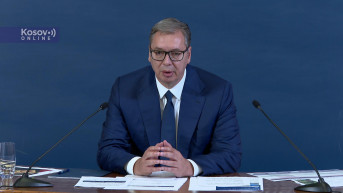
Serbian President Aleksandar Vucic said today that the key topics of his address to the United Nations General Assembly in New York would be the security and position of Serbs in Kosovo, as well as what he described as double standards and double morality within the international community.
“The key topic of my speech will be the security and position of Serbs in Kosovo and Metohija. This time, I will speak—and each time I have tried to explain the position of our country, which is on the European path but belongs to the Global South—about all the deceptions we have experienced over the past three decades, about false principles, hypocrisy and double standards. About how they explained to us that our people had to be handed over to the Hague Tribunal, yet we received nothing in return. We signed numerous agreements, and each time they were violated by those who had themselves signed them—those who were supposed to guarantee them,” Vucic said during an appearance on Radio Belgrade.
He said he would fight for the position of Serbia and the Serbian people, as he had also done regarding Srebrenica.
Vucic recalled that Serbia had faced criticism from Europe over the funeral of Ratko Mladic, while, he said, no one was now reacting to the rejection of the judgment against the KLA leaders.
“Imagine that—they criticized us, and there was practically no one in Europe who did not speak out about Mladic’s funeral, as though it could somehow have been avoided. It was foolish and pointless. What horrified them was the sight and the number of people, and that is the essence of it. There were no state-organized events in Serbia, no declarations against The Hague, even though the Hague Tribunal acted in an extremely immoral manner because they knew he was dying and did not allow him to die surrounded by his family. And then they told us that we must not deny judgments,” he said.
Vucic pointed out that the first-instance judgment against the KLA leaders had, in his words, been vehemently rejected by Albania, official representatives of Montenegro and North Macedonia, and Pristina, who had described it as disgraceful and unacceptable and said that it would be overturned.
“There was not a single reaction from Europe to the rejection of decisions by courts that they themselves regard as valid, important and impartial. I personally do not think highly of the Hague Tribunal, the Kosovo Chambers or the International Criminal Court, but they do. Yet there has not been a single word. They can attack EULEX and there are no demands that those responsible for the attack be punished. But it is their creation and they can do whatever they want, while Serbs have no right either to grieve or to celebrate,” the Serbian President said.
He reiterated that no one could explain this to him.
“I asked my colleagues about it at the Carpathian Initiative as well. I have to be honest and fair—some of them said, ‘Leave it, we know all about it.’ We Serbs have to understand that this is the era we live in. They will never admit that they made a mistake. As far as they are concerned, we should be delighted that they took 14 percent of our territory. If we do not say that, they will ask why we are looking to the past instead of the future. But if we ask why they do not say the same thing to Ukraine, they have nothing to say. And I believe Ukraine has the right to protect its territorial integrity,” Vucic stressed, describing this as an example of false principles and double standards.
Speaking about the Carpathian Initiative, he said it had been an important gathering during which he met with the presidents of Romania and Ukraine and the Prime Minister of Poland, representatives of countries with a combined population of around 90 million in Serbia’s immediate neighborhood.
He announced numerous meetings for the following week, both for himself and for the foreign and finance ministers, adding that he would attend a reception hosted by US President Donald Trump and hold talks with a large number of European leaders in New York.
“I believe I will also have a bilateral meeting with Sergey Lavrov,” Vucic added.
Vucic said that, while navigating “these crazy times,” it was important to do everything possible to preserve peace and stability and ensure security for all Serbian citizens, as well as security of oil and gas supplies. He said gas storage facilities were full and reserves stood at 690 million cubic meters.
He added that, given that elections had been held in Russia, he did not rule out a telephone conversation with Russian President Vladimir Putin.
Asked about his meeting with the Romanian President, Vucic said they had discussed transport links between the two countries.
“I believe we will build the Belgrade-Vrsac and Vrsac-Timisoara motorway, which would be the most important transport connection between the two countries,” the President said.
He said it was important to talk to the Russians about NIS, as well as about the gas contract that was due to expire.
“You only have to look at the Germans and Scandinavians practicing landings on one island or another, while others are conducting exercises elsewhere. This morning, drones attacked Moscow more heavily than ever before; yesterday or the day before, Kyiv and its surroundings were subjected to the heaviest attacks yet, as was Ukraine’s entire logistics infrastructure, including trains, locomotives and everything else. It is as though doomsday is approaching,” Vucic warned.
He reiterated that the root causes of the problems had not been resolved either in the Middle East or in the conflict between Russia and Ukraine, which he also described as a de facto conflict between Russia and Europe.
“I am afraid of what kind of winter lies ahead, but we know our job and we must preserve stability and peace, as well as ensure that the market is fully supplied with petroleum products and gas for our consumers. None of this will be easy, but I believe we can do it,” Vucic stressed.
Regarding a final solution to the situation involving NIS, he said it did not depend on Serbia, which had done everything within its power.
“I think there are now calculations on various sides, including over who is in power in Hungary and so on. There are also talks with the American side and among all the parties involved, so how this will ultimately be resolved, I do not know myself,” Vucic acknowledged, adding that the situation was complicated because every party had its own geostrategic and geopolitical interests.
“There is no doubt that, on the one hand, the Russians would like to keep it under their control, while the Americans would like to prevent the Russians from retaining it. At the same time, they are considering whether it would be better for a European country to take it over or whether they should take it themselves. On the other hand, the Hungarians certainly have a good business opportunity in all of this, but the question is whether it is in their interest to potentially oppose the Americans over it. It is a complete tangle that is not easy either to explain or to understand,” the President added.
Vucic also said that he did not rule out speaking by telephone with Russian President Vladimir Putin today following the elections in Russia.
Commenting on European Commission President Ursula von der Leyen’s decision not to include Belgrade in her visit to the region next month because of the upcoming elections in Serbia, Vucic said that this was indeed one of the genuine reasons, although she could still meet Serbia’s legitimate representatives if she visited Belgrade at that time.
“At that point, she could meet the acting President, the caretaker Prime Minister... It does not make much sense, because you will have legal institutions at that time, even if they do not have a fresh political mandate because the election campaign is underway,” Vucic said.
Regarding the recently opened Israeli drone factory in Serbia, Vucic said that Serbia was beginning to implement the concept of a digital army, something that had also been demonstrated during the military exercise at Pester.

0 comments