
Vucic: Serbia fully supports Macron-Merz proposal on gradual EU integration
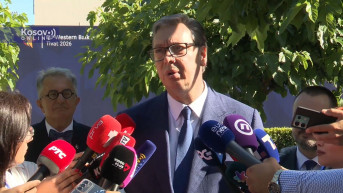
President of Serbia Aleksandar Vucic stated today in Tivat, following the EU-Western Balkans Summit, that Serbia fully supports the proposal put forward by French President Emmanuel Macron and German Chancellor Friedrich Merz on the gradual integration of candidate countries into the European Union.
“Regarding the Macron-Merz proposal on gradual integration, we are absolutely in favor of it. We believe it is a good proposal that will change the pace and energy of the accession process to the European Union. It does not mean avoiding obligations; rather, it means that once you fulfill your obligations, you receive recognition and are able to sit at the table,” Vucic told reporters.
He noted that the day in Tivat had been highly productive, as he held discussions with almost all participants attending the summit.
“I had lengthy talks with the Prime Minister of Belgium and the Prime Minister of Denmark, a dedicated bilateral meeting with the Prime Minister of Ireland, as well as discussions with the Prime Ministers of Spain and Slovenia, among many others. I believe we have further strengthened our bilateral relations. We discussed mutual visits and what we can do together in the future,” Vucic said.
He expressed confidence that Serbia would open Cluster 3 in the coming period and would also be ready for Cluster 2, as well as for the opening of additional negotiating chapters.
“These are very positive developments. It was an open and sincere discussion. A very positive day for our country, a good day for Europe and the Western Balkans,” Vucic said, adding that several countries, ranging from Lithuania to the Benelux states, had insisted on full alignment with the EU’s foreign policy, including the introduction of sanctions against Russia, which they requested from Serbia.
Kosovo Discussed During Bilateral Meetings
Responding to a question on whether Kosovo had been discussed during the summit, Vucic said that he had addressed the situation in Kosovo during his bilateral meetings.
“I saw that Pristina’s representative spoke about Serbia, referring to us as ‘little Russians’ and talking about malign influence—you know the usual rhetoric. Most others did not. However, in the bilateral discussions I had, from Prime Minister Mitsotakis to Prime Minister Fico, I spoke about Kosovo because it is an important issue,” Vucic said.
Asked what other topics had been raised at the gathering, he replied that Serbia must complete reforms related to the Venice Commission, ODIHR recommendations concerning electoral legislation, and the Regulatory Authority for Electronic Media (REM).
“If we were to fulfil those requirements, we would open Cluster 3 and pave the way for opening other clusters as well,” Vucic added.
Asked about relations with Montenegro, he reiterated that Serbia is interested in every form of cooperation and that there is considerable room for further progress.
He pointed out that the Port of Bar would find it difficult to achieve substantial profitability or strategic significance without being connected to Serbian industry, which he described as the only major industrial base in the region.
“I will always invite our partners from Montenegro to engage in dialogue,” the Serbian president said.
Asked whether he had met with Serbian political representatives in Montenegro, Vucic replied that he had not.
“I did not meet with anyone, although I am always willing to do so. Milan Kneževic injured his shoulder, and I was also unable to see Andrija Mandic. There will be opportunities on another occasion, including in Belgrade. I am always ready for discussions and for exchanging views on the position of our people,” Vucic stated.
Asked whether Serbia would cooperate with Montenegro regarding the extradition of former President of the State Union of Serbia and Montenegro, Svetozar Marovic, Vucic replied that Serbia would first seek cooperation with Montenegro on issues related to respect for the United Nations Charter and United Nations Security Council Resolution 1244, which, he emphasized, is “a thousand times more important, more serious, and more complex issue.”
Commenting on the broadcast of a concert by Marko Perkovic Thompson on Croatia’s public broadcaster, Vucic said that Serbia and Croatia must nevertheless work towards building different and better relations in the future. As for Nazi-style salutes, he noted that he had already expressed his views on the matter on previous occasions.
“The Serbian people, who suffered greatly in the past, know better than anyone what such salutes have brought throughout history. As far as we are concerned, we will continue to demonstrate our anti-fascist character wherever possible and remain committed to preserving the truth,” President Vucic said.

comments