
Vucic: Serbia will defend its territorial integrity and the UN Charter
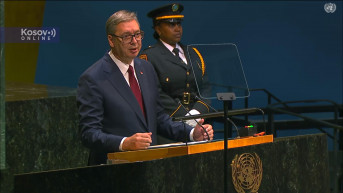
Serbian President Aleksandar Vucic said in his address to the United Nations General Assembly that the international order based on respect for the United Nations Charter and the law founded upon it no longer existed, and that all countries that had recognized the “unilaterally declared independence of so-called Kosovo” had participated in violating the UN Charter. He stressed that for ten years he had faced pressure aimed at abandoning the full implementation of the Brussels Agreement, which had been endorsed by the EU’s signature, and said that Serbia would defend its country, its territorial integrity, the United Nations Charter and UN Security Council Resolution 1244.
Vucic said that the international system had collapsed and that the world was witnessing the emergence of a new order centered around two main poles of power. He said that the order based on respect for the UN Charter had been destroyed by those who had carved up the territories of other countries in pursuit of their own interests, acting unscrupulously and shamelessly.
“‘Renewing trust, managing transformation: United Nations delivering results for everyone’ describes, to some extent, the moment in which we find ourselves. I agree that we need to restore trust in the United Nations, but I am not sure to what extent we can manage a transformation that has already taken place,” Vucic said.
Vucic stressed that the world was entering a period characterized by a more complex and less predictable distribution of power, in which the danger of conflict was greater.
“The international system as we knew it has collapsed. It no longer exists. Today, we are witnessing the birth of a new order centered around two main poles of power, alongside a growing number of powerful regional actors that possess significant political, economic, military and technological capabilities and seek to independently influence the shaping of their own environment and broader global processes,” he stressed.
According to him, this was not only about conventional armed conflicts between states, as conflicts were increasingly being waged through economic pressure, cyberattacks, disinformation and attempts to influence other societies.
“Moreover, this is not merely about conventional armed conflicts between states. Conflicts are increasingly being waged through economic pressure, technological restrictions, competition for resources and markets, cyberattacks, disinformation and attempts to influence other societies. Cultural and identity-based divisions are also becoming increasingly pronounced, politically instrumentalized and used to further deepen mistrust among peoples. The boundary between peace and conflict is becoming increasingly blurred, while the consequences of confrontation among major and regional powers are affecting ever more rapidly even those states that are not directly involved,” he stressed.
He said that for small and medium-sized countries such as the Republic of Serbia, such an environment represented an enormous challenge. According to him, the space for independent decision-making was narrowing, while pressure on states to choose one side was increasing.
“At the same time, disagreements among the most powerful actors are increasingly paralyzing institutions that are supposed to protect all states equally. The traditional system of international justice has been seriously undermined when interests become more important than law and the same rules do not apply to everyone,” Vucic said.
He stressed that the greatest problem today was not the absence of rules or political principles, but the failure to respect them, both in the past and today.
“The greatest problem today is not the absence of rules or political principles, but their disregard in the past and in the present. You will notice that today, with the exception of a few countries, everyone speaks about and invokes the UN Charter, the spirit of the Charter and the principles on which the world order that existed until recently was founded. It is as though they want to tell us that what happened in the past no longer matters—that we destroyed and violated that Charter, thereby opening a Pandora’s box that is impossible to close, but today we would like, without consequences, to return to the future,” Vucic explained.
He stressed that the very same principles that powerful and major countries had so brutally violated were now principles they sought to revitalize.
“How many times over the past two days, from this very podium, have you heard appeals and calls for respect for the principles of international public law, particularly when it comes to the conflict in Ukraine, while most of those same countries brazenly and recklessly remain silent about the fact that they themselves participated in violating the Charter and destroying the foundations of the international public-law system? Today, they want at any cost to return to those principles when they see that those who are more powerful and stronger have resorted to the same violations that they themselves committed when they were the most powerful and the strongest,” Vucic said.
He pointed out that the international order based on respect for the UN Charter and the law founded upon it no longer existed and that all countries that had recognized the “unilaterally declared independence of so-called Kosovo” and, without any basis in international legal documents, had sought to take 14 percent of Serbia’s territory had participated in violating the Charter.
“To many of you, this may sound like the distant past, but the wounds inflicted on international public law are becoming deeper and more severe. To be completely precise, the order based on respect for the UN Charter and the law founded upon it no longer exists. It was destroyed by those who carved up the territories of other countries in pursuit of their own political and economic interests. They did so unscrupulously, recklessly and shamelessly. Do you know what the sole official and formal reason was for the attack on the territory of the Republic of Serbia and the Federal Republic of Yugoslavia carried out by 19 NATO countries? You will not believe it. We were told that they attacked a sovereign, free and independent country in order to avert a potential humanitarian catastrophe,” Vucic stressed.
He said that the humanitarian catastrophe had not occurred and that he had yet to hear of or see a comparable example anywhere else in the world.
“The attack on that small but free and freedom-loving country, Serbia, was carried out with the intention of finally destroying the UN order established after the Second World War and formally and informally confirming the dominance of what was then a united Western world—the United States and Europe. Do you know which countries participated in adopting a UN Security Council decision to bomb an independent and sovereign country that had not attacked any other country? Not a single soldier or police officer from Serbia had set foot on the territory of any other country, and yet the decision was supposedly made,” Vucic noted.
He said he was certain that even most of those most familiar with world politics could no longer remember who had voted for such a decision in the UN Security Council, or perhaps in the General Assembly.
“Do not even try, because it is impossible to remember. Why? Because such a decision was never adopted, and, to make matters worse, no one ever even attempted to adopt one. They were so arrogant and powerful that they trampled over everything before them—from the Clinton administration to the governments of numerous European countries,” Vucic said.
For that reason, he added, Serbia supported the work of President Donald Trump’s administration and saw in it an opportunity to establish a more just international order and a more responsible approach toward Serbia as a close US ally in both world wars.
“And what they did not know or understand at the time was this: they trampled on Serbia, but they did not defeat it. Serbia rose like a phoenix from the ashes. Today, through its own example, it shows everyone in the world how the international public-law order is preserved and how international public law is protected. Nevertheless, the consequences of that brutal attack on Serbia are enormous and particularly visible here in the UN General Assembly—and, indeed, even more so on the numerous battlefields around the world. Why? Because principles, any principles, no longer exist. Those who once violated them have no moral right to speak about them,” Vucic said.
To make matters worse and the hypocrisy even more apparent, the Serbian President said, those same actors now positioned themselves as supreme arbiters of morality and protectors of every kind of value of the contemporary world.
Vucic stressed that for ten years he had faced every conceivable form of pressure aimed at abandoning the full implementation of the Brussels Agreement, which had been endorsed by the EU’s signature, and reiterated that Serbia would defend its country, its territorial integrity, the UN Charter and UN Security Council Resolution 1244.
He said that for four and a half years he had been listening to lectures about how many in the West were the world’s remaining beacon of democracy and defenders not merely of Ukraine, but of the rules and principles of international law.
“And when they raise their voices, believing themselves to be highly moral and their positions to be the only correct ones, we simply smile and ask: How did you treat Kosovo and Metohija and Serbia’s territorial integrity, which is guaranteed by the UN Charter and UN Security Council Resolution 1244?” Vucic stressed.
There was no answer to that question, he said, although “they kindly tell us and advise us not to look to the past, but to the future.”
“When we ask them, ‘Do you also tell Ukraine that the territories it is fighting for are not important?’ we end the pointless conversation and move on to another topic. And I want to warn all of you—all of you here who belong to the Global South: when you sign agreements with major powers, keep your eyes wide open,” Vucic warned.
He recalled that the Brussels Agreement had been signed in 2012 in an effort to resolve problems between Serbs and Albanians in Kosovo through compromise, and stressed that Serbia had fulfilled all of its obligations, while the sole obligation undertaken by the Albanian side—the establishment of the Community of Serb Municipalities—had still not been fulfilled.
“Interestingly, the agreement was not only accepted in the presence of the EU, but was also endorsed by the EU’s signature, yet that proved to be worth nothing,” Vucic said.
He stressed that, as President of Serbia, he had spent ten years facing all manner of maneuvers and pressure aimed at abandoning the full implementation of what had been signed.
“That is a lesson for us Serbs, but also for everyone else in the world who wants to protect and preserve their country. Despite everything, Serbia will defend its country, its territorial integrity, the UN Charter and UN Security Council Resolution 1244,” Vucic said.
The President thanked each of the 107 countries that had not recognized Kosovo.
“We know that many of those countries have been subjected to pressure, and we know that maintaining a principled position is sometimes far more difficult than it appears from the outside. Thank you for your consistency in not recognizing the independence of part of Serbia’s territory,” Vucic said.
Rise of Nazism in the region
Vucic said that Serbia was once again witnessing what he described as the rise of Nazism in its neighborhood, particularly in Croatia, and said that the Serbian people, who had suffered heavily at the hands of the Nazis, could not accept this.
“For us in Serbia, it is most difficult when we see Nazism once again being elevated onto the pedestal of social values in our neighborhood, particularly in Croatia, which takes pride both in its Nazi past and in the use of Nazi slogans and symbols today,” Vucic said.
He said that the Serbian people, as a people who had suffered enormously at the hands of the Nazis, could not accept the revival of what he described as the darkest forces of the past, responsible for the deaths of hundreds of thousands of Serbs, Jews and Roma in monstrous concentration camps such as Jasenovac.
“That is precisely why the moral lectures we hear from such actors are completely unacceptable to the Serbian people and Serbia,” President Vucic stressed.
Serbia supports the UN and reform of the world organization
The Serbian President also said that the world needed the United Nations more than ever, but that the organization had to become more effective, more capable of addressing the issues for which it had been created and better adapted to contemporary realities. He stressed that Serbia supported both the UN and reform of the UN system.
“We must anticipate the consequences of a world in which force is once again increasingly openly presented as the most reliable instrument of policy, where military budgets are growing, conflicts are multiplying, arms-control mechanisms are weakening, and channels of communication are disappearing precisely when they are needed most. We must therefore ask an essential question: Where are the United Nations in such a world? The Security Council is often blocked precisely during crises in which it should be most active. Other parts of the UN system face financial pressure, overlapping mandates, bureaucratization and legitimate demands from member states for more tangible results,” Vucic said.
He added that these were genuine problems and there was no benefit in glossing over them, but that this did not mean the United Nations was needed any less.
“We may need it more than ever, but it must be more efficient, more focused and more prepared to address the issues for which it was created. Over the past eight decades, states have not come to this building because they shared the same interests, but because they understood that the cost of resolving disagreements through armed force was too high. That is why multilateralism emerged and why we are here today. Serbia supports the United Nations and reform of the UN system so that the organization can become more effective and better adapted to contemporary realities,” Vucic said.
He added that Serbia advocated a more representative UN Security Council through greater representation of developing countries, particularly from the African continent, as well as more inclusive regional representation and an additional seat for the Eastern European Group.
“However, without a genuine return to the principles on which we have already agreed, I do not expect progress in terms of concrete UN results,” Vucic said.
He pointed out that peace was not the only test of the international community’s ability to manage change.
“We are in the midst of a technological transformation whose full scope we are only beginning to understand. Artificial intelligence is already changing the economy, education, medicine, security, the labor market and the way states function. It can bring enormous benefits to humanity. It can also deepen existing inequalities, enable new forms of manipulation and create security risks that we could only have dreamed of a few years ago. During our leadership cycle in the Global Partnership on Artificial Intelligence, which Serbia chaired in 2025, one of our priorities was to ensure that technological progress remained linked to safety, human rights, the rule of law, accountability and reducing the digital divide,” Vucic said.
He recalled that the Belgrade Ministerial Declaration had received the support of 44 member states and the European Union and had reaffirmed the need for safe, sustainable and human-centered artificial intelligence.
“The more powerful technology becomes, the more responsible the people who manage it must be. We can have the most advanced algorithms, quantum computers, drones, systems and artificial intelligence capable of processing in seconds data that previously required years. At the same time, if we allow the fundamental rules of the international order to be applied selectively, technological progress will not bring security. It will merely make us more technologically advanced in a world that has become politically less predictable,” Vucic said.
He stressed that if the international community wanted to responsibly manage the transformation ahead, it first had to reinforce the foundations on which the international system rested.
“Those foundations are simple: the sovereign equality of states, respect for territorial integrity, the prohibition of the use of force except in cases explicitly provided for by the UN Charter, and the obligation not to change the rules from one case to another,” Vucic said.
He expressed gratitude to all countries that had honored Serbia by confirming their participation in Specialized Expo 2027, which will be held in Belgrade next year.
He then returned to the issues of trust and responsibility.
“We will not restore trust through grand statements and declarations if we continue afterward to behave as we did before. Each of us must begin with our own decisions. Serbia is trying to do so by preserving peace in its neighborhood, participating in peacekeeping missions far beyond its borders, helping others when they are threatened, talking even to those with whom it disagrees and fulfilling the commitments it undertakes. More actions like these are what will restore trust in international law and in the United Nations,” Vucic said.
Serbia on the European path
Vucic reiterated that Serbia remained on its European path, but said its citizens rightly expected a clearer perspective and more tangible results from a process in which the country had participated for more than a decade.
“We are grateful to the European Union, particularly European Commission President Ursula von der Leyen and European Council President Costa, for every form of assistance they have provided and continue to provide to our country. Although full membership in the European Union remains our strategic priority, we cannot fail to notice the prolonged enlargement fatigue both among certain EU member states and among candidate countries,” Vucic reiterated.
He said that Serbia’s European path was itself a good example of the length and complexity of the process, recalling that Serbia had obtained candidate status in 2012 and opened accession negotiations in 2014—more than twelve years ago.
“Serbian citizens therefore rightly expect a clearer perspective and more tangible results from a process in which our country has participated for more than a decade. In circumstances in which it is uncertain whether the next enlargement of the European Union will take place in the near future, we have sought to be constructive and propose practical ways of overcoming the existing impasse,” Vucic said.
This, he said, was the reason for the proposal to allow the Western Balkans to gradually join the European single market and gain access to the Schengen Area even before attaining full EU membership.
However, he added, a stable and integrated Europe, of which Serbia was a part, and Serbia’s European path did not mean abandoning traditional friendships. Thanks to those friendships, he said, Belgrade was one of the few European capitals with direct flights to the United States, the People’s Republic of China and the Russian Federation.
“I owe particular gratitude to President of the People’s Republic of China Xi Jinping for the support provided during the Covid pandemic, as well as for the enormous investments made in Serbia, and I hope that his talks with President Trump will be productive and contribute to stabilizing global affairs. At the same time, we nurture ties with our traditional friends and partners in Africa, Asia and Latin America, with whom we recently marked in Belgrade the 65th anniversary of the First Conference of the Non-Aligned Movement, held in our capital in 1961,” Vucic said.
He said Serbia’s openness reflected its development strategy, its history and its understanding of the world.
“Serbia believes that states can have a clear course and their own interests without closing the door to those with whom they do not agree on everything. After all, a world in which we speak only to those who think exactly as we do would have little need for diplomacy. Freedom and independence in decision-making are Serbia’s highest values,” Vucic said.
0 comments