
Western Balkans still far from EU quality of life, Kosovo weakest economy in the region
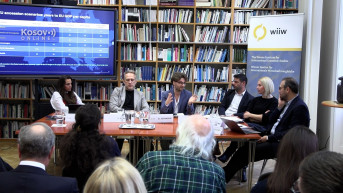
The Western Balkans remains far from the quality of life enjoyed by EU citizens, according to the Western Balkans Annual Convergence Report 2026 by the Vienna Institute for International Economic Studies (wiiw), which assesses quality of life in the region and the progress made by the six economies in converging toward living standards in the European Union.
The report was prepared as part of the Converge2EU project, which compares the six Western Balkan economies with the EU across eight key areas of everyday life: the economy, social affairs, healthcare, education, the environment, governance, digitalization and infrastructure. It examines whether the region is narrowing the gap with the EU and how long it could take to reach the EU average in each of these areas under different European Union accession scenarios.
Institute economist Ana Milinkovic presented the report, according to which the region is making progress, but only on the “easy issues,” while continuing to lag behind on the “hard issues.”
Montenegro, which leads the region in the accession process, is 21 years behind the EU in terms of GDP per capita. If it joined the EU, it could close that gap in 14 years.
Serbia currently lags 33 years behind, but EU membership could reduce the time needed to close the gap to 19 years.
Albania is 31 years behind, while EU accession could enable it to close the gap in 21 years. Bosnia and Herzegovina lags as much as 81 years behind, while even if it joined the EU, it would need 41 years to reach the EU’s GDP per capita level.
According to the report, Kosovo would need 62 years, while EU membership would allow it to close the gap in “only” 40 years.
North Macedonia is the furthest behind, requiring 100 years to reach the EU’s GDP per capita level, although EU membership would “shorten” that period to 50 years.
“The situation is such that the Western Balkans is currently at around 50 to 60 percent of the EU’s quality-of-life level, meaning roughly half the standard enjoyed by Europeans. And this is nothing new. We know the situation is not particularly good, but what matters more is whether there is progress. The main finding is that there has been some modest progress, but it is far too slow and needs to be much stronger,” economist Branimir Jovanovic told Kosovo Online.
He pointed out that Montenegro had made the greatest progress in the region over the past year, improving the quality of life of its citizens by one percentage point, while North Macedonia had actually regressed, with the other economies falling somewhere in between.
“We compared eight areas—the economy, social policy, education, healthcare, the environment, institutions, digitalization and infrastructure. The area in which the region performs best is digitalization. The situation is weaker in infrastructure, the environment and the economy. When it comes to the economy, there has been slight progress—wages have increased throughout the region—but what is problematic is that wage growth has not been accompanied by productivity growth. In other words, we do not have a productive base in the region, and it is not improving at the same pace as wages are rising,” Jovanovic explained.
He noted that the situation in education and healthcare was relatively good due to the legacy of socialism, but that both areas were either stagnating or deteriorating. This, he said, was problematic because long-term sustainable growth and progress were impossible without education and improvements in healthcare.
“When it comes to social policy, the situation is similar. We are not doing that badly compared with the EU because we inherited a relatively functional system from Yugoslavia, but the problem is that this is also deteriorating. That is the general picture. As for the areas that are not performing well, I mentioned infrastructure and the environment. Those are the weakest points, and what is particularly concerning is the lack of progress—they are actually regressing. That is the general picture in the Balkans. There is some convergence, but it is based too heavily on wage growth and certain minor improvements, while there is no real improvement in quality of life,” Jovanovic stressed.
Speaking about Kosovo, he said that there had been no significant progress over the past year and that political problems were also reflected in the data. According to him, Kosovo had stagnated or even regressed in certain areas.
“Kosovo has seen improvements in wages because both the minimum wage and the average wage have increased. That is the positive side. The social sphere performs better than some other areas, but even there the indicators remain fairly weak,” Jovanovic stressed.
He pointed out that Kosovo had the weakest economy in the region.
“That is hardly surprising, but Kosovo has not made significant progress either—or at least not enough for people to feel an improvement in their quality of life,” Jovanovic explained.
Political scientist Vedran Dzihic of the Austrian Institute for International Affairs stressed that all outstanding issues in the Western Balkans needed to be resolved for the region to make progress toward reaching EU levels.
He pointed out that there was now an opportunity to advance the enlargement process and that it should not be missed.
Donika Emini, founder and director of the foreign policy think tank D-Square, said that the authorities in Kosovo linked everything to relations with Serbia, even though those relations did not prevent them from implementing the necessary reforms in education, the public sector and healthcare.
She added that this was merely being used as an excuse.
Marko Kmezic of the Centre for Southeast European Studies said that differences were not as pronounced when it came to the rule of law and democratic standards, but were much more visible through an economic lens.
The Western Balkans Annual Convergence Report 2026 is the key annual reference document produced under the Converge2EU project. Moving beyond the traditional monitoring of the number of EU negotiating chapters opened and closed, the report systematically assesses living standards in the six Western Balkan economies in the accession process—Albania, Bosnia and Herzegovina, Kosovo, Montenegro, North Macedonia and Serbia—against EU-27 averages.


0 comments