
Anniversary of the murder of Dimitrije Popovic: A wound that still bleeds
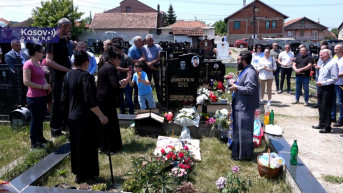
A memorial service at the cemetery, along with the laying of flowers and lighting of candles at the memorial chapel in Gracanica, marked the 21st anniversary of the murder of Dimitrije Popovic.
Family and friends gathered to commemorate the young man tragically killed by Albanian extremists in front of a fast-food kiosk.
Jorgovanka Popovic, Dimitrije’s mother, emphasized that her son was killed for no other reason than being a Serb.
“You could’ve just had a coffee together, not shot him. Parents should teach their children—regardless of nationality—to love, befriend one another, drink coffee, travel together. But instead, they shot my son, two meters tall, a good student, my youngest,” she said.
She added that despite the years that have passed, time has not healed the wound.
“A bleeding wound, my son, never heals. Never. You loved Gracanica, even as a little boy in Pristina—you loved visiting Uncle Ratko, playing with Dejan and Dalibor, your sister Sandra. You didn’t want to leave Gracanica, and here you are, my son—we are all here around you, your friends, your godparents, your neighbors, everyone known and unknown. Everyone mourns, because you are not the only victim in Kosovo and Metohija—many paid with their lives and soaked the roads with your blood, Serbian blood,” she said.
“Dimitrije Belonged to Christ”
Following the memorial service, Father Jovan Cvetkovic stated that Dimitrije’s life was not taken simply because he was young, or because his name was Dimitrije—but because, as he said, “Dimitrije belonged to Christ.”
“Christ’s Dimitrije suddenly became an obstacle to someone, and that young life was extinguished. Extinguished, but not forgotten. Woe to the one who has no one to remember them before God. And no one remembers the murderers—for before God, their evil will cast them into hell. Hell is their home, their homeland. That is the fate of every unrepentant sinner. The one who suffers, however, draws closer to his Creator, for man is made to dwell in and glorify God's presence. That glory is what man was created for—to share in it with the holy angels,” said the priest.
A Testament to the Latest Serbian Suffering
Writer and Dimitrije’s uncle, Ratko Popovic, noted that the memorial chapel dedicated to Dimitrije also stands as a testimony to the suffering of the Serbian people in recent history.
“We gather here in memory of our fallen to express our anger and bitterness toward those who come as so-called peacemakers, selling us democracy and love that they claim is equal for all. Here, we express a special love—for those who gave their lives for our sacred homeland, for our sacred lands inherited from our holy kings and emperors. We continue to witness today that Kosovo is a land we will never leave, and we want the beat of our hearts to reach our departed above,” said Popovic.
The memorial was attended by family, friends, representatives of the Office for Kosovo and Metohija, and members of the Serb List.
“Killed Only Because He Was a Serb”
Milos Terzic, Assistant Director of the Office for Kosovo and Metohija, emphasized that Dimitrije Popovic’s only “crime” was being a Serb—and that his death represents more than a personal tragedy, but a symbol of broader suffering.
“Even today, 26 years after 1999, shots are still being fired at Serbian children gathering Christmas oak branches. Albanian police officers, who under the Brussels Agreement have no mandate in Serbian communities, enter schoolyards, harass Serbian graduates—and all of this is met with silence from the international community. Silence from those who speak daily of the rule of law, multiethnicity, and human rights. The murder of Dimitrije Popovic, of children in Gorazdevac, the Stolic family—we spoke about it just yesterday—the Sutakovic family in Djakovica—these will forever remain a stain on the conscience of the entire international community. They came to Kosovo and Metohija after the adoption of UN Security Council Resolution 1244, with 50,000 heavily armed NATO and KFOR troops, and they failed to protect the Serbian people,” said Terzic.
He added that the Popovic family stands as a symbol of perseverance and sends a message of survival and rootedness in Kosovo—and that the Serbian people cannot and will not disappear.
“It is our duty to stand with our people in Kosovo and Metohija. They must remain a priority for every Serbian government. But it’s clear that the Serbian tear has no parent, and we cannot rely on the international community or the West. That’s why in the period ahead, all of us must contribute to strengthening the Serbian state—economically, politically, and militarily—because that is the only guarantee for preserving the Serbian people, interests, and national values in Kosovo and Metohija,” said Terzic.
“Dimitrije Was the Purest Victim”
Writer and journalist Zivojin Rakocevic called Dimitrije Popovic the “purest victim” and a symbol of child suffering in Kosovo.
“Evil knows precisely where to strike—and the core message of that evil is: ‘We will strike you where it hurts most—in your children, your cemeteries, your churches.’ That night, every Serbian heart trembled. No mother didn’t ask herself if it was safe to leave her child in Kosovo. Then came the answer—through a photograph on Dimitrije’s grave, where he smiles, and through this chapel, which became a symbol of faith in this land and its sacredness. That night and morning, we saw a lake of blood in Gracanica. Dimitrije reminded me of a child sitting among spilled cherries,” said Rakocevic, before reading verses dedicated to the murdered youth.
Dimitrije Popovic was murdered on June 5, 2004, when Albanian extremists opened fire from a moving vehicle coming from Gnjilane, targeting him and three of his friends.
Albert Krasnici and Labinot Gasi from Pristina were charged with the murder. Then a minor, Krasnici was sentenced to nine and a half years in prison, while Gasi was acquitted. In January 2021, Krasnici was killed by his father during a family dispute.
0 comments