
Ciric: Holy Empress Jelena is on the fresco that Kurti showed to the Pope; he used manipulation
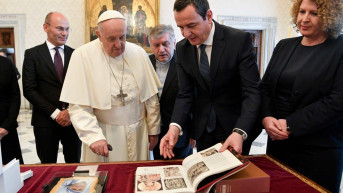
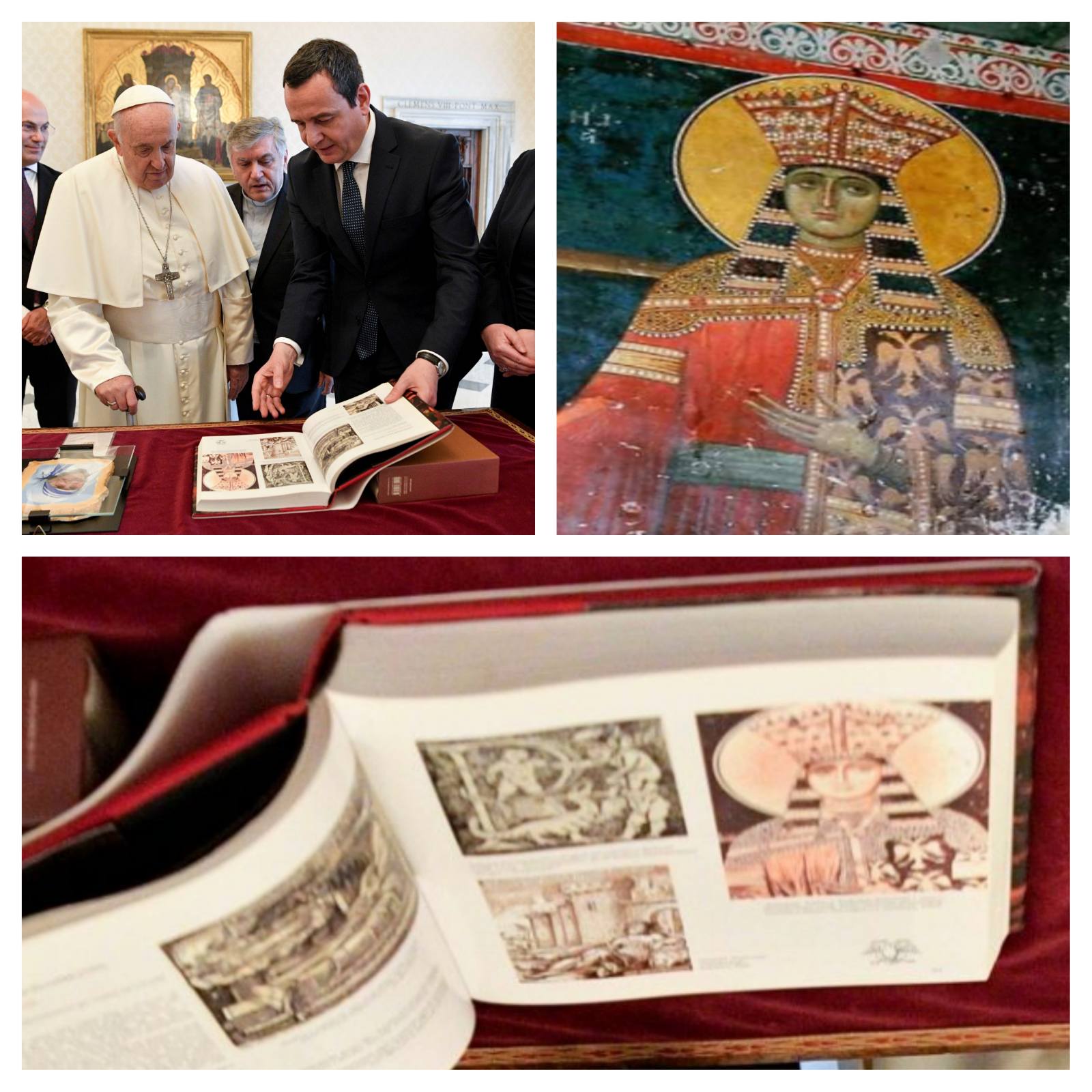
Kosovo Prime Minister Albin Kurti met with Pope Francis in the Vatican last week, and with the announcement of this visit, Kurti published a photo on social networks showing the Pope a reproduction of a fresco in a publication that he supposedly brought to the Pope as a gift.
Art historian Jasmina S. Ciric tells Kosovo Online that it is most likely a publication that was created for that meeting and that it was most likely designed to "promote so-called Kosovo's heritage", but that the fresco depicts the Holy Empress Jelena, the mother of Constantine the Great, and that the fresco is located in the Lesnovo Monastery in North Macedonia, the endowment of a Serbian lord.
Ciric, who is also an assistant professor at the Faculty of Arts and Philology of the University of Kragujevac, recalls that according to the views expressed in recent Albanian historiography, which, as she points out, is often based on unreliable interpretations, Voisava Tribalda Kastrioti, the mother of Gjergj Kastrioti Skanderbeg, is supposedly represented on this fresco, which is why this photo was not chosen by chance because the Albanians use Skanderbeg to build their own identity based on what it is not.
Ciric also points out that the meeting between Kurti and the Pope can only be described as a meeting that, she says, was arranged for all occasions through certain private channels, because the audience was not officially included in the list of papal receptions that day.
"In one photo that appeared on the official Twitter profile of Albin Kurti, as well as in most of the media that reported the news, we see the moment when Kurti shows Pope Francis a book (for now unknown title) in which there is a reproduction of the fresco on the right side. Any connoisseur of the painting of the Serbian rulers in the Middle Ages, and especially the connoisseur of the wall painting program of the Lesnovo Monastery, is clear that this is a fairly unprofessional and unrealistically reproduced fresco depicting the Holy Empress Jelena, the mother of Constantine the Great. The fresco is located on the north side of the western wall of the nave of the church dedicated to St. Archangel Michael and St. Gabriel of Lesnovo in the Lesnovo monastery, between Kratovo and Zletovo in the Republic of North Macedonia," Ciric tells us.
According to her, the church was built in 1341 and is the endowment of a Serbian lord with the titles of the grand duke, sebastrocrator, and then despot Jovan Oliver, who ruled the territory between Ovce Polje and along the left bank of the Vardar.
"Since the fresco on which Saint Empress Jelena is painted, usually, next to the Holy Emperor Constantine, it represents the counterpart of Saint Sava of Serbia and Simeon Nemanja, which underlines the analogy between the first Christian ruler and the first bearers of spiritual and secular authority. A similar counterpart exists, for example, in the Church of St. George in Staro Nagorichane, where Emperor Constantine and Empress Jelena are next to King Milutin and Queen Simonida," Ciric says.
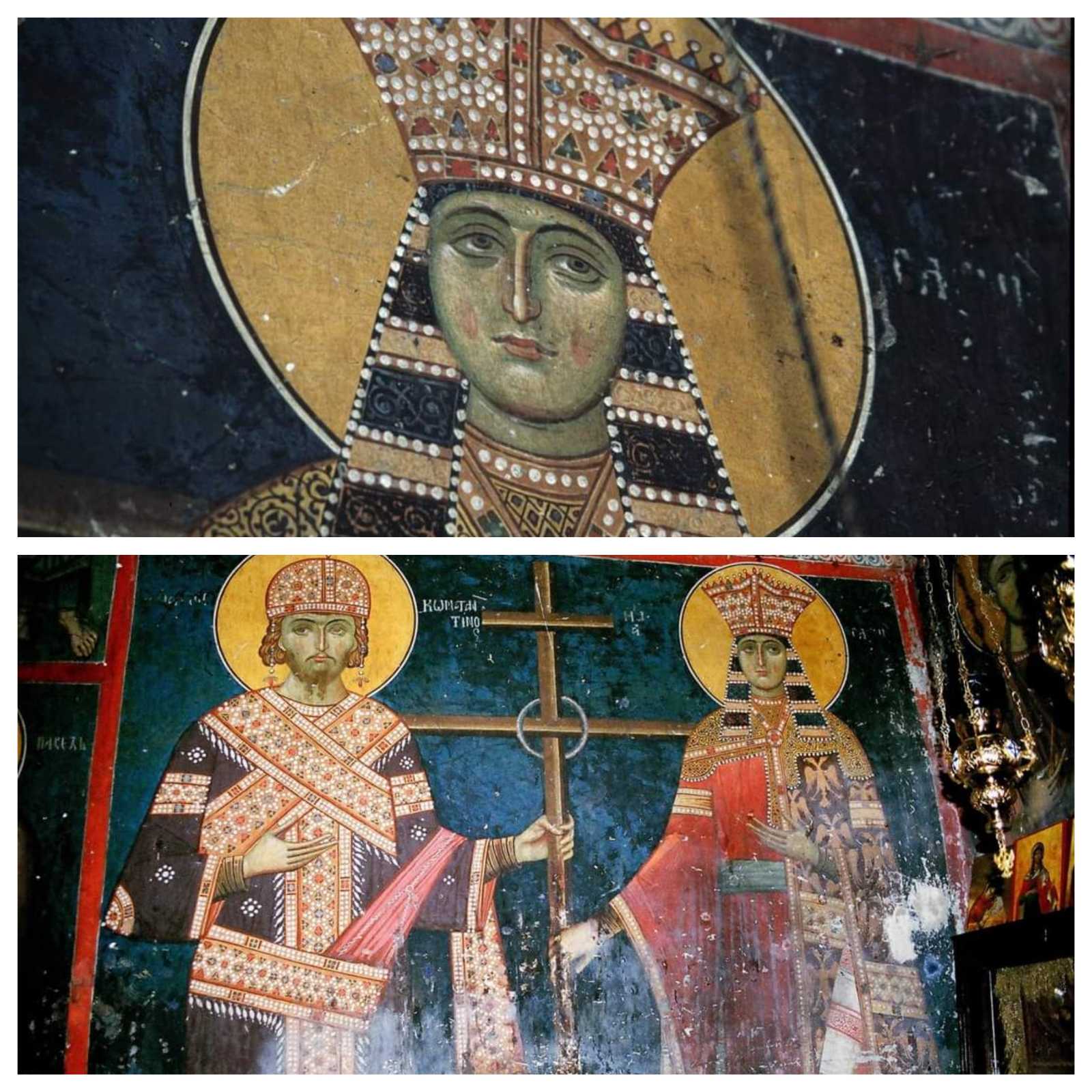
However, she reminds that according to the views expressed in recent Albanian historiography, which, as she points out, is often based on unreliable interpretations, Voisava Tribalda Kastrioti, a native of Polog (in today's North Macedonia), the mother of Gjergj Kastrioti Skanderbeg, is supposedly represented on this fresco.
"It is historically true that Voisava Kastrioti was the mother of Gjergj Kastrioti Skanderbeg. A dual identification of the fresco appears on Albanian websites. From time to time on social networks, we see that on Albanian pages she is completely wrongly identified as the mother of Gjergj Kastrioti Skanderbeg, Voisava Tribalda Kastrioti, and sometimes even as the mother of Djuradj Crnojevic (and there was an exchange of identities of two famous historical figures of Serbian origin). The aforementioned fresco was certainly chosen by the temporary Kosovo authorities, as well as their historiographers because for years the misinterpretation that it is Skanderbeg's mother has been repeated mostly on social networks. The fresco was actually misused by the layman for the purpose of discursively shaping and constructing a new, Kosovar identity and creating the roots of Kurti's 'Kosovo' heritage. This photo was not chosen by chance, since the cult of Skanderbeg is extremely important for the new discourse and identity of the so-called state of Kosovo imposed by Kurti. Kosovar Albanians especially use Skanderbeg in building a collective national identity, and that actually led them to a dead end," Ciric says.
Our interlocutor explains that Kosovo Albanians use Skanderbeg to build their own identity based on what it is not.
"At the time of Skanderbeg, there was no Albanian nation. Gjergj Kastrioti was one of the most magnificent figures of the 15th century in all of Europe. How he called himself in a letter written in Cyrillic in 1450. year, he was born on May 6, 1405, on the family property (most likely in the village of Sine), in the vicinity of the town of Debar in the border area between today's Macedonia and Albania. The first Kastrioti to go down in history was Gjergj's great-grandfather Branilo, the head of the town, and previously a leader in the army of Emperor Stefan Dusan. Through many years of warfare, he earned a fiefdom on the Gardi River with Kastri Castle, an old Byzantine (Roman) fortress after which the Kastrioti family was named. Therefore, it is not an Albanian surname, but a toponym. When it comes to his mother, it is true that there is no preserved fresco, especially not in the Republic of North Macedonia, as Kurti tends to show by using a fresco that cannot be linked to Skanderbeg's origin in any way. Voisava is by no means of Albanian origin, as is often stated in Albanian historiography, as well as on Wikipedia in foreign languages, which does not even have connected historical sources of the first order to which any interested reader could refer. Voisava's father was a landowner. The Romans (Byzantines) sometimes used the word Tribals as a synonym for the Serbs. According to some recent research, it is certain that it belonged to the Brankovic family, since the Brankovic family ruled the area around Polog in today's Republic of North Macedonia. That's why Ivan Jastrebov mentioned Voisava as a noblewoman who was a descendant of Prince Voisava Pologi domini filia of Polog," Ciric explains.

As for the publication itself, which was presented to the Pope, Ciric says that it is not a monograph on the Lesnovo Monastery, as was wrongly stated in some media.
"The act of showing such a publication, as well as the need for 'self-representation', is interesting, especially because from the two pages we see in the photo, it is clearly concluded that it is about constructing historical facts in a way that suits Kurti and his supporters. The displayed pages of the book tend to indicate something that Kurti's supporters recognize as the so-called Kosovo history and art. Thus, there is an open space for misinterpretations, manipulations, and de facto implementation of pressures for the recognition of Kosovo. It goes without saying that this type of public diplomacy is primarily based on the display of soft power, which means through cultural experiences presented by extensive publishing ventures that abound in misinterpreted historical sources. Probably knowing the previously stated position of Pope Francis, "Preserving the memory of our people means preserving the future", Albin Kurti used a kind of manipulation. The way he presented his policy to Pope Francis has elements such as advocacy and manipulation of 'soft power' using cultural artifacts that do not fully correspond to the geographical area, but are suitable for the 'branding' of Kosovo," Ciric says.
Despite the fact that the Pristina institutions, she adds, adjust the data as it suits them, one of the reasons why the Vatican, unlike other Western European countries, does not recognize Kosovo is the issue of conflicts between the Islamic and Christian worlds. The Vatican, she says, has its own priorities in foreign policy and cultural diplomacy, and relations with countries and different regions, especially in the Balkans, can be a part of complex geopolitical, religious, and identity negotiations.
Finally, Ciric points out that the conversation between Pope Francis and Albin Kurti was not an official audience.
"What actually happens if the Pope meets with a representative of a country that the Vatican does not recognize?" The answer is very simple - the meeting is not even mentioned in the list of official meetings. The daily Vatican newspaper "L'osservatore Romano" does not mention this meeting, and at the same time the meeting is not on the official Papal Audience list on the Vatican website for both June 21 and 22, so, in this case, we can only speak about the meeting that was arranged on all occasions through certain private channels and patrons with the catchphrase 'we Christians are called to approach everyone and in all situations'. But there was certainly no audience that was officially included in the list of papal receptions daily," Jasmina S. Ciric concludes.

0 comments