
Conference on the state of the judiciary in Northern Kosovo: Return of judges and prosecutors considered crucial
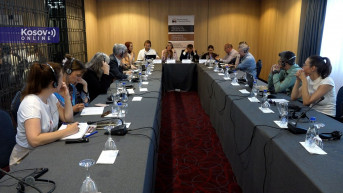
The conference "Judiciary in Northern Kosovo: Challenges, Institutional Representation and Prospects for Return," organized by the non-governmental organization Advocacy Center for Democratic Culture (ACDC) with the support of UNMIK, was held today in Pristina. Participants at the roundtable emphasized that the withdrawal from institutions in 2022 had limited access to justice and that the return of judges, prosecutors, and administrative staff is both highly important and urgent.
The conference brought together representatives of judicial institutions, the Kosovo Judicial Council, the Kosovo Prosecutorial Council, the legal profession, international organizations, and civil society organizations, with the aim of opening an expert dialogue on the functioning of the judiciary in northern Kosovo following the departure of judges, prosecutors, and administrative staff from the Serbian community in 2022.
Andrea Lako, Head of the Justice Division at UNMIK, stressed that integration remains one of UNMIK's key priorities.
"A judiciary that reflects the diversity of Kosovo not only improves access to justice for all communities, but also fosters trust, strengthens interethnic relations, and contributes to long-term stability. I hope today's discussions will have a practical impact on the way forward and reinforce our commitment to an independent and transparent judicial system," he said.
In his opening remarks, ACDC Executive Director Dušan Radaković said that the return of judges and prosecutors from the Serbian community in northern Kosovo to the institutions is of great importance, describing the Brussels Agreement on the Judiciary as one of the best of all the agreements reached.
"It takes at least eight years for any individual, regardless of nationality, to become a judge. If the current judges and prosecutors were dismissed at this point, it would mean that no Serbian judge could be appointed to any court for the next six to eight years. From a legal perspective, it is extremely important for this process to be implemented as soon as possible. I also believe that the return of judges, prosecutors, and administrative staff could encourage a certain number of police officers to return as well. A return through the judiciary could initiate the return of more people and help restore the severely damaged trust that communities in the north have in the institutions," he said.
Radaković added that judicial examinations had been held last weekend and that, for some time now, either only one person from the Serbian community—or none at all—has passed the exam.
He also announced that a debate on the same topic would be organized in North Mitrovica next month.
Deputy Chair of the Kosovo Prosecutorial Council Dardan Vuniqi stated that the departure of judges and prosecutors from the north had restricted access to justice.
"This has also affected citizens' trust in institutions. Nevertheless, the institutions, particularly the Judicial Council and the Prosecutorial Council, have demonstrated institutional resilience despite all the challenges. However, the consequences are reflected in numerous delays, and the Prosecutorial Council has established mechanisms and found ways to continue operating. We deployed additional prosecutors from other prosecution offices to ensure that the Basic Prosecution Office in Mitrovica would not become blocked. At present, we have only five prosecutors who remained. Some have died in the meantime, while others have retired, and this is now affecting the work of the prosecution office," he said.
According to Vuniqi, integrity, impartiality, independence, and meritocracy are the fundamental qualities that distinguish a prosecutor.
He added that the judges' and prosecutors' resignations could affect their integrity should they decide to return to work.
"They resigned for political reasons. Will that affect their return? I would say yes. Nevertheless, we will discuss the issue within the Prosecutorial Council and address it in the best possible manner. We will always respect the Constitution of the Republic of Kosovo. The Basic Prosecution Office in Mitrovica currently has only 13 prosecutors—11 local prosecutors, as envisaged by the agreement, and two transferred from other prosecution offices. Some prosecutors have expressed their willingness to work in North Mitrovica, and I believe we have achieved an outstanding result considering the workload and the number of cases. Today, that prosecution office is in very good condition in terms of caseload, resolved cases, and year-end results," Vuniqi said.
Deputy Chair of the Kosovo Judicial Council Arjeta Sadiku emphasized that the representation of communities within judicial institutions is not a privilege but a constitutional guarantee of a professional and inclusive judicial system.
"At the Supreme Court, 15 percent of the judges come from non-majority communities. More broadly, throughout the judiciary of the Republic of Kosovo, judges and administrative staff from non-majority communities, including the Serbian community, perform their duties at all levels of the judicial system. The current composition of the Kosovo Judicial Council also reflects this constitutional standard. Of the Council's 11 members, three come from non-majority communities—the Serbian, Bosniak, and Turkish communities. These facts demonstrate that the judiciary of the Republic of Kosovo is built on professionalism, expertise, equality, and the inclusion of all communities, in accordance with the Constitution and the law," Sadiku stated.
Attorney Jovana Filipović said that legal practitioners face numerous practical problems related to delays and violations of the right to a trial within a reasonable time.
"Representatives of the Judicial Council and the Prosecutorial Council rely on figures and statistics obtained through mathematical calculations. That does not mean those figures are inaccurate, but the problem is that, in practice and in our daily work, we encounter numerous issues related to delays and the failure to respect the right to a trial within a reasonable time, especially in urgent cases that require expedited proceedings. When the Court of Appeals panel in North Mitrovica was operational, proceedings moved exceptionally quickly. Even civil cases that were not urgent were returned to the Basic Court within six months, which was truly an ideal situation. Then came the COVID-19 pandemic, followed by the accumulation of cases, and afterward the withdrawal from the institutions, which I have maintained from the outset was an entirely wrong way to draw attentionto a problem. We now see that citizens have very little confidence in the legal system," Filipović said.
She added that everyone faces language barriers.
"As for the language barrier, everyone is affected—from us lawyers to citizens who suffer tremendous stress simply trying to obtain an ordinary certificate confirming they have no criminal record. The problem lies in the very approach. There are no signs in Serbian at the service counters. Even when you enter the court, I often encounter situations where they simply refuse to register my appeal or lawsuit," Filipović said, reminding participants that Serbian is also an official language in Kosovo.
Senior Researcher at the Kosovo Law Institute Gzim Shala stressed that the representation of communities in institutions is not merely an institutional formality but a necessity for their proper functioning.
"Unfortunately, because of a single case that was used as a pretext for political interference, we have moved backward in this process. A process that had been built through great effort, compromise, and dedication, and that required years to achieve stability, was suddenly undermined at its foundations. Political interference left the judiciary without judges, prosecutors, and other staff members from the Serbian community. The consequences were not symbolic—they were tangible. The administration of justice, particularly in the north, became much more difficult, court proceedings were delayed, citizens faced major obstacles, and perhaps the most difficult consequence to repair has been the loss of trust, especially among the Serbian community, in the justice system," Shala emphasized.
He noted that the judicial institutions had sought to keep the system functioning in northern Kosovo.
"The courts and prosecution offices have not been closed, but we must ensure that they continue to exist and deliver justice to citizens under all circumstances. However, we must acknowledge that the system is not functioning in the same way. Representation is no longer the same, because the Serbian community no longer sees itself reflected within the judicial system. This affects both efficiency and effectiveness. Somehow we manage the functioning of the prosecution and judicial systems, but how do we manage the trust of Serbian citizens when they see that there are no members of their own community within the judiciary—no judges, prosecutors, or other staff?" he asked.
He praised the approach taken by the Kosovo Judicial Council and the Kosovo Prosecutorial Council for keeping the door open for judges and prosecutors to return whenever they choose.
Following the introductory remarks, a discussion took place among the panelists, who disagreed with Vuniqi's assertion that judges and prosecutors had lost their integrity by resigning from their positions for what he described as political reasons. Following the exchange, Vuniqi left the conference.



0 comments