
“Five minutes of thunderous silence” marks World Press Freedom Day in Gracanica
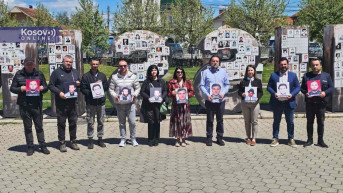
The Journalists’ Association of Serbia and the Journalists’ Association of Kosovo and Metohija marked World Press Freedom Day in Gracanica with an action titled “Five Minutes of Thunderous Silence.” The President of UNS, Živojin Rakocevic, stated that the situation for media in Kosovo is absolutely dramatic.
Rakocevic emphasized that 261 recorded cases of threats to journalists’ work point to one conclusion—that the context can be described as a kind of war zone.
“What has happened? How is it possible that such force is directed against the journalistic profession, against work, freedoms, and the right of people to be informed? It is no longer a question of whether you can go out and report—now the issue is whether you dare to identify yourself as a journalist, whether you can wear a vest with press markings, whether you can go out and describe what the two opposing sides look like,” Rakocevic said.
He stressed that the situation in Kosovo is absolutely dramatic.
“There is the same darkness prevailing as in all these years. There has been no minimal progress in investigating the killings of 17 abducted, missing, and murdered colleagues—seven Serbs, seven Albanians, and three foreigners. This is the only territory in Europe where there is no press and where print media is banned. This is the only territory in Europe, outside of active conflict, where language remains a trigger for problems—for both people and media,” he said.
Rakocevic also raised the question of how to respond.
“Of course—justice, lawyers, freedom, legal processes, pressure, what we are doing. But today we are in a situation where we must expose ourselves to plural propaganda. That is the paradox of our time: either you are a victim of a particular propaganda and live within it, unable to escape, or you consciously expose yourself to a plurality of propagandas in order to gather fragments of truth and assemble them into something resembling a mosaic of professional life, normal personal life, and the assurance that you will not become a victim when moving from one system of propaganda to another,” he said.
The President of DNKiM, Ivana Vanovac, stated that in previous years the dominant issue in Kosovo had been security, while this year financial challenges have come to the forefront.
“On the other hand, we still face a highly pronounced discriminatory attitude by institutions in Kosovo, which do not invite Serbian-language media and editorial offices to events. They do not consider them credible sources of information. Even when they do invite them, they completely disregard the fact that, under the Law on the Equal Use of Languages, we have the right to translation, the right to understand what is being said, and the right to ask questions and receive answers. In general, nothing has changed in that regard. Nor has it changed that journalists whose reporting is not to someone’s liking simply cannot enter the territory of Kosovo,” Vanovac said.
She also recalled that the fate of missing media workers remains unresolved.
“No one even considers reopening that investigation to determine what happened to the people whose photographs we held here as proof that we do not forget and that we are aware that our own fate—and the lack of interest in our potential disappearance—might be the same. Five minutes of thunderous silence is not enough for the world to treat this issue with the seriousness it deserves. Everyone should read our statement individually and understand how serious the problems facing the broader media community are,” Vanovac said.
Secretary of DNKiM, Jelena Markovic, read out the proclamation.
“Threatened security, targeting, police repression, and obstruction of work are the reality of the media community in Kosovo and Metohija. The practice of unjustified bans on journalists entering the territory continues. Serbian media in Kosovo and Metohija are also facing serious financial difficulties, with even the most credible outlets at risk of shutting down. There is an increasingly pronounced discriminatory attitude by institutions toward Serbian editorial offices and the Serbian language, as well as arrogant behavior by public officials toward journalists and media workers,” the statement said, among other points.
World Press Freedom Day is observed on May 3, by decision of the United Nations General Assembly, in order to raise awareness of the importance of media freedom and remind governments of their duty to respect and support the right to freedom of expression guaranteed by Article 19 of the Universal Declaration of Human Rights, as well as to mark the anniversary of the Windhoek Declaration, a statement of principles on a free press adopted by a group of African journalists in 1991.
0 comments